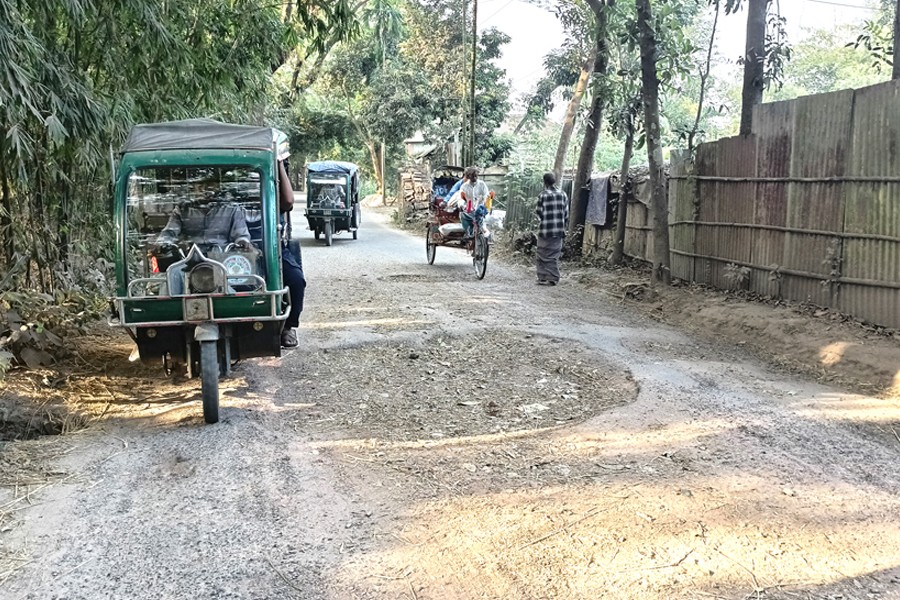
 The photo shows a big pothole on the Mitora-Koitora Bazar Road in Manikganj Sadar upazila- FE Photo
 MANIKGANJ, Dec 06: Rural roads across Manikganj district have fallen into such a state of disrepair that describing them as merely `poor' would be an understatement.
From Ghior to Shibaloy, Saturia, Daulatpur, Singair, Sadar and Harirampur, none of the upazilas presents an encouraging picture. Whether travelling from the district town to the villages or from villages to markets, people face the same hardship everywhere. Farmers, students, patients, office-goers and traders no one is spared from the crisis.
 For people travelling from Singair, Shibaloy, Ghior, Harirampur or Daulatpur to the district headquarters, rural roads are the only lifeline. Yet these roads are so badly broken that daily travel has become a painful struggle. Patients require twice as long to reach hospitals, students must wade through dust and muddy water to attend school, and transportation of goods gets frequently disrupted.
Office-goers and traders often fail to reach their destinations on time, while farmers are the worst affected as perishable crops get spoiled before reaching the market.
During visit to different areas, it was evident that years of neglect have left roads filled with knee-deep potholes and mud. In many places, there are no visible bricks or gravel left. Rainwater accumulates on the damaged roads, creating puddles like small ponds. Such roads are unsafe even for walking, let alone driving. Deep potholes frequently cause accidents involving motorcycles, auto-rickshaws and pickup vans. Locals allege that except for seasonal patchwork repairs, no long-term initiative is taken. As a result, the time required to travel from villages to upazila towns has nearly doubled.
The situation is the same on major routes in Harirampur, including Jhitka-Balla, Lauta-Helachia and Balra-Gopalpur. In Daulatpur, roads like Bachamara-Jionpur and Jionpur-Khalsi remain severely damaged. Saturia's Bhatara Bazar-Chachitara and Delua Bazar-Savar routes are also broken. In Singair, Moslemabad-Sholla, Jamsha-Golaidanga and Baira-Ghonapara roads are in such poor condition that locals jokingly say there is a `silent competition' to determine which one is worse. Even the Mitora-Koitora Bazar road in Sadar upazila adds daily misery for residents.
People from different walks of life say the broken roads are affecting every aspect of their lives.
Khorshed Hossain, a farmer from Daulatpur, said, "The road from Jionpur Bazar to Ghior is completely broken. Except for motorcycles and horse carts, no other vehicle can move smoothly. Auto-rickshaws run only at certain points. Because of the road, taking our produce to market has become very difficult."
Halima Begum of Koitora village in Sadar upazila shared her struggle. "The road from our village to Mitora is full of potholes. Patients suffer the most on this route. We want urgent repair," she said.
Ambulance driver Shohidul Islam, who works on the Jafarganj-Uthli road in Shibaloy, said, "This 10-km road is covered with potholes. During the monsoon, there's knee-deep water at several points. Sometimes the ambulance gets stuck in a ditch, and the patient's condition gets worse. Driving on this road is extremely challenging."
Imran Molla, a businessman from Harirampur's Jhitka area, said, "Transporting goods to Jhitka market has become expensive. Many drivers refuse to come because of the road. If the goods do not reach the market on time, the price drops."
Auto-rickshaw driver Fozlu Miah from Baira-Ghonapara in Singair added, "The vehicle breaks down every time it hits a pothole. Repairing it costs more than what I earn. We need a solution soon."
Despite the severe condition, there is a glimmer of hope. The Ministry of Local Government, Rural Development and Cooperatives has undertaken a major rural infrastructure development project involving Tk4.50 billion (Tk450 crore) for Manikganj. The project includes upgrading 210.34 kilometres of bituminous carpeting roads, constructing 22.66 kilometres of uniblock roads, maintaining 24.87 kilometres of roads and building 757 metres of bridges and culverts. The project is scheduled to run from July 2024 to June 2029.
ABM Khorshed Alam, executive engineer of LGED, Manikganj, acknowledged the situation. He said, "There are about 3,500 kilometres of rural roads in the district, of which 1,700 kilometers are paved. At least 400 kilometres are currently unfit for movement. Repairing these roads requires around Tk 1.20 billion (Tk 120 crore). Heavy rainfall has caused many roads to deteriorate rapidly."
The impact of these broken roads on daily travel, business, farming and healthcare is now clearly visible. Locals hope that once the new project is implemented, normal communication will resume, and their suffering will finally ease.
asadlimon@gmail.com
© 2026 - All Rights with The Financial Express

