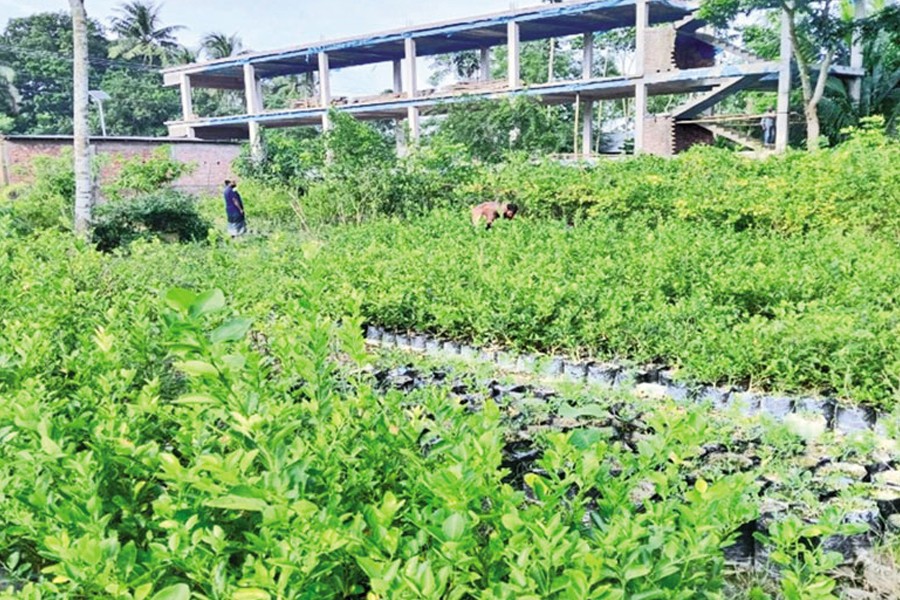
 A panoramic view of 'the nursery village' Basudebpur in Monirampur upazila of Jashore district- FE Photo
 BENAPOLE, June 30: Barely 13 kilometres south of Jashore town lies Basudebpur, a small village in Rohita union of Monirampur upazila, entering where feels like stepping into a vast botanical garden.
Rows of nurseries line both sides of the road, displaying colourful flower, fruit, timber and medicinal plant saplings. From household courtyards to roadside plots, hardly an inch of land remains unused.
As far as the eye can see, the landscape is painted in shades of green. Nearly 80 per cent of the village's residents are directly or indirectly involved in the nursery business.
 More than 500 nurseries, large and small, produce around 1,500 varieties of saplings. Farmers, traders and gardening enthusiasts travel from across the country to purchase saplings from Basudebpur.
The nursery trade has transformed the local economy, making hundreds of families financially self-reliant. Today, the village is widely known as the "Nursery Village."
The arrival of the monsoon marks the busiest season of the year. Workers can be seen clearing weeds, watering young plants with sprinklers, and loading saplings onto vans, three-wheelers, trucks and pickup vehicles bound for destinations across Bangladesh.
Men and women work side by side in almost every nursery. During the rainy season alone, sapling sales reach nearly Tk 15 crore, while annual turnover is significantly higher.
The roots of Basudebpur's nursery business go back nearly five decades. The journey, however, began modestly. Villagers once used locally known bachra-uncultivated fallow land-to grow saplings of native spices and fruit trees. After meeting their own needs, they sold the surplus, earning a small income.
Many landowners allowed villagers to use their land either free of charge or for a nominal rent. At the time, litchi saplings were the most commonly cultivated. Over the years, the business expanded from litchi to a wide range of fruit, timber and ornamental plants, eventually giving rise to the hundreds of nurseries that exist today.
The nursery industry in Basudebpur was pioneered by former union parishad member Mohammad Ali, who established the village's first nursery even before Bangladesh's independence. Today, his sons continue the family legacy. Their establishment, known as Puratan Nursery, spans around 22 bighas of land and houses hundreds of species with more than 100,000 saplings. Mohammad Ali once received a national award as the country's highest producer of plant saplings.
"Our nursery became known as Puratan Nursery because it was the first in the area, and eventually that name became our official identity," said Anwarul Islam, Mohammad Ali's youngest son.
"The nursery is now around 55 years old. We believe it was the first commercial nursery in the Khulna division. At one time, traders from different districts of the division collected saplings from here for resale."
Basudebpur is best known for its litchi saplings, with local growers claiming it to be the country's largest producer.
The saplings are especially popular among farmers in Dinajpur. Every monsoon season, between 40 and 50 truckloads are shipped to Dinajpur and other parts of the country. More than 30,000 to 40,000 litchi saplings are supplied to Dinajpur alone each season, generating Tk 20 to 25 lakh in sales during the rainy months.
At the entrance to Basudebpur Bazar stands the nursery of Enamul Haque, built on nearly an acre of land beside his home.
A graduate in accounting from Rajshahi University, Enamul once held a promising job in Dhaka. During the Covid-19 pandemic, however, he resigned and returned to his village to start a nursery business.
"I produce saplings myself and also source plants from other growers for sale," he said. "The response has been very encouraging, and I've decided not to return to my previous job."
The story of Mosharraf Gazi is equally inspiring. Thirty-seven years ago, he worked as a day labourer on other people's land. Later, he leased just five decimals of land to grow saplings. Encouraged by good profits in the first year, he expanded to one bigha the following season. There was no looking back.
Today, he cultivates saplings on 18 bighas of his own land. The income from his nursery enabled him to build a two-storey mosque and a madrasa at Basudebpur Bazar.
Like Mosharraf Gazi, several other nursery owners in the village have become millionaires through the business. Among them are Ruhul Amin of Bhai Bhai Nursery, Riaz Torofdar of Torofdar Nursery, Swapan Kumar Biswas of Biswas Nursery and Kudrat Ali Gazi of Bismillah Nursery.
Mahabubur Rahman, president of the Basudebpur Nursery Owners' Association, said the village is home to more than 500 nurseries."It is difficult to find a family here that is not involved in sapling production in some way," he said.
benapolejessore@gmail.com
© 2026 - All Rights with The Financial Express

