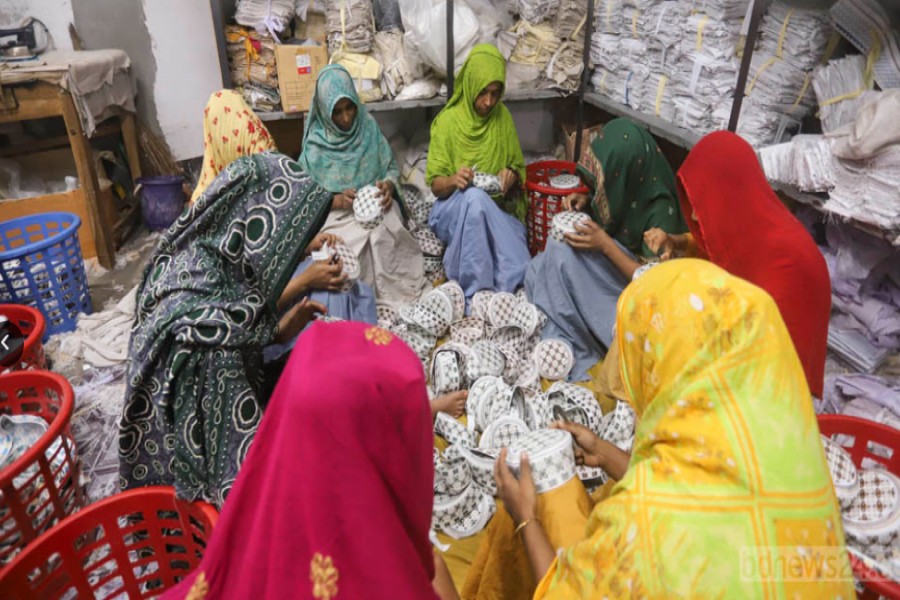
 Women workers busy making cap at Satra village in Sherpur of Bogura district. — FE Photo
 BOGURA, Mar 03: A cottage industry producing traditional skullcaps in northern Bogura developed into a fast-growing export sector, with handmade crochet caps from the country gaining a strong foothold in Middle Eastern markets.
More than 1.2 million handmade mesh caps are exported every month, according to industry estimates.
Shipments surge during the holy month of Ramadan and the Hajj pilgrimage season, when export volumes typically double.
During peak periods, exports are valued between Tk 1.2 billion and Tk1.5 billion, while annual export earnings from the sector range between Tk1.0 billion and Tk1.5 billion.
Although skullcaps are produced in around 15 to 20 districts across Bangladesh, exporters say Bogura's handmade crochet caps dominate markets in Saudi Arabia due to their lower prices and consistent quality along with aesthetic side.
Data from the "Bangladesh Jali Tupi Business Association" show that the average market price of a cap is about Tk 40.
Production averages roughly 150,000 pieces per day, equivalent to Tk6.0 million in daily output and about Tk 2.19 billion annually.
Around one-third of the production is exported by 10 to 12 exporters based in Bogura.
The finished caps are shipped to Saudi Arabia, United Arab Emirates, Qatar, Malaysia, India, Pakistan, Sri Lanka and Nepal.
The industry is largely home-based and labour-intensive.
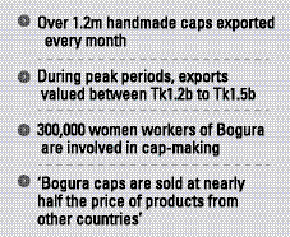
Around 300,000 women workers across approximately 200 villages in 12 upazilas of Bogura are involved in cap-making, according to Jewel Akand, founder president of the association and owner of Jewel Cap Depot.
Sherpur Upazila is the largest production hub, where caps are produced in a wide range of designs including Tahfiz, Makorsa, Biscuit, Kadam Flower, Fishbone, Pineapple and Ten-Flower patterns.
The Tahfiz design is currently the most sought-after.
Exporters receive advance orders from traders at home and abroad and distribute work among rural women artisans. Demand for such caps rises during the month of Ramadan.
The industry has become an important source of income for rural households.
Belal Hossain, owner of Belal Traders said the caps were produced through intricate needlework using thread and crochet hooks.
He warned that prolonged close work often damages the eyesight of women workers and called for government incentives and health support.
Bogura is traditionally an agricultural district, particularly the riverine upazilas of Sherpur and Dhunat, where rice, jute, potatoes and vegetables are widely cultivated.
However, frequent flooding and river erosion have pushed many households to seek alternative livelihoods.
Local residents say the cap-making industry began to expand after the devastating floods of 1988 forced many families in Dhunat to find new sources of income.
The craft later spread to neighbouring areas including Kazipur and Tarash in Sirajganj district.
The industry expanded significantly in the 1990s, while export volumes began rising from 2020.
After a slowdown during the COVID-19 pandemic, exports have been growing again since 2023, said Masud Rana, secretary of the Bogura Chamber of Commerce and Industry, estimating the sector's commercial value at Tk2.0 billion -Tk3.0 billion.
Field visits to Sherpur and Dhunat show that 60 to 70 villages have effectively developed into specialised cap-producing clusters.
Saleha Begum, a 35-year-old worker from Satra village in Sherpur, said she took up cap-making after marriage to support her household.
She now earns more than Tk 5,000 a month, enough to cover her children's education expenses and contribute to family costs. "It is great support for my family," she said.
Another worker, Nazu Begum, 39, said income from cap-making allowed her to buy a small plot of land, build a house and marry off one daughter while supporting the education of two others.
Skilled workers can produce 10 to 12 caps a day, earning Tk300-Tk400 daily on average.
Exporters say Bogura now ships about 18 varieties of caps worth more than Tk1.0 billion annually.
Kamal Pasha, president of the local cap exporters' association said Bogura-made caps dominate markets in Mecca and other Saudi cities.
"Bogura caps are sold at nearly half the price of products from other countries while maintaining good quality," he said. "That is why demand remains strong."
editorsajedur@gmail.com
© 2026 - All Rights with The Financial Express

