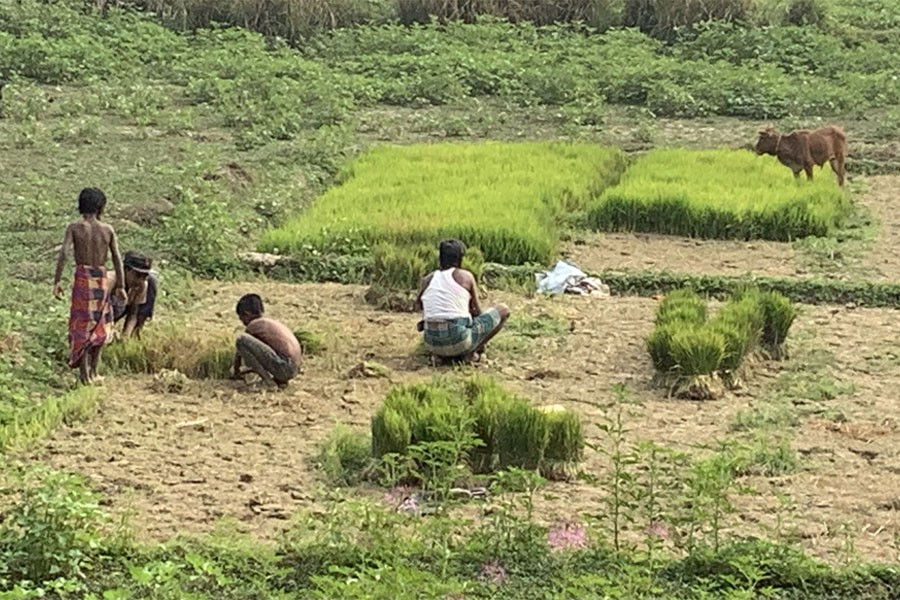
 Farmers engaged in the last-time collection of Boro seedlings for transportation at a village in Golapganj upazila of Sylhet as the season is nearing end- FE Photo
 Transplantation of Boro paddy seedlings is nearing completion in Sylhet region in the current season while farmers in Chandpur district are passing a busy time planting the rice with the hope of a bumper harvest.
Our Sylhet correspondent reports: Peasants in the haor areas of the region have finished transplanting Boro paddy seedlings while it would be completed in the non-haor areas within a week or two, farmers and official sources said.
However, due to inadequacy of irrigation facilities and absence of natural source of water, vast tracts of land will remain fallow in Moulvibazar, Sunamganj and Sylhet districts this time, it is feared. A source at the Sylhet divisional office of the Department of Agricultural Extension (DAE) said 100 per cent Boro paddy transplantation has been completed in the haor areas with a total of 276,310 hectares of land brought under farming.
On the other hand, in the non-haor areas, transplantation has been finished in 83 per cent area of the total targeted 184,000 hectares of land.
It is expected that farmers there could complete transplanting paddy seedlings within a week or two, the source added.
Against the total 496,746 hectares of land to be brought under Boro farming, total production target was set at 20,50,201 tonnes in the entire Sylhet region.
So far 460,310 hectares of land have been cultivated with the paddy in the region.
The district-wise break-up of the paddy cultivation is as follows: 81,514 hectares of land in Sylhet, 47,263 hectares in Moulvibazar, 114,521 hectares in Habiganj and highest 217,007 hectares in Sunamganj.
Farmer Farid Mia of Turukbag village in Golapganj upazila of Sylhet said, "We've completed Bora paddy transplantation last week, but some land in our area still remains uncultivated for the delay in water recession. Same situation prevails in some low lying areas as well."
However, many marginal farmers are in trouble due to rise in labour cost and prices of seed and other inputs, complained some farmers like Abdul Haque of Kandigaon in Sylhet Sadar.
The Boro cultivation cover area includes 275,813 hectares in haor region and 220,933 hectares in non-haor area.
DAE official sources said the farmers, especially those in the haor region, had been requested to cultivate short-duration and early-variety paddy to avert the risk of early rains and other calamities. The varieties include BINA evolved ones and others.
Our correspondent from Chandpur writes: In most places of the district, farmers are awfully busy planting seedlings of Boro paddy even in the marshy fields braving the morning chilly weather.
The growers are hopeful of fulfilling the Boro paddy production target of 2,79,218 tonnes, if there is no natural calamity. As per plan of the Department of Agricultural Extension (DAE), Chandpur, Boro paddy is being cultivated on a total of 63,980 hectares of land in the eight upazilas of the district during this season. A total of 2,42,645 farmers are cultivating Boro paddy across the district this time.
Talking to the FE, Ali Ahmad Bepari (60), an old farmer of Debpur village, Suman Mia of Lodergaon village, Mostafa Kalu of Kumardughi, Nasir Gazi of Mohamaya and Mohammad Ali (40) of Polli Biddut area, all under Chandpur Sadar, and Montu Munshi, Sadek Mia and a few other farmers of Bolakhal and Shomespur areas in Hajiganj upazila said if the weather condition remains favourable till next March and April, they are optimistic of reaping a bumper Boro harvest. According to the DAE in Chandpur Sadar, 5,640 hectares of land are being brought under Boro paddy farming in the upazila and the expected yield is about 24,169 tonnes.
While talking with the FE, DAE official Md Mobarak Hossain expressed optimism saying if the climatic condition remains good and there is no natural calamity, the Boro production target is most likely to be achieved this year. After harvesting paddy in the upcoming May-April, affected farmers would be able to recoup their financial losses caused by the latest flood.
forsylhet@gmail.com
maayerbadhon@gmail.com
© 2026 - All Rights with The Financial Express

