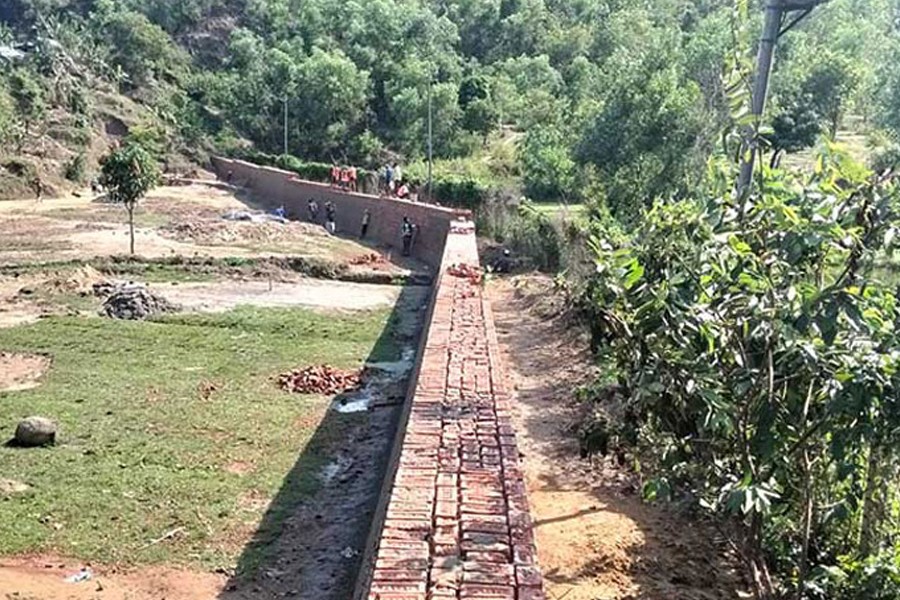
 Photo shows a 137-metre-long brick wall has been erected inside a key elephant corridor in a protected forest area of Teknaf upazila of Cox's Bazar district- FE Photo
 COX'S BAZAR, June 30: The construction of a nearly five-metre-high and 137-metre-long brick boundary wall inside a key elephant corridor in a protected forest area of Teknaf, Cox's Bazar, has sparked growing concerns among environmentalists, forest officials and local residents over its potential impact on wildlife and biodiversity.
According to the Forest Department and local sources, the wall is being built inside the reserved forest behind Rohingya Camp-26 at Shalbagan in Hnila Union. Construction has been ongoing for nearly two months as part of a waste management facility project funded by the United Nations Development Programme (UNDP).
 Local residents alleged that trees and vegetation are being cleared to facilitate the construction of permanent infrastructure within the protected forest, disrupting the natural habitat of wildlife.
They fear the project could adversely affect elephants, monkeys, foxes, jungle cats, reptiles and numerous bird species inhabiting the area.
Experts said the Shalbagan forest is one of the most important wildlife habitats in the Ukhiya-Teknaf landscape and has long been recognised as a major movement route, or elephant corridor, for endangered Asian elephants.
The construction of a high boundary wall within the corridor could obstruct elephant movement and increase the risk of human-elephant conflict, they warned.
HM Faridul Alam Shaheen, joint convener of the Cox's Bazar chapter of environmental organisation Dharitri Rokkhay Amra (DHARA), said the Shalbagan forest is not only an important habitat for elephants but also a critical corridor connecting their traditional migration routes.
"Permanent structures such as boundary walls will hinder the natural movement of wildlife and may have long-term negative consequences for biodiversity and the ecological balance of the forest," he said.
He further warned that if elephants are deprived of their traditional routes, they may seek alternative pathways through nearby settlements, increasing the likelihood of casualties and property damage.
Local resident Mohammad Hasan said the Rohingya influx has already placed enormous pressure on forests, hills and agricultural lands in the area.
Constructing new infrastructure inside protected forests will further aggravate environmental degradation and threaten the region's fragile ecosystem," he added. Environmental groups and local stakeholders argued that a comprehensive Environmental Impact Assessment (EIA) should have been conducted before implementing the project. They called for an immediate suspension of the construction work and a review of the project location.
While acknowledging the importance of proper waste management in Rohingya camps, they stressed that the protection of reserved forests, wildlife habitats and elephant corridors must be given equal priority.
Failure to do so, they warned, could undermine Bangladesh's national and international commitments to environmental conservation and biodiversity protection.
Divisional Forest Officer (DFO) of Cox's Bazar South Forest Division, Abdullah Al Mamun, said no permission had been granted by the Forest Department for the construction of the boundary wall inside the reserved forest.
The project is being implemented by a contractor under UNDP funding, but the Forest Department has not approved any such construction. We have formally raised our objections with the Office of the Refugee Relief and Repatriation Commissioner (RRRC) and requested that the work be halted. However, construction is still continuing," he told reporters.
He added that the area serves as a vital movement route for elephants and other wildlife species.
"The construction of a permanent wall in such a location may severely affect wildlife movement, habitats and the ecological integrity of the forest," he said.
Refugee Relief and Repatriation Commissioner (RRRC) Mohammad Mizanur Rahman said a significant amount of waste is generated daily in the Rohingya camps, and improper disposal could lead to serious environmental pollution.
"The project aims to establish a modern waste management system to address this growing challenge," he said.
However, he acknowledged that constructing permanent infrastructure inside a protected forest area is not an ideal solution, while emphasising that effective waste management remains an urgent necessity.
The development has reignited debate over balancing humanitarian needs with environmental protection in the Rohingya-hosting areas of Cox's Bazar, where forests and wildlife habitats have faced increasing pressure since the influx of forcibly displaced Myanmar nationals.
tahjibulanam18@gmail.com
© 2026 - All Rights with The Financial Express

