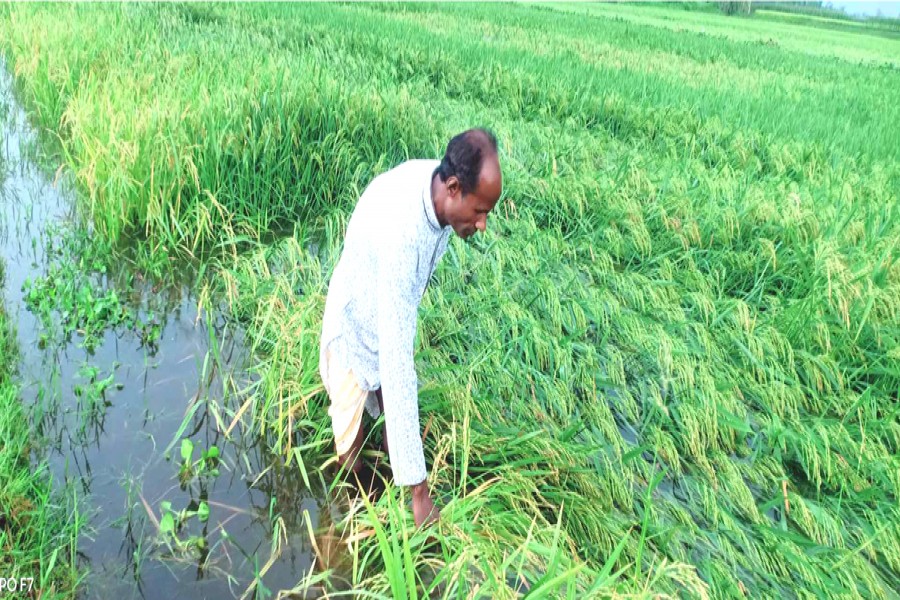
 A farmer is inspecting his affected Boro paddy field which was submerged due to torrential rainfall of the past several days. The photo was taken from Sadya Pushkorni area in Rangpur Sadar upazila- FE Photo
 Water falling in a rapid stream for the torrential downpour continuing for the past several days
has submerged vast tracts of Boro paddy fields in low-lying areas across five districts of the Rangpur agriculture region and Gaibandha district, sparking off fear of a considerably big
crop failure.
Our correspondent from Rangpur says: A good number of farmers told The Financial Express that their standing semi-ripe, ripe and unripe Boro crops have been spoiled by stagnant water owing to five to six days of heavy downpour, triggering concern of crop damage, as prolonged inundation may severely affect grain quality.
Cultivators assumed that they might get 3 to 4 maunds less paddy per bigha than expected due to the prolonged inundation of standing Boro plants.
Due to submersion of Boro fields in low-lying areas across the region, harvesting of the mature crops is severely being hindered, growers said.
According to the Department of Agricultural Extension (DAE), Rangpur, Boro paddy was cultivated on 509,095 hectares of land in five districts under Rangpur agriculture region.
The districts belonging to the region are Rangpur, Kurigram, Nilphamari, Gaibandha and Lalmonirhat.
Visiting different areas of the region, the FE correspondent found many Boro paddy fields in low-lying areas have already gone under water due to continuous heavy downpour.
Rahidul Mia, a farmer of Sadyapushkorni area in Rangpur Sadar upazila, said, "This year I cultivated Boro on three bighas of land with the hope of a good harvest. But my optimism was shattered by torrential rainfall that wreaked havoc on my standing half-ripened and ripened paddy. Half of my paddy is inundated in the field, and the crop I could harvest is getting damaged at home owing to a lack of sunlight."
He said that many growers like him are in a dilemma about whether to reap their mature crops or delay the harvest. He added that both options are similarly upsetting.
He said that he had to spend additional money for hiring labourers to harvest his crops, as their demands were much higher than the usual costs. If he delayed, the crop might perish in the field, he further said.
Faridul, a peasant of Balua area in Mithapukur upazila of Rangpur told FE, he cultivated Boro on two bighas of land. But his entire mature crop field is now under water. If the situation lasts too long, he may not be able to save most of his crops, he feared.
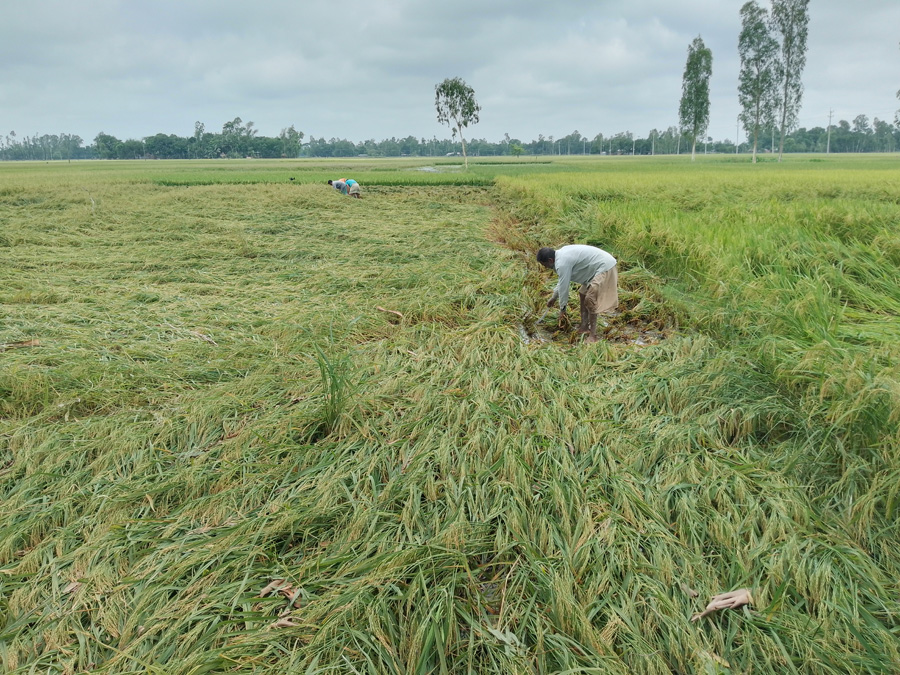
The photo shows a farmer busy harvesting Boro paddy in a low-lying area of Gaibandha Sadar upazila
- FE Photo
Furthermore, lightning strikes during thunderstorms made farm labourers reluctant to work. Although some labourers showed interest in harvesting, they demand exorbitant wages, placing a huge burden on cultivators.
Meanwhile, many farmers said that due to incessant rainfall, they are not able to use pesticides in their late cultivated Boro fields, which has made their crop fields vulnerable to massive pest attack, resulting in significant crop losses.
When contacted, Md. Sirajul Islam, DAE additional director in Rangpur region, told The Financial Express that Boro paddy fields in low-lying areas of the region have been inundated. The situation is still not so alarming. If the sheaves of paddy remain above water, they can be saved. The situation is expected to be normal soon, he also said.
Our correspondent from Gaibandha reports: In Gaibandha district, water has largely accumulated in the fields of Iri-Boro paddy due to continuous rainfall. Rainwater has caused submersion especially in some low-lying areas.
Due to water accumulation in the fields, semi-ripe paddy is about to be destroyed. Farmers are not able to harvest their crop due to labour shortage. Before the harvesting season starts, wages of workers spike to as much as Tk700-800 per person, putting farmers in trouble.
Meanwhile, moderate to heavy rainfall has occurred in isolated areas in various upazilas of the district, which has brought relief in some areas but has caused waterlogging and suffering in others.
A field visit on Thursday (April 30) showed the picture of the paddy fields. Semi-ripe paddy on hundreds of hectares in low-lying areas of Badiakhali union, Goyailbari, Chakbarul and Rifaitpur under Palashbari upazila is submerged under rainwater.
Many farmers have started harvesting semi-ripe paddy without any other option.
Farmers said that due to waterlogging, they are having to pay wages of Tk 7,000 to 8,000 per bigha to harvest their paddy. Still workers are not available.
Farmer Belal Hossain of Chakbarul village in Badiakhali union said despite the adverse weather, the paddy yield has been quite good this time.
However, due to waterlogging caused by several days' continuous rainfall, paddy is submerged under water.
Earlier, it cost Tk3,000 to 3,500 to harvest one bigha of paddy, but now it costs Tk6,000 to 7,000 or more.
Even with money, workers are not available.
Atiqul Islam, deputy director of the DAE, Gaibandha, said this year 129,020 hectares of land in the district have been cultivated with Iri-Boro paddy. So far paddy on 212 hectares of land have been affected by rain of the past few days. If there is no new rain, paddy in the affected land will not be damaged.
sayedmofidulbabu@gmail.com
atik.mms2014@gmail.com
© 2026 - All Rights with The Financial Express

