MANIKGANJ, Apr 18: Despite severe erosion onslaughts during last monsoon,
no permanent solution has been taken yet keeping Paturia ferry terminal and surrounding areas at risks once again with the next rainy season upcoming.
The Paturia-Daulatdia river route remains a vital transport link for people and goods traveling between the capital and 21 southwestern districts of the country.
Since the ferry terminal was shifted from Aricha to Paturia in 2002, its importance has steadily increased. Every day, some 1,500 and 2,000 vehicles and several thousand passengers use this route. Although pressure has eased after the opening of the Padma Bridge, the route remains essential.
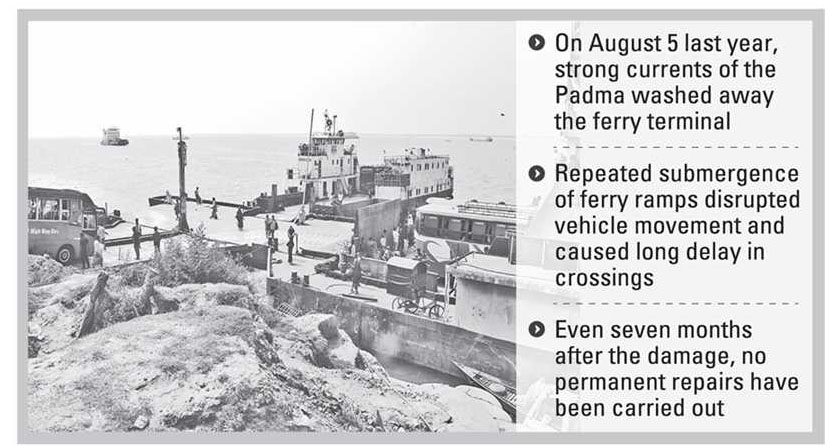
On August 5 last year, strong currents of the Padma River completely washed away the Paturia ferry terminal. At the same time, five houses and a poultry farm near the ferry terminal area were also swallowed by the river.
Ferry terminals numbered 3, 4, and 5 were the worst affected. During that period, repeated submergence of ferry ramps disrupted vehicle movement and caused long delays in crossings.
Even nearly seven months after the damage, no permanent repairs have been carried out. Instead, the terminals are being kept operational through temporary fixes, leading to daily disruptions. Vehicles often get stuck while boarding or disembarking from ferries and, in some cases, break down midway. This has increased crossing times and created long traffic congestion in the terminal area. A recent visit to the site shows that with the river water receding, pontoons have been lowered, making the connecting approach roads unusually steep.
Heavy vehicles frequently struggle to climb up after disembarking from ferries, often halting midway. In many cases, wreckers are needed to pull them up, posing constant risks to drivers and passengers.
Danger became evident on the night of March 11, when an oil tanker lost control while getting off a ferry at terminal number 5 and fell into the river. A rescue vessel named Hamza managed to recover it after nearly 16 hours. Officials say the steep approach road was a major contributing factor behind the accident.
Drivers and local residents allege that erosion recurs every year during the monsoon, damaging the terminals. However, no durable embankment or long-term infrastructure has been developed. Instead, authorities continue to rely on temporary repairs to keep this crucial route running.
With the monsoon season approaching again, there are still no visible signs of effective preventive measures. Concern is growing that if erosion intensifies like last year, the entire ferry operation could face serious disruption.
Local resident Rafiqul Islam said, "Within just three weeks of erosion last year, the launch terminal, five houses, and a poultry farm were washed away. Yet no preventive measures have been taken this year. If erosion starts again, the entire ferry terminal could collapse, putting nearby areas at risk."
Truck driver Sentu Mia, who regularly transports goods to Kushtia, said the route saves both time and cost. "Before the Padma Bridge, we had to wait for hours at the terminal. Now the pressure is less, but the current condition of the terminal makes us anxious. We fear a repeat of last year's situation," he said.
Abdus Salam, deputy general manager of the Aricha office of the Bangladesh Inland Water Transport Corporation (BIWTC), said all ferry terminals suffered some level of erosion last year and were later repaired by the Bangladesh Inland Water Transport Authority (BIWTA). However, he warned that if erosion occurs again this year, the damage could be more severe. "Without permanent river training and proper terminal reconstruction, it will be difficult to sustain this important route," he added.
Meanwhile, BIWTA Executive Engineer at Aricha River Port, Robiul Alam, said the current risks have been formally communicated to the relevant ministries.
asadlimon@gmail.com
© 2026 - All Rights with The Financial Express

