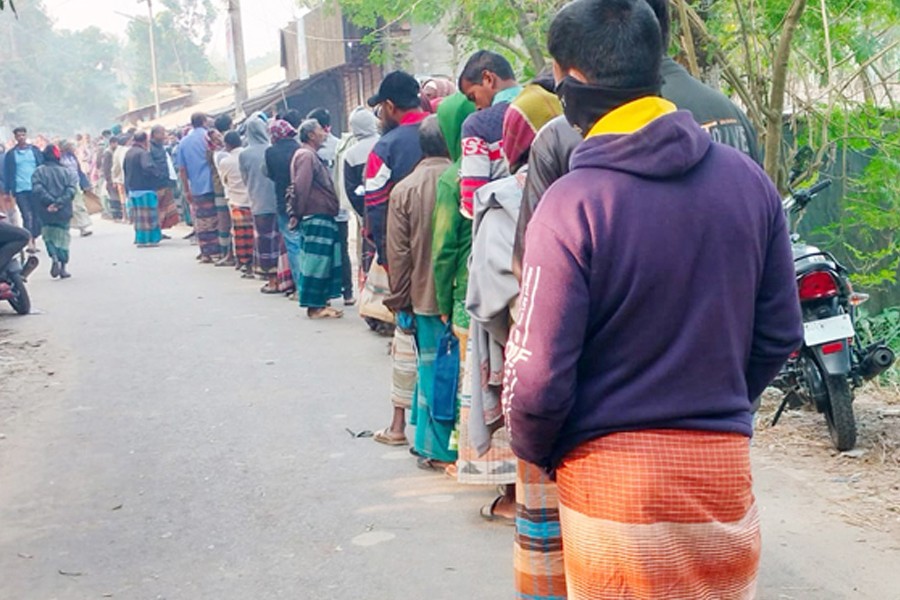
 Farmers queue up for fertiliser at a Bangladesh Agricultural Development Corporation dealer point at Deulia village in Bagmara upazila of Rajshahi district — FE Photo
 RAJSHAHI, Dec 22: At the very outset of the potato farming season, farmers in the sixteen districts under Rajshahi and Rangpur divisions have become increasingly worried as they are not getting fertilisers as per their needs, causing disruptions in field preparation and early planting.
They alleged that dealers were selling fertilisers in limited quantities, forcing many growers waiting in queues for hours.
In some areas, dealers were rationing fertilisers to one or two bags per farmer, far below what is required for potato and winter vegetable cultivation.
According to the Department of Agriculture Extension data, a total of 11.5million (115 lakh) tonnes of potatoes were produced in Bangladesh in the past 2024-25 fiscal year, of which 8.7million (87 lakh) tonnes was produced in Rajshahi and Rangpur divisions alone.
 In the 2024-25 season, the agricultural officials have set a target to produce about 8.4 million (84 lakh( tonnes of potatoes from 0.343 million (3.43 lakh) hectares of land in Rajshahi and Rangpur divisions alone.
Farmers said that about two sacks of (100 kilograms) muriate of potash, also known as MOP, one sack (50 kilogrammes) of diammonium phosphate, also known as DAP, and one sack of triple superphosphate, also known as TSP, are required per bigha of land at the beginning of potato cultivation.
However, the DAE allocated about 23.15 kg MOP, 36 kg DAP, and 1.3 kg of TSP per bigha, which the growers said was inadequate.
According to the DAE Rajshahi divisional office, 14,551 tonnes of MOP, 25,281 tonnes of DAP, and 9570 tonnes of TSP have been allocated in the Rajshahi agriculture region, comprising Chapainawabganj, Naogaon, Natore and Rajshahi districts, in the past one month while about 15,380 tonnes of MOP, 29,450 tonnes of DAP, and 9,466 tonnes of TSP are to be allocated in December.
Visiting several upazilas of Rajshahi on Sunday, long queues of farmers were seen in front of almost all Bangladesh Agricultural Development Corporation and Bangladesh Chemical Industries Corporation dealer points since the morning.
Habibur Rahman, a villager from Deulia village under Bagmara upazila, told that he stood in the line as he needed at least 18 sacks of fertiliser but he could not manage a single one.
"I have stood in the queue since morning. Yet, I am not sure whether I will get any sack of fertiliser since there are several hundred people in front of me," he said.
Naim Islam in Kalai upazila of Joypurhat said that they were getting one or two sacks of fertilisers from the authorised dealers against a demand of fifty sacks.
Hafizur Rahman, a BADC dealer at Bagmara upazila, told that the crisis was mainly caused by reduced supply.
'If my allocation is supposed to be three truckloads, I am receiving only one at the initial stage,' he said, adding that if farmers needed five sacks each, he could give only one.
'The next day the farmers come again and the same long line forms. We are giving farmers whatever we get. But when everyone returns the next day for the remaining amount, the pressure increases again,' he said.
Meanwhile, farmers alleged that they were forced to buy fertilisers from alternative sources at exorbitant prices, which would increase their production costs sharply.
Lutfar Rahman, a farmer from Tanoreupazila in Rajshahi, told that he had to buy a sack of TSP and DAP each at Tk 1700, and MOP at Tk 1350, although the government-set prices of MOP, DAP, and TSP fertilisers at the farmer level were Tk 1000, 1050, and 1350 respectively.
He said that after failing to secure required fertilisers, he had implanted seeds with less fertliser he generally used. "There will surely be less production this year," he added.
Sakiul Islam, a farmer of Rajahar village under Gobindaganj upazila in Gaibandha, said he had to buy a sack of TSP at Tk 1970, DAP at Tk 1470, and MOP at Tk 1140, as there had been severe crisis of fertiliser in their area.
He alleged that the sellers were also not providing them any vouchers.
Farmers also alleged that the ongoing crisis was deepening as fish farmers were using urea fertilisers in their ponds.
Meanwhile, amid the crisis, a group of dishonest traders were also stockpiling fertiliser at their houses and other places instead of authorised shops and warehouses.
Recently, a team of Bagmara upazila agriculture office and Bagmara police in Rajshahi seized 444 sacks of illegally stored fertiliser from the home of a Swechchhasebak League leader at Dhangachhi village.
Later, the fertiliser was sold among the farmers at the government-set prices.
However, Sabina Begum, deputy director of the DAE Rajshahi divisional office, said that there was no fertiliser shortage, adding that the crisis was being created largely due to farmers' overuse of fertilisers during potato cultivation.
"Potato growers are being overly enthusiastic. They are applying three to four times more fertiliser than required. Where the recommendation is 30-35 kg, many are applying up to 100 kg,' she said.
She also said that they had been telling farmers repeatedly that DAP already covers the phosphate component; applying DAP and MOP together is unnecessary.
"Still the growers are using both DAP and MOP," she said, adding that agricultural extension workers were conducting field visits, demonstrations and distributing leaflets to educate farmers on correct fertiliser use, including balanced application of DAP, TSP, MOP, and urea, noting that excessive application of one type can affect yields and costs.
The officer added that many farmers in Bogura, Joypurhat and parts of Rajshahi complained that they were buying TSP at Tk 1,700 to Tk 1,900 per sack - much higher than the official rate.
"Farmers must insist on cash memos for their purchases. This ensures that dealers cannot overcharge," she said, urging both authorities and farmers to work together to use supplies efficiently while avoiding misuse.
She also urged media outlets to avoid amplifying 'unverified claims' of scarcity. "Farmers must learn to use what is available and increase the use of organic fertiliser," she added.
anaetru@gmail.com
© 2026 - All Rights with The Financial Express

