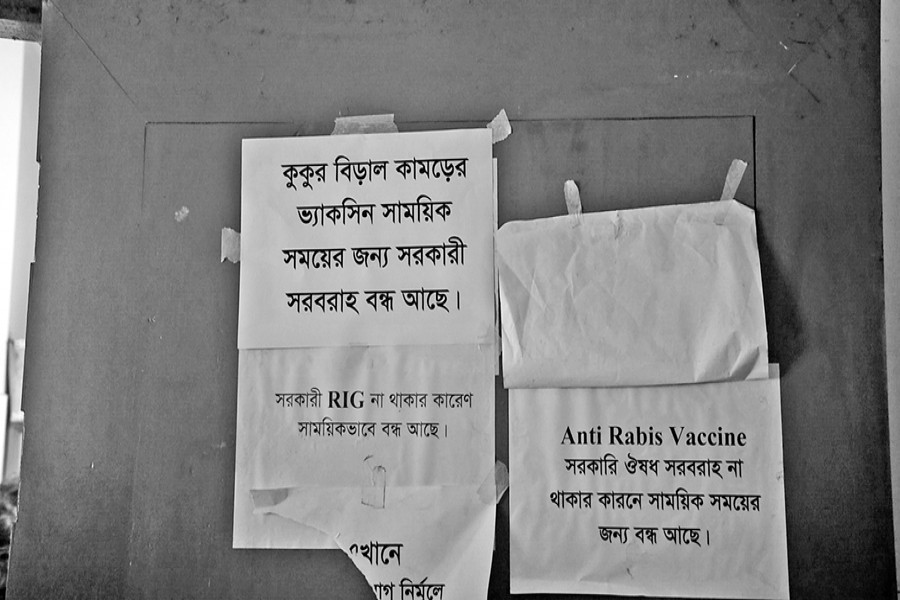
 The photo shows notices on rabies vaccines shortage on a wall at Manikganj Sadar Hospital in Manikganj district.-FE Photo
 Despite repeated requests to authorities, rabies vaccines have not been delivered at government hospitals, leaving low-income people deprived of the life saving vaccine.
Our correspondent from Rajshahi reports, a prolonged shortage of rabies vaccines at Rajshahi Medical College Hospital (RMCH) has severely disrupted post-exposure treatment services, rising out-of-pocket costs and leaving patients visiting the hospital from different parts of the country facing uncertainty.
The crisis, which has persisted for nearly 18 months, has effectively halted the hospital's free vaccination programme. Patients bitten or scratched by animals are now being forced to purchase vaccines from private pharmacies, often at prices beyond their financial capacity.
A recent visit to the hospital found patients arriving from Rajshahi, Rangpur and Khulna divisions in large numbers, only to find no vaccines available at the facility. Hospital officials said the supply of rabies vaccines from the DGHS became irregular in early 2025 and has remained completely suspended for the past six months. In an attempt to manage the situation, the hospital authorities procured around 2,000 doses independently at a cost of approximately Tk 1.1 million. However, the stock was exhausted three weeks ago.
On average, 280 to 300 patients seek rabies vaccination at RMCH daily, indicating a monthly requirement of around 8,000 to 9,000 doses. Without government supply, the hospital has been unable to meet this demand.
The shortage has placed a disproportionate burden on low- and middle-income families. Shahabur Ali, a resident of Rajshahi city, said he had to purchase additional doses for his daughter after receiving the initial ones free of cost. "I am worried about managing the remaining doses," he said.
Another patient, Ali Hossain, said he failed to find the vaccine despite arranging money and visiting multiple pharmacies. "Even after managing funds, I could not get the vaccine. I don't know what to do now," he said.
Jewel Rana, a van driver from Puthia, is struggling to continue treatment for his three-year-old child, as each dose now requires out-of-pocket expenditure alongside travel costs.
Medical experts warn that rabies is almost 100 per cent fatal once symptoms appear, making timely vaccination essential after any animal bite or scratch. The treatment protocol requires doses on days 0, 3, 7 and 14, with some cases requiring up to six doses over 90 days. Disruptions in this schedule significantly increase the risk of death. Sources say the shortage is not linked to domestic production. Leading pharmaceutical firms, including Popular Pharmaceuticals and Incepta Pharmaceuticals, continue to produce rabies vaccines and maintain supply in the private market. This suggests that gaps in public procurement and distribution are driving the crisis.
Dr Shankar K Biswas, spokesperson for RMCH, said multiple requests have been sent to the DGHS seeking urgent allocation. "We procured vaccines on our own, but those stocks have already run out. We hope supply will resume soon," he also said.
Our correspondent from Manikganj adds, the government supply of rabies vaccines at Manikganj Sadar Hospital remains suspended, forcing more than a hundred patients each day to purchase the life-saving shots from private pharmacies. The situation has put significant financial pressure on low-income families. At the 250-bed Manikganj General Hospital, an average of 120 to 130 patients seek treatment daily after being bitten or scratched by animals. However, due to the ongoing shortage, the hospital is unable to provide vaccines free of cost as it previously did. Patients who fail to get the vaccine at the hospital are turning to local pharmacies. Although some supply is now available in the market, the cost has become a burden for many.
Benjir Ahmed, who brought his daughter from Delua in Saturia Upazila, said, "My daughter was scratched by a cat yesterday. The doctor advised immediate vaccination, but the hospital had none. I had to buy it from outside for Tk 500, plus Tk 10 for a syringe. It used to be free at the hospital."
Mohammad Salam, a day labourer from Sadar Upazila, shared similar concerns. "I came to the hospital right after being bitten by a dog. Since it wasn't available here, I had to buy it from a pharmacy. I struggle to earn daily wages, and buying such an expensive vaccine is very difficult. But I had no choice, as rabies can be fatal. Four of us had to share the cost."
Pharmacy owners say that while the supply has slightly improved compared to a month and a half ago when only one or two doses were available against orders of ten, It is still not fully stable.
Senior Staff Nurse and Vaccine In-Charge Sabuj Mia said, "The government supply has been suspended since December 16 last year.
anaetru@gmail.com
asadlimon@gmail.com
© 2026 - All Rights with The Financial Express

