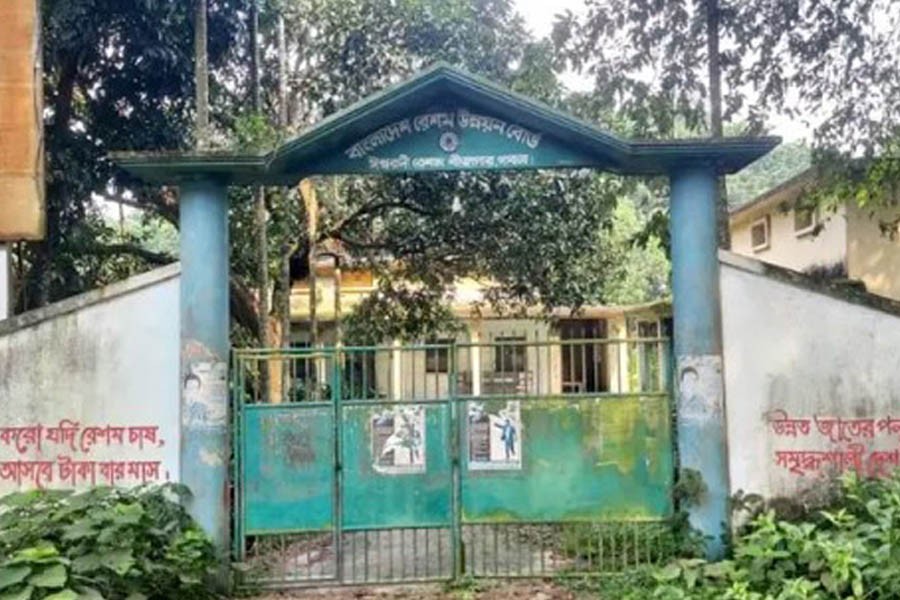
 Photo shows the dilapidated frontal view of Bangladesh Sericulture Development Board on the Pabna-Ishwardi highway in Ishwardi upazila of Pabna district — FE Photo
 PABNA, Oct 24: Where earlier there used to be a hustle and bustle of cutting mulberry leaves, rearing silkworms, making cocoons and making silk thread from them throughout the year.
However, the evolution of time has created a spooky atmosphere in that seedbed today. Due to the closure of activities for a long time, the vast area of the seedbed is now covered in dense jungle and abandoned buildings and infested with snakes and insects.
 It is learnt that out of 17 sanctioned posts of staffers in the Ishwardi Silk Seedbed, only one manager is serving, while rest of the posts are lying vacant.
In addition, although there are opportunities for employment for more than a hundred workers, 22 workers on daily attendance, two night watchmen and a computer operator on monthly contract are working here.
These daily attendance workers work for 10 to 12 days a month. The rest of the days they have to remain unemployed. As a result, the workers here have to live on a living wage.
Information research reveals that a silk nursery was established in 1962 on 107 bighas and 12 kathas of land in Arankola Mouza on the Pabna-Ishwardi highway under Ishwardi upazila in Pabna. At one time, silkworms were reared and silk eggs, and silk cocoons produced in the Ishwardi silk nursery. Yarn was made from the cocoons. Mulberry tree cultivation activities were also carried out throughout the year. Currently, only mulberry tree seedlings are being produced here on a small scale. Apart from that, all other activities have been closed. As a result, the once bustling silk nursery is now silent and silent.
According to the silk nursery office sources, 59 bighas of the 107 bighas and 12 kathas of land of the silk nursery are under mulberry cultivation. The remaining 38 bighas of land include offices, residential buildings, silk breeding houses, weaving houses, 19 buildings, and four ponds.
It can be seen on the ground that mulberry farming, silkworm rearing and silk egg production have stopped. Although there are mulberry trees, there is no manpower to take care of them. As a result, the land of mulberry trees has turned into a forest.
There are four one-story and two two-story huge buildings used for mulberry farming and silkworm production.
Of these, four one-story buildings are abandoned. The plaster on the roof of the building has fallen apart and the windows and doors have started to crack, and creepers have grown there and formed bushes. As a result, a spooky atmosphere prevails. Workers of the silk nursery said that it had a golden past.
In addition to mulberry seedling production, mulberry insect farming, silk egg and cocoon production, yarn was once made from silk cocoons here.
That yarn was sent to the Rajshahi Silk Factory. Various clothes including world-famous silk sarees were made. Now, mulberry seedling production activities are ongoing on only 29 bighas of land. All other activities have been stopped.
The workers said that on June 27, 2019, they staged a protest against the Silk Board authorities because of the retirement of five workers of the nursery.
As a result of the long protest, the authorities announced closure of all activities of the nursery. After about two and a half years, on October 18, 2021, permission was given to produce mulberry seedlings under a project of the Silk Development Project. Since then, it has been going on in some way.
The then senior officials, citing unfounded reasons, have stopped production of silkworms, silk eggs, and silk cocoons here.
They strongly demand from the current senior officials of the Silk Development Board that the production of silkworms, eggs, and silk cocoons should be resumed in the nursery. Then, month-long employment opportunities will be created for the workers.
Workers complained that after working in this nursery for 30 years, the authorities send the workers away empty-handed when they retire.
Acting Farm Manager of Ishwardi Silk Nursery Md. Khokon Ali told The Financial Express, "Out of 17 posts in the Ishwardi Silk Seedbed, I am the only one who is working in one post.
There is no person in any other post."
He further said that the entire institution has become a jungle. It is impossible to move inside the institution due to the jungle. Snakes and insects have built nests on the internal roads as the jungle is filled. The jungle cannot be cleared due to lack of money.
For six years, silkworm rearing, silk egg and silk cocoon production activities have remained stopped.
motiarfe@gmail.com
© 2026 - All Rights with The Financial Express

