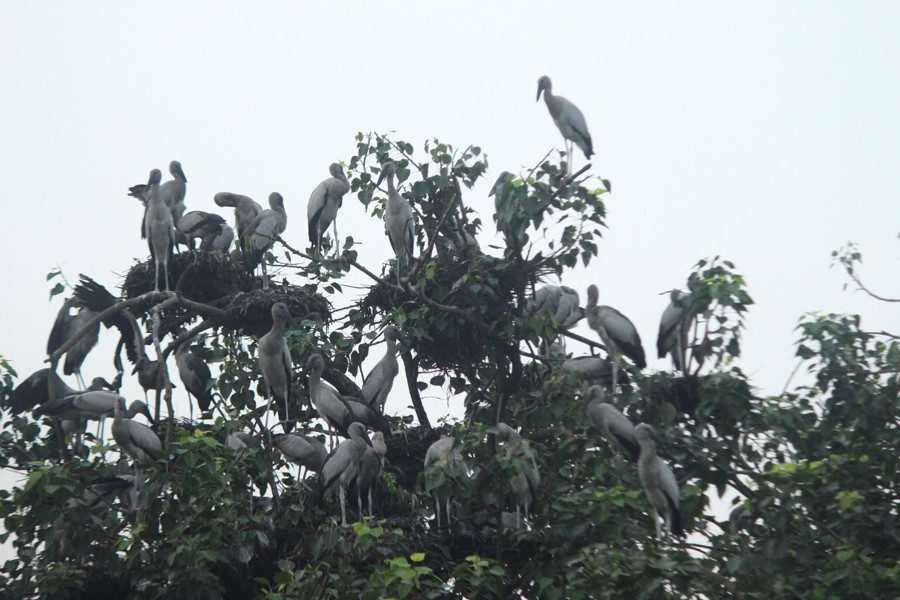
 Photo shows storks sitting on a banyan tree in Shibganj upazila of Bogura district- FE Photo
 A CORRESPONDENT
BOGURA, Oct 11: Five of Bogura's 11 upazilas have now become seasonal homes to thousands of migratory Asian openbill storks (locally known as Shamukhol), transforming the northern gateway district into a new attraction for tourists.
The birds build nests in trees and marshes in Shibganj, Sherpur, Kahaloo, Dhunat and Sariakandi upazilas of the district.
Local bird enthusiasts estimate their number at around 20,000 - nearly double that of last year. Believed to migrate from the Himalayan region, these storks perch on trees near wetlands and feed mainly on small fish and snails. They migrate to this country mainly facing a food crisis.
Members of Team for Energy and Environmental Research (TEER), a campus-based organisation at Bogura Government Azizul Haque College, said the majority of the birds have congregated in Bihar Hat of Shibganj upazila and in Ramnagar village of Sherpur's Garidah union.
The Forest Department confirmed that the rise in the birds' number was due to abundant food, safe habitats and favourable weather conditions. In some areas, the birds are even beginning to establish permanent colonies.
According to locals, the storks typically arrive during the Bengali months of Chaitra and Baishakh (March-May), nesting in banyan trees, laying eggs, hatching chicks and teaching the fledglings to fly. They depart by late Kartik (October-November), ahead of winter.
Amateur photographer Mr. Adil Khan recalled that, in the past, influential locals cut down banyan trees and deprived the birds of shelter. "Now things have changed," he said.
"If anyone tries to hunt the birds, volunteers and locals protest, and the administration remains alert. There have even been cases of fines and imprisonment," he added.
The president of TEER - which won a national award in 2021 for its work in protecting wildlife and the environment - said the first flock nested in Bihar village in 2011.
"Back then, people caught and ate them, and outsiders trapped them," he said.
"Later, local students and our group launched a united initiative. A decade ago, we declared Bihar village a 'safe haven for birds'. Since then, awareness has grown, and villagers now treat birds and animals with affection. We have also managed to raise awareness in Sherpur," he added. Ramnagar, located on the banks of the Karatoa River near the Bogura-Dhaka highway, is another hotspot.
Villagers describe the storks as grey birds with long wings and slightly gapped beaks, often seen resting motionless on treetops.
The openbill resembles a heron and is nicknamed Shamukhol - or "snail-eater" - for its habit of cracking open snail shells with its beak before swallowing.
They also feed on fish, crabs, frogs and small aquatic creatures. A single tree can host 25-30 nests, built jointly by males and females from twigs, sticks and vines in about 10-12 days. Some nests measure up to five feet across.
Divisional Forest Officer Md Motlubur Rahman explained: "The area has a plenty of wetlands and safe habitats. For example, Ramnagar village has the largest concentration of storks because it is surrounded by bamboo groves, the Karatoa River, large ponds, cultivated fields and trees with sturdy branches."
Ms. Tahmina Akhter, upazila nirbahi officer, said the administration is working to protect the birds' colonies.
"We monitor the sites regularly. Locals are urged to remain vigilant. Any attempt at hunting or harming birds must be reported immediately to the administration and police," she added.
sajedurrahmanvp@gmail.com
© 2026 - All Rights with The Financial Express

