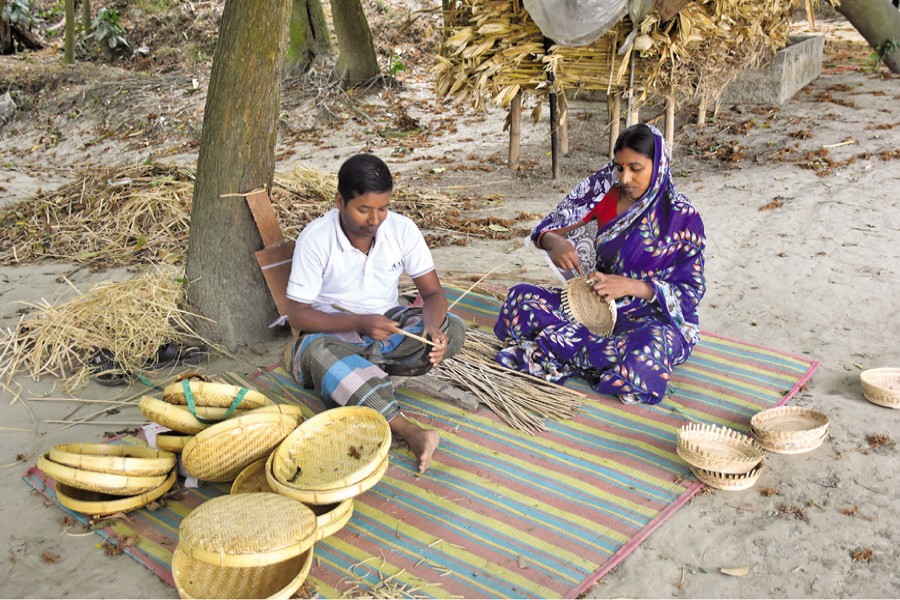
 Two artisans were pictured making handicraft products with bamboo and cane at Sribari Rishipara village in Ghior upazila of Manikganj. — FE Photo
 A CORRESPONDENT
Manikganj, June 21: At Sribari Rishipara village in Ghior upazila of Manikganj, a 200-year-old handicraft industry continues to shape lives and livelihoods.
Around 150 families comprising 300 to 400 individuals are engaged in the work of crafting products from bamboo and cane, a heritage that has passed down through generations.
The artisans of Sribari Rishipara produce a diverse range of handmade items including baskets, trays, stools, mirror frames, fruit trays, and flower vases.
Their products not only cater to the domestic market but they are also exported to nearly 25 countries generating an annual export income exceeding Tk10 million (Tk1.0 crore).
A recent visit to the village found every household bustling with activities-hands weaving magic from bamboo and cane into exquisite household items.
Amal Chandra Sarker, a craftsman, shared, "Three generations in our family have been involved in this craft. In the past, we produced traditional items, including measuring baskets and stools. After receiving training, we now produce modern household goods. We can make about 450 products of different designs, of which prices range from Tk60 to Tk 4,000 each.'
Debnath Chandra Sarker, another artisan, said, "Our products are currently exported through intermediaries based in Dhaka. If we had direct access to international markets, our profits would be significantly higher. Government patronisation in this arena would be a game-changer."
Young entrepreneur Arnab Sarker who promotes and sells products both online and in person echoed concerns about raw material shortage and financial constraints.
"Despite there being a strong market demand for the items, middlemen often take the lion's share of the profit. With access to low-interest loans and direct export opportunities, new entrepreneurs like us could have become much more self-reliant," said Arnab.
Another artisan Nikhil Chandra Sarker highlighting the growing costs of raw materials said, "Earlier, a maund of cane cost Tk1,000; now it is Tk1,500. We have to bring cane from Rajbari, Sylhet, and Sunamganj, which adds to transportation costs and hassle. We still sell our products at old rates because of the market competition."
Women at the village are also actively involved in producing the handicraft items.
Anita Rani Sarker has been producing bamboo products for over 12 years.
"I mostly make fruit trays and flower vases from home. The profit margins have shrunk due to rising material costs, but it's still a vital source of income."
Bhobadish Chandra Sarker, president of the local Bamboo and Cane Cooperative, emphasising the urgent need for government patronization said, "Without affordable raw materials, this heritage craft is fading. If commercial bamboo farming began, we could revive interests among youths."
According to Muhammad Morshed Alam, assistant general manager at SME Foundation, said, "We provide training on product designs and development, marketing techniques, and help artisans participate in trade fairs. We also connect them with international buyers, which helps generate nearly Tk10 million annual export income from this village alone."
Dr Manowar Hossain Molla, deputy commissioner of Manikganj, said, "We are working to preserve and promote this traditional handicraft industry. Plans are underway to set up bamboo nurseries and plantations. We have already communicated with relevant government departments and spoken with local bank managers to ease loan conditions. Additionally, we have extended technological and promotional support to the artisans."
© 2026 - All Rights with The Financial Express

