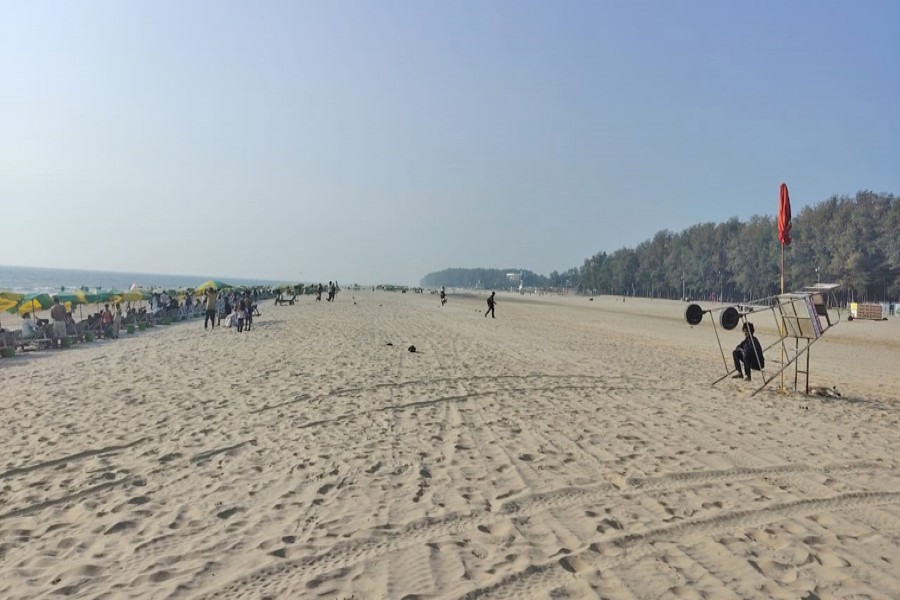
 Fewer tourists are seen on the beach of Cox's Bazar because of the national election preceding and Ramadan- FE Photo
 OUR CORRESPONDENT
COX'S BAZAR, FEB 14: Tourism in Cox's Bazar, the country's premier seaside destination, has slowed significantly since the national election preparations and due to the upcoming Ramadan, with hotel bookings falling to as low as 15 per cent.
Stakeholders in the tourism sector said while a modest influx of visitors is expected between February 14 and 17, tourist arrivals are likely to decline further
from February 18 with the commencement of Ramadan.
Although February is typically one of the busiest months for Cox's Bazar, this year's election schedule
and the approaching Ramadan have dampened travel plans. Industry insiders noted that tourist numbers
generally drop during
Ramadan, making this period particularly challenging for businesses dependent on seasonal visitors. However, they remain hopeful that the losses will be offset during the Eid holidays.
According to sources, bookings in nearly 500 hotels and motels across Cox's Bazar have fallen below 15 per cent due to the election and Ramadan.
Even star-rated hotels are operating at an average occupancy rate of 15-20 per cent, with a significant portion of guests being foreign nationals, particularly NGO workers and representatives of development agencies.
Many mid-range
hotels and
guesthouses are reporting near-zero bookings. Some establishments
discouraged new reservations for three days due to the election.
The downturn has hit small beachside businesses the hardest. At Kolatoli and Laboni points, several local vendors and residents described a stark contrast
with previous years.
Shafiqul Islam, a seashell and handicraft seller, said that during this time of year it is usually difficult to find standing
space on the beach due to heavy crowds. "But now, from morning until noon, very few visitors can be seen. Without tourists, our sales almost come to a
halt," he said.
Abdul Mannan, a mobile photographer, said that although security
measures were strengthened during the election, restricted transport movement prevented many visitors from travelling to Cox's Bazar. He fears the situation may worsen once Ramadan begins.
Rahima Begum, who sells coconuts and street snacks, said,
"We survive on daily earnings. Because of the election, tourists could not come. Once Ramadan starts, there will hardly be any visitors at all."
On Friday at Sugandha Point, tourists Zahidul Haque Chowdhury and
Shamim Ahsan from Rajshahi said they had arrived in Cox's Bazar before the election and experienced some travel disruptions.
They added that due to religious commitments during Ramadan,
they have no plans to travel during the month, but intend to visit the beach again after Eid.
Local residents believe that once post-election normalcy returns, tourist numbers may recover slightly
toward the end of the season. They expect a revival of the tourism sector centering on Eid after Ramadan.
Abul Kashem Sikder, president of the Cox's Bazar Hotel and Guest House Owners' Association, said vehicular movement-including taxis, private cars, microbuses, pickups, and
trucks-was restricted from Tuesday night until Friday evening due to the election. Local CNG-run auto-rickshaws also operated on a limited scale, further
reducing tourist arrivals.
He added that tourist numbers had remained negligible for at least 10 days prior to the election, causing significant financial losses for businesses in the sector.
Mukim Khan, general secretary of the Marine Drive Hotel Owners'
Association, said that many people returned to their hometowns to vote on February 12, including hotel staff. Transport restrictions made it difficult for tourists to move around.
Abdul Qader Mishu, director of Hotel Ocean Paradise, said that
room bookings had been almost non-existent for at least a week before the election. From
February 3 to 9,
average occupancy ranged between 10 and 15 per cent, half of which were foreign NGO workers.
Abu Taleb, general manager of Hotel The Cox Today, said that out of more than 200 rooms, only 20 to 25 were occupied. He expressed hope that the tourism sector would rebound after Eid-ul-Fitr.
tahjibulanam18@gmail.com
© 2026 - All Rights with The Financial Express

