It was 51 years ago that the Bangladesh government, for the first time in the country’s history, demonetised the Tk 100 banknote. The decision to invalidate the banknote, the highest-value note at the time, was driven by the urgency to curb the spread of fake notes and black money. The formal decision was announced by the then finance minister over the radio and television on the evening of April 6 1975. People were, however, initially given three days to deposit the note in exchange for smaller-denomination notes. The impact of the country’s first and only demonetisation move was mixed. It helped to reduce the money supply, which again contributed to containing the inflation. Many of those who had accumulated a large amount of cash did not go for an exchange, as they feared they would be asked about the sources of the money, which, of course, were shady. The smugglers in the border areas also did not dare to come for an exchange. Overall, there was a positive vibe, though no rigorous study had been done to determine the overall impact of the demonetisation.
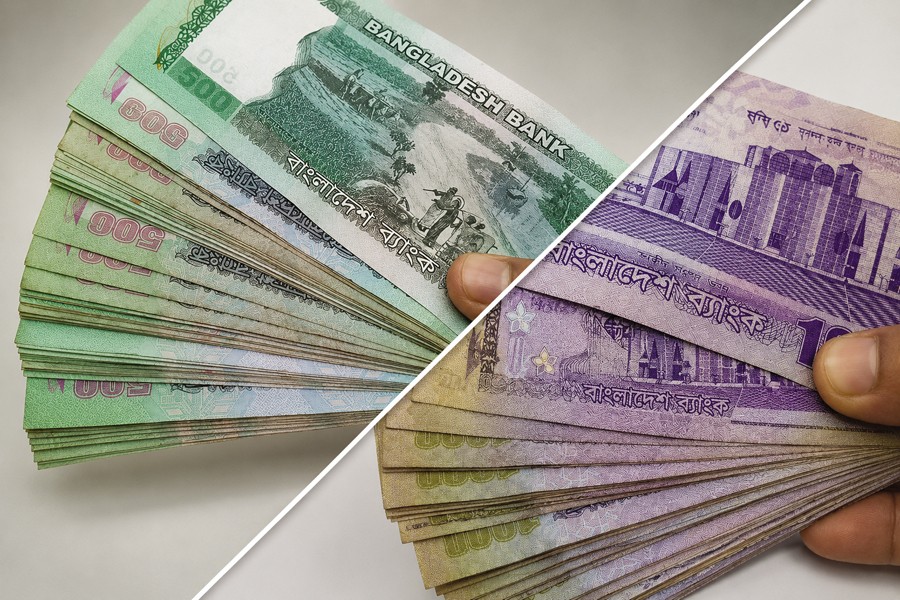
The discussion on demonetisation has resurfaced in the country. Last week, a member of parliament from the treasury bench proposed temporarily invalidating the banknotes of Tk 500 and Tk 1,000. He argued that doing so would improve liquidity in the banking system, as undeclared cash would be brought back into circulation. He also argued that the move would help to curb money laundering and tackle the flow of black money. The lawmaker also suggested allowing holders of Tk 1,000 and Tk 500 notes 1 to 2 months to deposit them with banks. He further argued that individuals unable to demonstrate the legitimate sources of their funds should be allowed to legalise those by paying a tax of between 20 and 25 per cent.
It is unclear whether the lawmaker’s proposal is based on any substantive research or merely a table talk, as it has serious implications for the economy. It may also send the wrong signal and even create uneasiness in the country’s financial market due to the spread of speculation. Fraudsters may also use the opportunity to deceive people, as various modes of fraud are now possible online.
There is no doubt that a large amount of black money prevails in the economy, generated by widespread tax evasion. A portion of the black money, however, is invested in gold, bonds, and real estates. So, these amounts of black money have already entered the formal economy. Some portion is also converted into foreign currencies, and the remaining amount is kept as cash by the black money holders. There is also no reliable estimate of the amount of black money, so it is not possible to determine how much cash is black money.
As cash holdings are quite high, despite various efforts to increase the use of electronic or digital transactions, this is a matter of concern and is also considered a strong indicator of a surge in untaxed money or undeclared income. Statistics from the Bangladesh Bank showed that at present, around 90 per cent of the total currency in circulation is outside banks. The amount stood at Tk 3,030.18 billion at the end of March this year, against the total currency in banks at Tk 390.66 billion. The ratio of currency in banks to currency outside banks stood at 12.90 per cent at the end of March this year, compared with 10.20 per cent at the end of June last year.
Central bank statistics also showed that around 90 per cent of the banknotes in circulation are high-value notes – the Tk 500 and Tk 1,000 denominations. In total, roughly half of the banknotes in circulation are Tk 1,000, and around 40 per cent are Tk 500. So, it is logical to assume that black money holders keep their cash in these two high-value notes. Now, demonetisation of these two notes will compel people to rush to banks for exchange, creating unprecedented pressure on commercial banks. Regular business activities at banks will be severely disrupted, and many branches will not be able to exchange small-denomination notes for large ones. Even three months will not be enough to complete the exchange, as banknotes of Tk 10, Tk 20, Tk 50, Tk 100, and Tk 200 constitute less than 10 per cent of the total notes in circulation.
Moreover, when people deposit notes in banks, they need to submit proof of sources although bank staff will not take responsibility as it is definitely not within their scope of work. It is also not possible to deploy taxmen in the banks to do the work across the country. Thus, people have to rush from here to there, like in football, to clarify the sources of money. Overall, serious chaos will ensue, making it almost impossible for the government machinery to manage the situation.
Additionally, the proposal’s ambiguity about the future status of the notes after the demonetisation period undermines its credibility. Without clarity, the incentive to deposit large notes is weakened, further reducing the proposal’s likely effectiveness.
It is to be noted that the demonetisation of Indian rupees, bank notes of Rs500 and Rs 1,000 a decade ago, did not produce the desired result. Around 99 per cent of the withdrawn notes were returned to the Indian banking system, indicating that black money is not destroyed. Millions of Indians, especially those who are in the middle-income and low-income brackets, suffered a lot. Small businesses were hit hard. Though the Modi government claimed it was a success, it is mostly unsubstantiated, as black money still prevails in India and counterfeit notes are also widespread. The dream of a cashless economy has also not been achieved, as reflected in the Indian government’s shift towards a cashless approach.
After the fall of the tyrant Hasina in the face of the July uprising in 2024, some suggested demonetising Tk 500 and Tk 1000 banknotes to seize the cronies and rent-seekers of the fallen regime. If the measure had been taken immediately after Hasina fled to India on August 5, 2024 for shelter, there might have been some positive impact. Nevertheless, it was a time of chaos and conflict, and there was virtually no government in the country for three days. So, any success in that demonetisation move was very unlikely at the time, and it’s even slimmer now.
asjadulk@gmail.com
© 2026 - All Rights with The Financial Express

