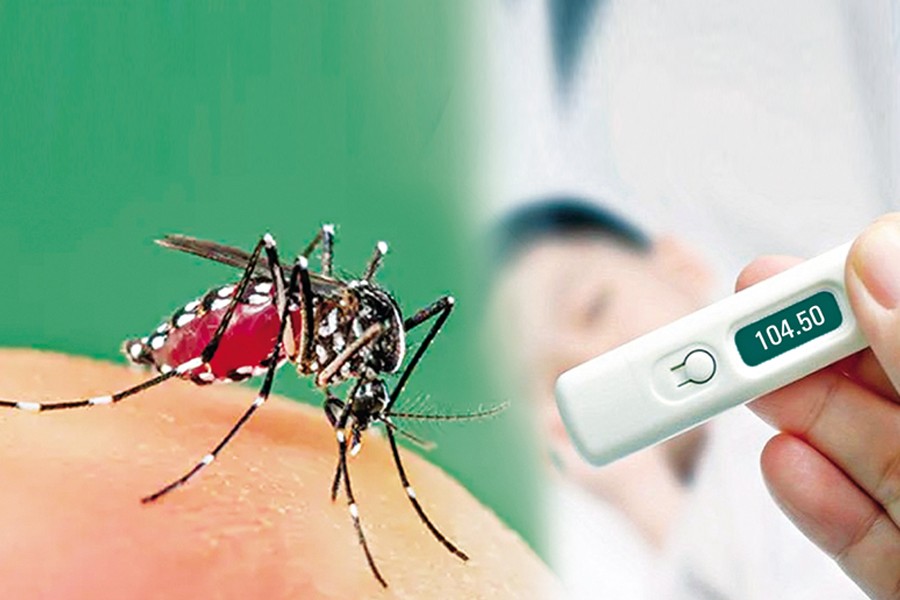
Dengue, a vector-borne killer disease, remains largely unaddressed by the government. Of course, the hospitals are doing their best to treat the patients brought in critical conditions. But such patients usually succumb to their conditions despite the best of doctors' efforts. This year many children have already been orphaned or parents lost their babies to the deadly dengue. The most shocking part of the dengue-related death is that the victims or their close family members are caught quite unawares by dengue fever. In fact, in most cases, dengue comes with fever, which the patients often ignore or just take paracetamol tablets thinking that would be enough to treat the condition. But within a week, their conditions worsen, the patients begin to feel very weak, may even suddenly start vomiting. When rushed to hospital, it is too late. The death comes as an unexpected shock for the victim's family members. The reason is that the victims are not aware that they are carrying the deadly dengue virus. There is every possibility that the area where the patients live is an aedes mosquito-infested one. Now, had the local government bodies like the city ward, municipality, city corporation, etc., carried out enough awareness campaign, involved the local residents in destroying the breeding grounds of aedes mosquito, the residents would be inspired to check every corner of their houses and alleys of the residential area for possible breeding place of the aedes mosquito and destroy those. Even if there still was a case detected, early hospitalisation could save the patient's life.
Between January and September 26, 188 people have already died of dengue, while 44,693 have been hospitalised across the country. As already noted, according to the Directorate General of Health Services, many of these patients are quite in the dark about the severity of dengue and as such seek medical help only when the disease reaches its critical condition. The DGHS data further say, 81 per cent of the dengue patients who died this year were hospitalised after three or more days of fever. By analysing such 114 cases of dengue-related deaths, it could be inferred that 74 per cent of the deaths occurred within 48 hours of hospital admission and half of those deaths taking place due to Dengue Shock Syndrome. Close to 43 per cent of the cases had comorbidities, the DGHS analysis further revealed.
That dengue, or the aedes mosquito responsible for the deadly disease, is no longer a capital city-based one has been amply demonstrated by its spread to Barishal, the second most dengue-hit division this year. According to DGHS reports, so far, out of the eight administrative divisions of the country, Dhaka and Barishal division together account for three-fourths of the dengue-related deaths and nearly equal number of hospitalisations. Notably, Sylhet and Rangpur divisions remain the only divisions that have no recorded dengue-related deaths so far. However, there is also no room for complacency for this, since it is not due to any special measures against dengue adopted in these two divisions that they have been spared dengue-related fatalities so far. In fact, the dengue-vector, which has already spread out of Dhaka to Barishal division this year, can do so in other divisions. If no nationwide drive against dengue is launched meanwhile by the government's appropriate agencies, it is a matter of time before the disease will extend its deadly tentacles to other divisions, too. In this connection, entomologists have warned that if infected people carrying the deadly virus from Dhaka or Barishal, travelled to those places, then the virus may be transmitted to those divisions, too.
In fact, four other divisions including Chattogram, Rajshahi, Mymensingh and Khulna reported their share of caseloads and deaths. Interestingly, thus far, with Dhaka as the epicentre of dengue outbreak, traditionally, Chattogram occupied the second hotspot of dengue in terms of the number of hospitalisations and deaths. But this year, Barishal division, or more particularly Barguna district, seems to have replaced Chattogram. This September has so far proved to be the deadliest month with 60 dengue deaths reported in just three weeks surpassing July's record of 41 fatalities, which was previously considered the peak. Similarly, hospitalisation rate is also the highest in this month with the related figure reaching around 45,000 till 27th of this month. Though there is no clear-cut pattern regarding the rise or fall in the rate of dengue transmission or fatalities, there is also no respite from hospitalisation nor fatalities from this mosquito-borne disease. In absence of a well-coordinated comprehensive approach to combat the menace of dengue, new areas will see the spread of the disease with its attendant sufferings and deaths. There should be, as public health experts consistently advised, aggressive vector-control measures in place along with systematic patient tracing, and expansion of hospital capacities to handle dengue-patients. The dengue situation may any time turn for the worse and even spiral out of control, according to the public health experts.
In this connection, to meet any emergency, the DGHS has reportedly issued a 12-point directive across the country with instructions to prioritise dengue treatment as the number of cases and fatalities continue to rise. Now these are the measures the DGHS is taking and hospital authorities responding to within their abilities. But hospitals can treat a patient after s/he is infected with dengue. But it is beyond their power to prevent dengue from happening. So, the responsibility naturally goes to the local government bodies. But what have they been doing so far? Their job usually end with spraying insecticide with fogging machines. But researches have shown that the insecticides being used under the dengue eradication programmes are not effective in destroying the primary dengue vector, the aedes mosquito. But the authorities concerned, local government bodies to be specific, have made no serious attempt so far in that direction. In 2019, a major dengue outbreak took place in the country that spread to the rural areas. But preventive measures were lacking at that time. The situation has far from improved either during the intervening years. Community-level awareness is now at its lowest level. Therefore, urgent steps are required to combat the vector from breeding, growing and spreading. Meanwhile, vaccination programme for children against dengue should be launched, with free inoculation for them in rural areas.
The dengue situation is worsening. Under the circumstances, the government from its highest level should consider dengue an emergency and act accordingly.
sfalim.ds@gmail.com
© 2026 - All Rights with The Financial Express

