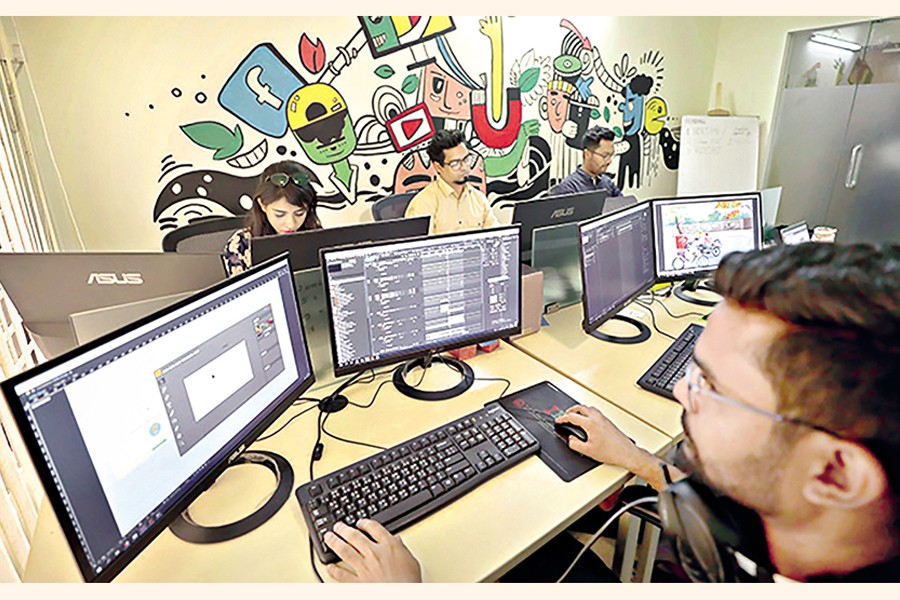
 Animators working at a studio in Dhaka — Pixelaa Studios Photo
 Bangladesh's animators have been busy. For more than a decade they have produced sleek, colourful sequences for global entertainment giants -- from television commercials to mobile games -- often without anyone knowing the work was done in Dhaka rather than Delhi or Manila. The talent is there; the infrastructure is not. Were the state to take the industry seriously, insiders reckon, exports could reach $3 billion within a few years.
That is no small sum for a country still dependent on shirts and shrimp. Globally the animation business is booming, driven by the explosion of streaming services, games and digital advertising. Analysts expect the market to reach $550 billion by 2030. Neighbouring India and China already dominate the outsourcing end of this value chain. Bangladesh, with its low costs, English-speaking youth and digital literacy, could claim a slice. But instead of becoming an exporter of ideas, it remains an exporter of labour.
Roughly 20,000 people now work in animation studios across Bangladesh. They are young -- nearly 28 per cent of the country's population is under 30 -- and technically adept. In a nation struggling with graduate unemployment of over 40 per cent, the creative industries ought to look like a gift. Animation is labour-intensive, scalable and largely immune to logistics bottlenecks. Yet despite producing world-class material, most Bangladeshi studios operate as anonymous subcontractors, their names erased from the credits.
According to industry insiders, it's a ten-billion-dollar opportunity hiding in plain sight.
Many believe Bangladesh's bureaucrats still treat animation as a curiosity rather than a commercial prospect.
The Ministry of ICT, notionally responsible for nurturing digital industries, admits there are "no current plans" to invest in sectoral infrastructure. Projects may be "considered after the next government is in place," an official says. That is bureaucratese for "not any time soon."
Producing professional-grade animation requires hardware muscle. Rendering -- the process of converting complex 3D data into finished visuals -- demands banks of high-end computers known as rendering farms. These cost millions to build but are easily shared. Bangladesh has none. Studios rely on rented overseas servers, pushing up costs and turnaround times.
Then there is regulation. The country's financial rules, designed for a world of tangible goods, make hiring or paying foreign specialists a headache. Because the central bank keeps tight control over foreign-currency transfers, paying international consultants can take months, if it is permitted at all. "In most countries entrepreneurs can pay foreign staff directly through convertible capital accounts,' notes an entrepreneur adding 'In Bangladesh that's nearly impossible.'
This protectionism may safeguard foreign-exchange reserves but it also blocks skill transfer. Animation is global by nature: collaboration with foreign designers and storytellers is essential. Without a mechanism to move money smoothly across borders, Bangladesh cannot build the partnerships that give creative industries scale.
The industry's ailments are not technical but institutional. Infrastructure, finance and training are the holy trinity of digital growth; all three are missing. India's government, for instance, created regional animation clusters, tax breaks and dedicated export zones, helping the sector surpass $2.5 billion in annual revenue. China poured billions into animation schools and content studios to promote "cultural self-confidence." Bangladesh, by contrast, spends more on regulating Facebook than on fostering its own digital content.
A few interventions could change that. Tax rebates for creative exports, public-private partnerships for shared rendering hubs, simplified foreign-payment rules and targeted vocational training would be a start. The country's Export Promotion Bureau could treat animated content like ready-made garments: a product with comparative advantage and global demand.
So far, however, policymaking remains stuck in analogue mode. The state continues to equate technology with hardware -- assembling mobile phones or laptops -- rather than intellectual property. Creative industries require a different mindset: one that values code, story and design as tradable assets.
The case for animation is not purely economic. Creative exports confer soft power. South Korea built a global image through K-pop and dramas; Japan did it with anime. Bangladesh, too, once captured imaginations with "Meena," a UNICEF-backed animated series launched in 1993 that taught children across South Asia about equality and education. It became a cultural touchstone -- and a reminder that animation can transmit social ideas more effectively than lectures or laws.
Since Meena, progress has been glacial. The few public initiatives that exist focus on one-off projects rather than ecosystem building. There is no national animation policy, no state-backed institute, no funding scheme for start-ups in the field. Universities teach design but rarely link graduates to commercial pipelines. Studios remain isolated, struggling to find financing or global exposure.
"Without an ecosystem, talent leaks away," laments a chief executive of an animation house.
Our best animators end up working for overseas firms. Bangladesh gets the wages, not the intellectual property, he lamented.
Indeed, the biggest threat is not failure but invisibility. Thousands of Bangladeshi animators already freelance for studios in North America or East Asia. They are paid per project, with no credit and no residuals. Their skills enrich global brands while the domestic industry stagnates. It is the digital equivalent of the garment sector's low-wage model -- efficient but unrewarding.
Escaping this trap means building original intellectual property: home-grown characters, stories and visual worlds that can travel. The folklore of Bengal -- from the Nakshi Kantha to Thakurmar Jhuli -- is rich source material. But original content requires risk capital and marketing, not just technical expertise. Here again, policy inertia bites. Bangladesh's venture-capital scene remains small, and state banks view intangible assets with suspicion.
If properly financed, local studios could exploit a global appetite for diverse voices. Platforms such as Netflix and Disney+ now actively seek non-Western content. The Bangladeshi diaspora alone constitutes a ready audience. Yet without a pipeline for financing, intellectual-property protection and international distribution, those opportunities slip away.
Beyond cultural pride lies a pragmatic argument. Each animation studio employs programmers, writers, sound designers, marketers and project managers -- exactly the sort of high-skill, urban jobs Bangladesh needs. Unlike manufacturing, creative work has low environmental impact and high export potential. It can be done from anywhere with broadband.
Youth unemployment, officially around 10 per cent but far higher among graduates, makes the need urgent. The International Labour Organisation estimates that two-thirds of new graduates struggle to find suitable work. A thriving animation industry could absorb part of this surplus while diversifying exports. It would also align neatly with the government's "Smart Bangladesh" vision of a knowledge economy.
The alternative is grim: a generation of tech-savvy youth underemployed in call centres or migrating abroad. The country risks squandering not just a market opportunity but a social one.
To move from promise to policy, Bangladesh needs three shifts.
First, build infrastructure. Shared rendering farms and cloud facilities could be developed through public-private partnerships, reducing costs for small studios. The state already builds technology parks; adding a creative-content wing would be trivial.
Second, liberalise payments. A modest reform of foreign-currency rules -- allowing verified digital exporters to pay for overseas services through licensed platforms -- would unlock international collaboration. The central bank could monitor flows digitally, minimising abuse.
Third, invest in people. Subsidised training programmes, internships and university linkages could produce a new generation of animators, scriptwriters and producers. A national institute for animation and digital arts would signal seriousness.
Such measures would not strain the budget. The entire sector today is smaller than a mid-sized garment factory. But its multiplier effects could be huge: every dollar spent on creative infrastructure generates far more value than on bricks and mortar.
Bangladesh's policymakers are fond of talking about "graduating" from least-developed-country status. That transition will not be achieved by sewing more T-shirts. It will come from exporting imagination. The digital economy is borderless; creative capital, once developed, compounds quickly.
Yet the country's instincts remain defensive. Where India and Vietnam court global studios, Bangladesh worries about capital flight. Where others subsidise innovation, it fears "misuse of funds." Such caution may keep accountants happy, but it leaves the country creatively paralysed.
To its credit, the interim government led by Dr. Muhammad Yunus has spoken often about diversification and youth employment. If those words are to mean anything, creative industries should be part of the reform portfolio. A modest Creative-Industry Fund, tax relief for export-oriented studios and inclusion of digital content in export-credit schemes would be a good start.
The private sector must also act. Local investors, quick to back fintech or logistics start-ups, have so far ignored animation. Yet the potential returns -- both cultural and commercial -- are immense. Regional streaming services, gaming platforms and advertising agencies are all hungry for cost-efficient creative production.
For Bangladesh, animation is more than an industry; it is a test of whether the country can evolve from a producer of cheap goods to a creator of intellectual value. The ingredients -- talent, connectivity, youth -- are already present. What is missing is vision.
Left alone, the sector will continue to churn out invisible exports: brilliant work signed under someone else's logo. With policy support, it could generate billions, create high-value jobs and project a modern image of a country too often pigeonholed as poor but industrious.
Bangladesh once taught South Asia lessons about microfinance and social enterprise. It could, with equal imagination, become a model for creative entrepreneurship. The world is ready to watch. The question is whether Dhaka is ready to draw.
mirmostafiz@yahoo.com
© 2026 - All Rights with The Financial Express

