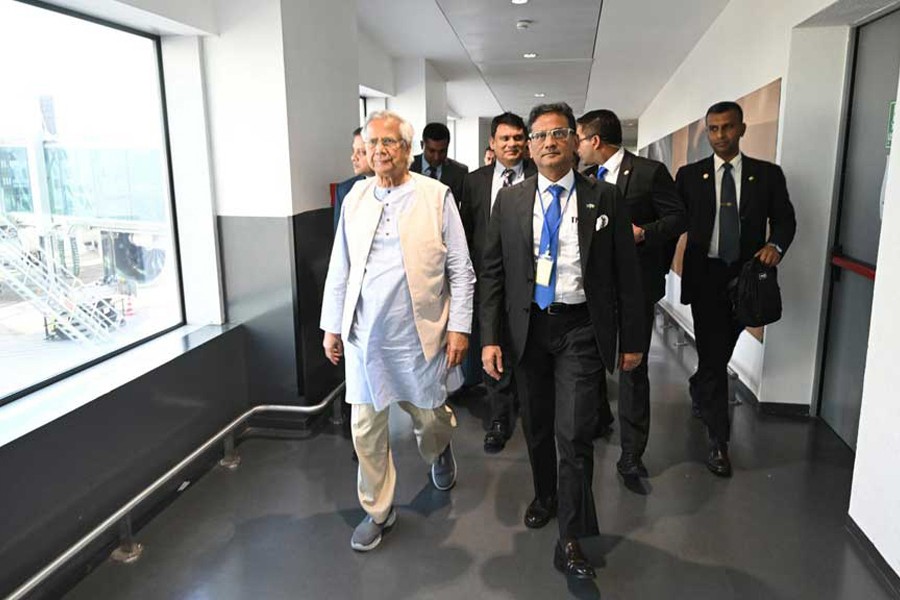
 Chief Advisor Muhammad Yunus arrived in Rome, Italy on Sunday to participate in the World Food Forum —Agency Photo
 Every year, thousands of Bangladeshis risk their lives crossing the Mediterranean Sea, driven by the hope of higher earning opportunities in Europe. For many, that dream ends in tragedy. Their overcrowded boats capsize; some names could be known and some remain unknown. The latter vanish into statistics.
According to the UN refugee agency (UNHCR), between January and August 2025, a staggering number of 13,148 Bangladeshis crossed the Mediterranean to reach Italy irregularly, accounting for 30.8 percent of all sea arrivals. This puts Bangladeshis at the very top of the list of those entering Italy through irregular routes -- a grim distinction that has persisted for years.
This backdrop gives new significance to Chief Adviser Professor Muhammad Yunus's visit to Italy this week. Officially, he is attending the World Food Forum in Rome, where he will deliver a keynote address on October 13. But behind the ceremonial appearances lies an urgent political and humanitarian agenda. Both Bangladesh and Italy have been engaged in talks to curb irregular migration and expand regulated labour migration. Yunus's visit could provide a critical opportunity to give that dialogue new momentum.
Italy's migration challenge is as much a domestic political issue as it is a humanitarian one. For Bangladesh, however, it is also a matter of national reputation and social stability. The exodus of young Bangladeshis -- often facilitated by human traffickers -- reveals deep-rooted problems: unemployment, limited access to decent work, and the lure of risky migration routes promoted by unscrupulous recruiters.
Bangladeshis while trying to land in a European country typically take a long, dangerous journey. Many travel first to Libya or Tunisia via irregular intermediaries. There they are trapped in detention camps, forced labour, or subjected to extortion before attempting the final and most dangerous leg across the Mediterranean. Some survive; many do not.
For Italy's right-wing government, led by Prime Minister Giorgia Meloni, controlling these arrivals has become a political imperative. Her administration has pledged to clamp down on irregular migration, arguing that uncontrolled flows strain public services and fuel social tensions. For Bangladesh, the issue is different but equally pressing. Irregular migration undermines the country's labour export reputation and exposes citizens to exploitation. It also deprives the economy of potential remittances that could have come from regulated, productive employment abroad.
Meloni was scheduled to visit Dhaka on August 30 to discuss migration and labour cooperation, but her trip was cancelled. Now, with Yunus in Rome, the focus shifts to whether the two leaders can meet again to push the agenda forward.
During their last meeting in New York on the sidelines of the UN General Assembly on September 25, migration dominated the discussion. Both leaders discussed ways to combat human trafficking and agreed on the need for closer cooperation in repatriating irregular migrants. They also explored opportunities to support legal migration by developing vocational training programmes in Bangladesh that align with Italy's labour market needs.
For Rome, the idea makes practical sense. Italy faces labour shortages in several sectors -- construction, agriculture, caregiving, and manufacturing among them. Bangladesh, with its large, young workforce, could supply skilled labour through proper channels. For Dhaka, such collaboration would create safer migration pathways and help address unemployment pressures at home.
A senior official at Bangladesh's Ministry of Foreign Affairs confirmed that migration will be "a key agenda item" in Yunus's meetings with Italian officials. "Visa issues may also come up, along with discussions on trade and defence cooperation," the official said.
The discussions may also revive Meloni's earlier proposal to establish a Bangladesh-Italy Trade Forum, designed to enhance bilateral investment and business ties. According to officials, there is a possibility that Meloni may visit Bangladesh in December, depending on political developments in both countries.
In May, Bangladesh and Italy signed a memorandum of understanding (MoU) aimed at curbing irregular migration and promoting legal labour mobility. While this agreement was hailed as a step forward, tangible results have been slow to emerge. Yunus's visit could provide the political impetus needed to operationalise it.
The MoU envisions a system where Bangladeshi workers would be trained domestically and deployed to Italy through approved recruitment channels, thereby reducing dependence on middlemen. It also commits both sides to share information on traffickers and improve coordination on migrant repatriation.
But implementing such agreements requires more than signatures. Bangladesh's recruitment sector remains plagued by corruption and weak oversight. Unlicensed brokers often lure jobseekers with false promises, charging exorbitant fees. Unless the government strengthens regulation and digitalises recruitment processes, the MoU risks being undermined by the same networks that profit from irregular migration.
Italy's domestic debate on migration often focuses on border control and deportation, but that narrative ignores the underlying human dimension. Most Bangladeshi migrants are not criminals -- they are workers seeking dignity and opportunity. Many come from rural districts where jobs are scarce and wages too low to sustain families. Their decision to leave is not driven by greed but by desperation.
Bangladesh's challenge is therefore not only to prevent irregular migration but also to create hope at home. Expanding technical education, investing in small industries, and providing access to safe overseas employment could all reduce the desperation that drives people into smugglers' hands.
While irregular migration dominates headlines, legal migration is also under strain. Thousands of Bangladeshis who travelled to Italy with valid visas in recent years are now caught in administrative delays. Many have been unable to renew residence permits, while others face expiring documentation that could push them into irregular status.
Meanwhile, those applying for new visas face long waiting times due to a backlog of applications.
These delays not only harm individuals but also undermine confidence in legal migration systems. Without reliable and transparent procedures, more people will be tempted to take illegal routes -- a vicious cycle both governments must break.
The Yunus administration has an opportunity to redefine Bangladesh's migration diplomacy. By combining Yunus's global standing as a Nobel laureate and social entrepreneur with pragmatic policy reforms, Bangladesh could advocate for a more balanced migration framework -- one that prioritises both regulation and compassion.
Instead of treating irregular migration solely as a law-and-order issue, Dhaka and Rome could frame it as part of a broader economic partnership. A joint labour mobility programme could focus on skill-building, certification, and ethical recruitment. Italy, in turn, could commit to faster visa processing and fair labour standards for Bangladeshi workers.
Such cooperation would not only address the migration crisis but also strengthen economic ties between the two countries. Italy is already home to one of Europe's largest Bangladeshi communities -- over 150,000 strong -- who contribute to both economies through remittances and entrepreneurship. Engaging this diaspora in policy discussions could make migration more sustainable and inclusive.
If Yunus's Italy visit results in renewed commitment to implement the May MoU, launch vocational training initiatives, and streamline visa processes, it could mark a turning point. A successful outcome would mean fewer deaths at sea, fewer people exploited by traffickers, and more Bangladeshis migrating legally, safely, and with dignity.
It would also reaffirm Bangladesh's reputation as a responsible partner in global migration governance -- a country willing to address irregular flows through cooperation, not confrontation.
But success will not come easily. It requires sustained political will, administrative reform, and genuine empathy for the lives at stake. Italy must look beyond deterrence; Bangladesh must look beyond remittances. Both must look toward building a system that respects human mobility as a right, not a risk.
Migration has always been part of Bangladesh's story. The question now is whether that story can move from tragedy to transformation -- whether a journey that once began with despair might, in time, become one of dignity.
mirmostafiz@yahoo.com
© 2026 - All Rights with The Financial Express

