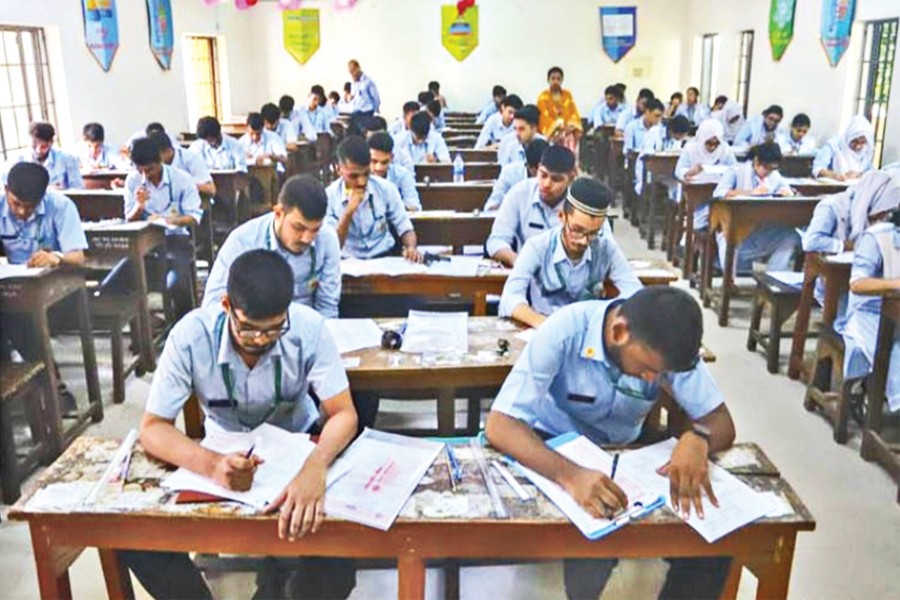
The news that 36 per cent of regular students enrolled for completion of higher secondary education have not even registered for this year's ongoing Higher Secondary Certificate (HSC) examinations is alarming. Two years back about 1.5 million students had completed admission to class 11 and now 0.55 million are missing from the exam. Last year, the dropout rate was 29 per cent, up from 21.51 per cent in 2024. But strangely, in 2023 academic year too, the dropout rate of students at the HSC level was 29 per cent. In 2021 and 2022, the years following the Covid-19 pandemic, the absenteeism was recorded at 21.14 and 22.72 per cent respectively. Why the dropouts in the academic year 2023 rose so sharply and fell equally abruptly in 2024 defy a logical explanation.
But this year's steep rise in dropout is a cause for serious concern. Apart from the 550,000 students who dropped out straightway, the numbers of examinees not appearing at the first few days' exams are mounting. The numbers of absentees range between more than 20,000 and well above 30,000. There is a need for a comprehensive study on this rising trend of absenteeism among students at the higher secondary level. Presumptions like early marriage of girl students and entry of boys into job market, economic hardship of students' families not allowing continuation of education and unemployment for university graduates may make some points but still fall short of hitting the bull's eye.
Last year the Dhaka Education Board took an initiative to find out what caused registered students of the secondary level not to appear for examination. Although it was not a comprehensive study, still it indicated that 41 per cent of the girl students were married off. Early marriage of girls should have reflection on the number of such candidates with abrupt drop in their appearance for HSC exam. This is hardly the case. In pass rate and higher score, girls are outperforming boys in the first two public examinations.
In fact, the rural-urban divide and disparities in education is often overlooked. Educational institutions with zero per cent pass are not found in cities but in rural areas. Yet another important issue escapes notice: the overwhelming majority of teachers have their origin in villages. They migrate to towns and cities---only more so to the capital city---in order to overcome their miserable financial condition in village schools. Only teachers of low calibre or a few reputed ones in exceptional cases stay in villages to pursue their low-paid profession.
In cities, proliferation of coaching centres presents an ugly truth. The truth is that teaching in classrooms is far too inadequate to prepare students for examinations, let alone arming them with a comprehensive knowledge of the subjects. In this respect, the pernicious impact of Covid-19 on the current batches of SSC and HSC students should be taken into account. They had suffered foundational lapses in earlier classes. No government programme was taken to make up for the educational losses suffered by them. Prolonged closure of educational institutions pushed them out of learning track. These batches of students are paying for the disruptions caused by the pandemic.
Yet not all students fall victim to the unlearning process. Parents who can afford house tutors and coaching centre costs ensured that their children made up for the learning gap. But students from poor families were not lucky enough to find themselves on the right track of recovery. Their knowledge gap widened because of absence of any government or school-initiated recovery measures. With weaknesses in foundational knowledge, these students continue to lag behind their peers in reputed educational institutions in cities and towns. Indeed, a lack of money and opportunities has ill-prepared students for appearing in examinations at the secondary and higher secondary levels.
The number of missing students from examinations should not soar after the generations that were in primary school during the Covid-19 phase pass out. But it is unlikely to happen because of the harsh reality of global politics and economy. While the privileged segments of society can weather the setback of international commerce and trade--- some even prospering in defiance of disruptions triggered by Donald Trump's reciprocal tariff, the lower classes of people are losing their jobs and livelihood options. Against the background of increasing industrial automation, workers find themselves terminated from employment. This is causing a social rift with uncertainty staring in the face of workers and employees down the rank.
Students of lower class families have increasingly been discriminated against, forcing them to discontinue education. Desperation of such families compels them either to migrate abroad or go for livelihood options of small trade, vending and driving auto rickshaws in cities and towns in order to keep their body and soul together. Thus the social divide is yawning.
In such a grim situation, there is a need for collecting data from educational institutions about the missing students. What exactly has driven them to drop out of education should be the basis of individual and collective interventions aimed at bringing them into the learning process. Demographic dividends will remain elusive if the millions of youths remain neither in education, nor in employment and training. This is a serious issue and should be treated so for an urgent action plan.
nilratanhalder2000@yahoo.com
© 2026 - All Rights with The Financial Express

