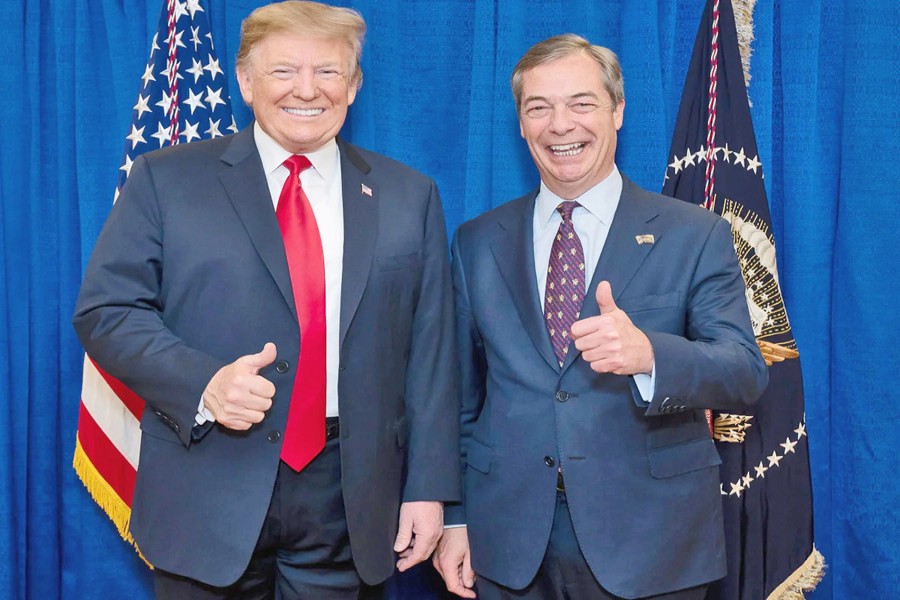
 Donald Trump & Nigel Farage
 The genie is out of the bottle and there is no putting it back. For a long time, the global rise of far-right and sectarian politics was something of a sideshow, visible but never potent enough to take over the political mainstream. But now these forces are seizing the centres of power everywhere. Just last Saturday, the local and regional election results across the United Kingdom handed Nigel Farage's Reform UK its most significant victory yet. An aggressively anti-immigrant party founded on racial hatred and fringe conspiracy theories, Reform UK won more seats than either Labour or the Tories. On a single weekend, it broke the two-party grip that had defined British politics for generations. For most of his career, Farage was the man serious people were not supposed to take seriously, a provocateur to be mocked and kept at the margins. He is now a credible candidate for Prime Minister. That is how profoundly the political culture has changed. What was once shameful has become acceptable and those who were once disgraced are now celebrated.
It would be tempting to dismiss all this as someone else's problem and as the turbulence of a distant nation. But the same current runs through the subcontinent with far more consequential force. India was, for a long time, held up as proof that democracy could not only survive but flourish in vast and deeply diverse societies. The country was celebrated for its capacity to accommodate, however imperfectly, a wide range of traditions within a single political frame. That reputation has been unravelling since the Bharatiya Janata Party (BJP) came to power in 2014. The party has governed not by broadening the political tent but by narrowing it, advancing a Hindu nationalism that would have been unrecognisable to the India envisioned by Mahatma Gandhi, Jawaharlal Nehru and B.R. Ambedkar. Its recent sweeping victory in West Bengal has extended that project still further, bringing one of the country's last major opposition strongholds under its control and pushing the vision of an inclusive and pluralistic India further out of reach.
The campaign to bring West Bengal under the party's control had been underway for years. The central BJP government steadily tightened funding from various national programmes directed at the state, leaving India's fourth most populous region trapped in economic stagnation by political design. Manufactured grievance requires manufactured misery, and that is precisely the environment that was created. Economic pressure, however, was only one part of the strategy. The government's influence over the Supreme Court and the Election Commission was also used to revise the electoral rolls of West Bengal, removing 9.2 million voters from the registers. The overwhelming majority of those disenfranchised were the Muslims, widely regarded as supporters of the Trinamool Congress government of Mamata Banerjee. Most of them had no avenue of appeal before elections were held. Those 9.2 million voters constituted approximately 18 per cent of the total electorate in West Bengal. To put this into perspective, there are countries where elections are won and governments are formed with vote shares not dramatically higher than that figure. In Germany, Friedrich Merz's Christian Democratic Union won 22.6 per cent of the total votes cast in the 2025 election, and yet Merz is now the Chancellor. In other words, the percentage of people denied the right to vote in West Bengal is comparable to the percentage of votes that brought a man to the chancellorship of one of the world's most powerful democracies. That's why any claim that the result in West Bengal is a democratic verdict of the people strains credulity to its breaking point.
The BJP's record in other states offers a preview of what West Bengal can expect. In Uttar Pradesh, the demolition of the homes and properties of Muslim residents by state machinery on the flimsiest of pretexts has become regular occurrence. The state's chief minister has earned the name Bulldozer Baba as an acknowledgement, apparently worn with pride, of the terror induced through these demolitions. Across BJP-governed states more broadly, violent vigilantism by self-appointed cow-protection groups and lynch mobs has become so normal that it barely raises an eyebrow. They have effectively converted the status of equality for Muslims and Christians into one of hatred and untouchability. Even educated and moderate Hindus who speak out against this climate are suffering heavily at their hands.
Some in Bangladesh have argued that the defeat of Mamata Banerjee may finally remove obstacles surrounding the Teesta water sharing agreement because her opposition had long been presented as the principal barrier. That optimism is misplaced. Mamata Banerjee's resistance always functioned more as a convenient excuse than the true reason for the prolonged deadlock. There is little reason to believe that a government which immediately after coming to power ordered barbed-wire fencing along the Bangladesh border will suddenly adopt a more generous posture regarding shared rivers. The fence is nothing but a statement of intent, and it echoes the politics of hostility that Donald Trump made fashionable when he campaigned on building a wall along the Mexican border.
There is a more immediate danger that Bangladesh must prepare for. Stripping 9.2 million residents in West Bengal of their voting rights has only emboldened BJP supporters who constantly label Muslim citizens as Bangladeshis. That rhetoric, combined with removal of voting rights, sets the stage for a possible mass expulsion down the line. The recent history of Myanmar shows exactly where such dehumanising action and language can lead. Bangladesh is already severely strained by the burden of hosting Rohingya refugees from Myanmar and has neither resources nor capacity to absorb more displaced people. This is all the more reason for the government in Dhaka to be on high alert, should the BJP leadership in West Bengal manufacture a crisis that forces the local Muslim minority across the border.
showaib434@gmail.com
© 2026 - All Rights with The Financial Express

