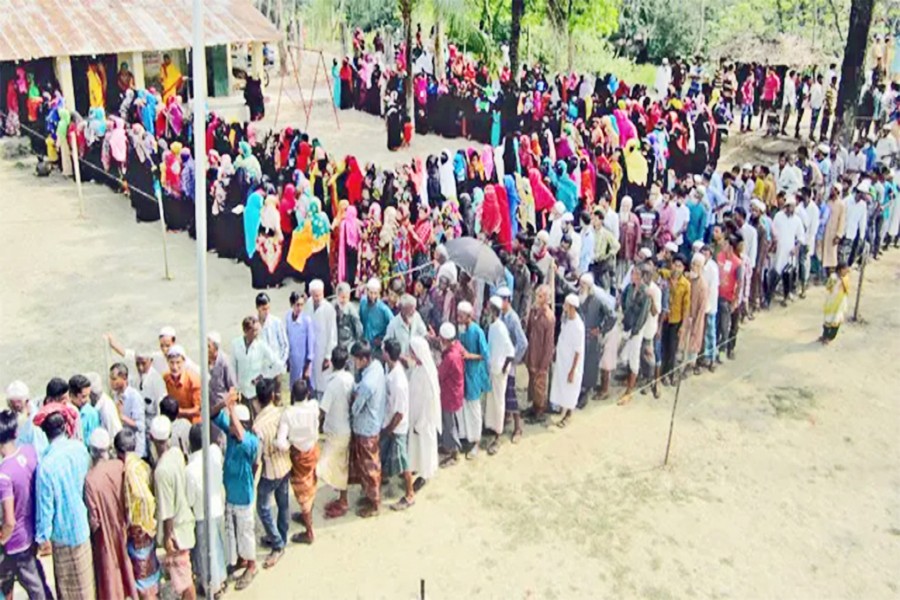
 Heavy rush of voters at a union council poll
 Chief Election Commissioner (CEC) AMM Nasiruddin has ruled out party symbol for election to the local government bodies. If this is a cause for psychological relief, the CEC admits that he is apprehensive of announcement of fielding party candidates by different political parties. He is concerned that rivalry between parties or wards can lead to bloody clashes. In the past some villages have witnessed such conflicts in which several people were left dead and wounded. The CEC adds that there is no guarantee that one fair and smooth election can ensure all successive polls will follow suit. However, his intention is to establish a tradition and culture of fair polls.
The sentiment expressed by the CEC reflects the reality obtaining in the country. Since he is quite aware of the challenges of holding polls to the local government bodies, he is expected to take adequate preparation at the time of such polls with deployment of adequate forces in the conflict-prone polling centres and villages. It was better for him not to hint at the past polls violence and the consequent deaths. Although no polls schedules have been announced, the indication is that the staggered election may start from September-October after the monsoon is over. Indeed, there is merit of staggered election in that the process allows concentration of focus on law and order in the sensitive areas.
With 13 city corporations, 330 municipalities, 61zila parishads, 495 upazila parishads and 4,599 union parishads, this small country should have long made polls to these bodies more meaningful than they are now without any interference and violence. Mostly used as a vehicle of expanding the spheres of partisan political influence, the culture of fair election could not develop at the grass-roots level. The very purpose of strengthening local government and dissolution of power has been defeated because of the centralised system of governance. Devolution of power ensures decentralised authority but instead of focusing on this political sovereignty, the local bodies are busy toeing the lines of partisan politics.
This country's parliamentary politics is of no help in this regard. Already, it has been the upazila nirbahi officer, a civil servant, who runs the show. Upazila chairmen have been reduced to the position of bargainers or middlemen. Now the new government is in favour of reserving a well-furnished 'dedicated room' or 'inspection room' for members of parliament at every upazila. A triumvirate administrative setup indeed! It can be assumed that the presence of the members of parliament at the UN office make the matter further complicated. The subordinate role now played by the upazila chairmen will further dissipate into insignificance. At the same time, no upazila nirbahi officer (UNO) will be at ease in functioning as the head of this tier of administration. There is no legal provision for accommodation of the members of parliament in the administrative arrangement at this level. Ideally law makers are supposed to help formulate laws in parliament.
Their presence in their 'dedicated rooms' during election to the upazila parishads and union councils is supposed to contravene the law and the possibility of creation of a level-playing field at these tiers of election will recede further in the horizon. Politicisation may take a turn for the worse. When the general expectation is to keep the local government bodies as much free from partisan politics as possible, all such moves give an indication to the contrary.
Yet there is no dearth of enthusiasm about the polls to the local government bodies among political parties. It is because of consolidation of the political influence for the ruling party and making some inroads into the established power by the opposition. Although the parliamentary polls and local government elections are different in nature, party nomination of candidates makes the latter politically sensitive. It is exactly where the division created at this level on the party line leaves a lasting divisive impact on the local community.
This stands on the way of empowering the local government as well. So far as development at the grass-roots level is concerned, it should have been a preserve of such bodies. But the elected representatives of the local government have almost no participation in making decisions on the development programmes for the local communities. This is exactly why bridges are constructed in the paddy field with no road on either end and there is no attempt to construct one where thousands of villagers would benefit from it.
Election or not, the local government should be allowed to play their due roles in order to not only decentralise the administration but also to ensure fare distribution of development finance. Once villages were solvent not only with food but also with other necessary materials produced locally to meet people's requirement for leading a modest life. Today consumerism has reached an unprecedented level and villagers have also become dependent on consumer goods from home and abroad. It is no longer possible to bring back the kind of self-reliant structure of villages of the past but at least the divisive politics as stoked by polls to local government bodies can be contained to a minimum level.
nilratanhalder2000@yahoo.com
© 2026 - All Rights with The Financial Express

