Two years ago, right around this time, Bangladesh watched a student movement gather such force that it changed the country's political course. Much has changed since then, but one thing has not. This remains a generation that is willing to make its voice heard when it believes it has been wronged. That willingness showed itself again this July when Higher Secondary Certificate candidates poured onto the streets of Dhaka and other parts of the country over a series of decisions surrounding their examinations. What began as frustration over uncertainty and the refusal to postpone tests in districts hit hard by flood quickly snowballed into something much bigger. Students surrounded education board offices and even marched to the Secretariat, demanding the resignation of the education minister. In a country where the HSC is often treated as a defining milestone, examinees do not lightly walk away from their studies to protest, making the sight of them out on the streets a shock to many. It should not have. Anyone who has followed the steady decline of higher secondary education over the years could hardly have been surprised by the outburst.
That frustration did not emerge overnight. It was years in the making. Ever since the pandemic disrupted classrooms, the authorities have papered over the cracks with one temporary arrangement after another to move batches from one year to the next. One year brought automatic passes, another introduced subject mapping while later examinations were held on a shortened syllabus. Each decision may have been justified by the circumstances at the time, but together they created an academic culture where exceptional measures gradually became the norm. Then came an abrupt change of course. Full length examinations based on the complete curriculum returned, even though many of the weaknesses exposed by the pandemic had never been addressed. Students were expected to meet higher academic demands, but the quality of classroom teaching had not improved enough to support those expectations.
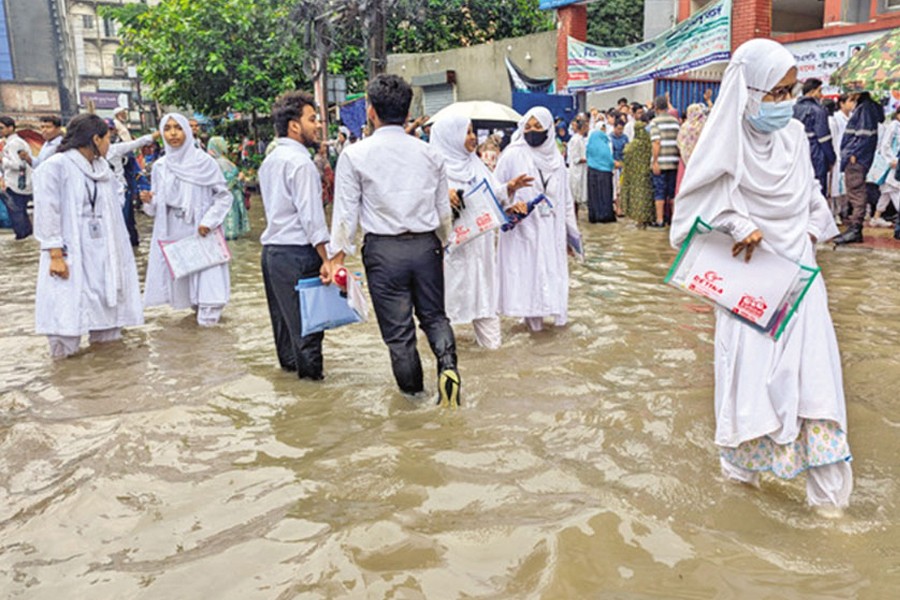
The accumulated frustration finally met circumstances that no administrative directive could overcome. Heavy flooding left many students struggling to reach their examination centres in parts of the country, yet the authorities remained reluctant to adjust the schedule there. Asking teenagers to make their way through chest deep floodwaters to sit for a public examination is difficult to defend. By the time many candidates reached their examination halls, they were already wet, exhausted and anxious. A public examination is meant to measure academic ability, not the capacity to overcome the hardships of a natural disaster. The insistence on keeping examinations on schedule, despite such conditions, created the impression that administrative convenience had taken precedence over the welfare of the very students it was meant to educate.
If there was any doubt about how disconnected the authorities had become from the difficulties students were facing, the controversy surrounding the education minister's leaked remarks removed much of it. In a widely circulated audio recording, he compared students caught in the rain to farm chickens that would develop a fever after getting wet. The remark may have been intended as a casual figure of speech, and the expression is not uncommon in everyday conversation to describe young people who have grown up in greater comfort. Even so, it was demeaning. It brushed aside the very real hardship of students trying to reach their examination centres through flooded streets and turned it into a joke about personal weakness. Remarks of this kind sound very different when they come from the person responsible for the country's education system. Under those circumstances, it was hardly surprising that many students saw the remark as an insult rather than an offhand comment. What had begun as a dispute over examinations soon became a matter of dignity, adding fuel to an already volatile situation.
The controversy did not end there. The examinations also failed in the one responsibility they were expected to perform without error. Preparing question papers for Bangladesh's public examinations is a lengthy process that begins well over a year in advance. Questions pass through several layers of setters, moderators and board scrutiny before a final version is selected and printed under strict security. Any mistake that survives every stage of that process is difficult to dismiss as ordinary human error. The usual remedy is to award full marks for the flawed questions after the examination. That may correct the score on paper, but it does nothing for the candidate who spent valuable time trying to solve a question that should never have appeared in the first place. Lost time cannot be restored after the answer scripts have been collected, nor can the anxiety and uncertainty created inside the examination hall. Examinations that demand accuracy from every candidate have little excuse for failing to meet the same standard themselves.
Those failures also made it harder for the authorities to win the confidence of students. Many of the concerns raised over inadequate preparation time, flooding and the conduct of the examinations deserved a serious hearing. Instead, the official response often suggested that students were being manipulated by political interests seeking to create instability. That may have been true of some who later joined the demonstrations, but it did little to address the concerns of those who had taken to the streets of their own accord. Once genuine complaints are dismissed as political, meaningful dialogue becomes increasingly difficult.
For now, the government appears to have brought the situation under control. That however deals only with the immediate crisis. Higher secondary education needs far more than changes to examination schedules. Schools and colleges must once again become places where learning comes before marks, while the education boards and the ministry must conduct public examinations with competence, transparency, fairness and a basic sense of empathy. Anything less will only set the stage for the same frustrations to return under different circumstances.
showaib434@gmail.com
© 2026 - All Rights with The Financial Express

