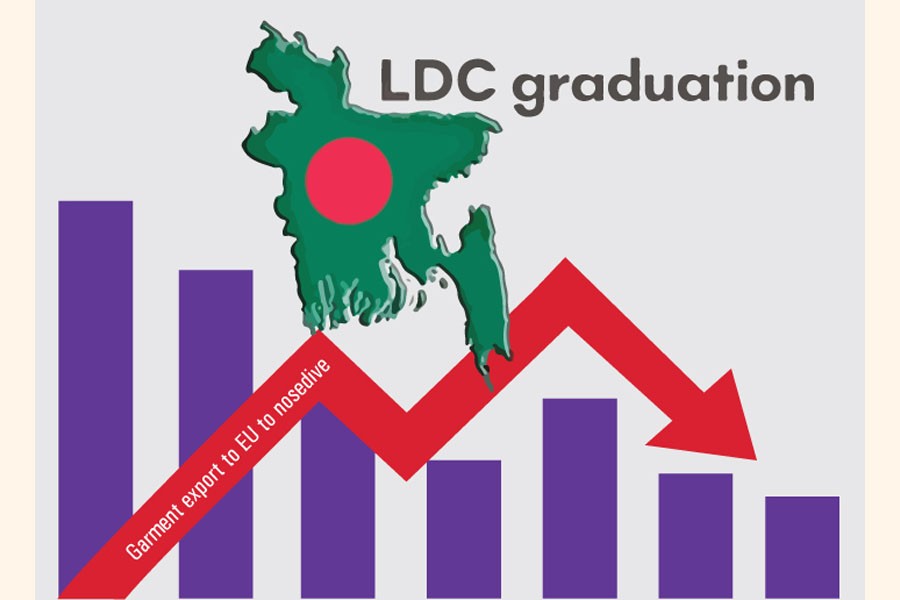
After decades on the global list of the poorest economies, Bangladesh is now set to cross an important economic threshold as it prepares to graduate from the Least Developed Country (LDC) category in November, 2026. This status change follows the country meeting all three United Nations graduation criteria including per capita gross national income, the human assets index and the economic and environmental vulnerability index on two consecutive occasions. While this progress reflects years of steady growth, graduation also brings in new challenges, particularly the phasing out of international support measures that have played an important role in that journey. Acknowledging this concern, the United Nations General Assembly resolution 59/209 emphasises that graduation must not derail development and urges a carefully managed transition to minimise the fallout from the loss of LDC-specific privileges.
The economic transformation that has paved the way for this graduation is hard to dispute. Over the decades, Bangladesh has undergone a fundamental shift in its economy, with agriculture's share of GDP falling from nearly 60 per cent in the early 1970s to just 11 per cent in 2022-23. Over the same period, merchandise exports expanded dramatically, rising from less than two billion dollars in the early 1980s to more than 43 billion dollars in 2022-23, driven largely by the export-oriented readymade garments sector. Today, Bangladesh is the world's second-largest apparel exporter, supplying more than a tenth of global demand.
This economic progress has been recognised on its achievement of various international milestones. In 2015, Bangladesh transitioned from low-income to lower-middle-income status according to World Bank classifications. This was soon followed by meeting the criteria for LDC graduation in 2018 and again in 2021, and the UNGA subsequently decided that Bangladesh's graduation would take effect on 24 November 2026 following a five-year preparatory period.
Graduation, however, will fundamentally reshape the external conditions under which these gains were made. This is because, unlike most least developed countries, Bangladesh has been the single largest beneficiary of LDC-specific international support measures, particularly unilateral trade preferences. Nearly three-quarters of its merchandise exports currently enjoy LDC-related tariff preferences. In major markets such as Australia and the European Union, more than 90 per cent of Bangladesh's exports enter duty-free, while in Canada, the Republic of Korea and the United Kingdom the share exceeds 80 per cent. The readymade garment sector, which has been the main engine of this preference-driven export growth, is therefore likely to face significant changes in importing countries' trade regimes after graduation, with tariffs rising sharply.
The World Trade Organisation has estimated that the loss of preferential market access could reduce Bangladesh's exports by more than 14 per cent. This risk is especially troubling because the country's economic transformation has so far relied heavily on a narrow comparative advantage built on low wages, limited regulation and cost minimisation. Graduation now makes it imperative for Bangladesh to move away from a trade-preference-dependent, low-wage export model and towards one grounded in higher productivity, innovation and quality, rather than price competitiveness alone.
The most immediate challenge centres around trade preferences, especially in the European Union, Bangladesh's largest export destination. RMG sector has prospered in the EU taking advantage of the EU's Everything But Arms (EBA) facility designed for LDCs. After graduation, Bangladesh will lose these EBA benefits and might be replaced by standard GSP for which tariff preferences are limited. Another option is to apply for the GSP+ scheme which offers duty-free access to 66 per cent of EU tariff lines including textiles and clothing. Even then, Bangladesh's apparel exports could still be subject to EU safeguard measures as the country already accounts for a large share of GSP-covered apparel imports. In such a scenario, Bangladeshi clothing exports to the EU could lose all tariff preferences and face an average duty of around 11.5 per cent.
Such an outcome would place Bangladesh at a significant disadvantage relative to competitors. Vietnam, for example, already benefits from a free trade agreement with the EU under which apparel tariffs are being phased out. By the time Bangladesh completes its transition period, Vietnamese garments are expected to enjoy zero duty access, creating strong incentives for buyers to shift sourcing away from Bangladesh. This risk of trade diversion is real and could undermine employment in a sector that employs millions, particularly women, and forms the backbone of the country's manufacturing base.
Any access to GSP preferences after LDC graduation will come with far more demanding rules of origin. For non-apparel products, exporters will be required to achieve at least 50 per cent domestic value addition while apparel exports will need to meet a double-stage transformation requirement, assuming the relevant safeguard provisions are amended. Although Bangladesh has built relatively strong backward linkages in knitwear, the woven garment segment remains heavily reliant on imported fabrics. As a result, complying with stricter origin criteria will be difficult without substantial investment in upstream industries or adjustments to the rules themselves. Moreover, all preference schemes are conditional and can be temporarily suspended if trading partners conclude that commitments related to labour standards or human rights are not being adequately upheld.
These requirements for double transformation in apparel and high domestic value addition for non-apparel exports are quite stringent. Under the current global system driven by value chain-led trade where countries specialise in just one or a few components of the overall production of final items, fulfilling such high rules of origin requirements is extremely difficult, especially for capacity-constrained countries transitioning out of LDC status.
At this stage, it is clear that Bangladesh is only partially prepared for graduation and remains far from insulated against its risks. The country has repeatedly defied expectations in the past, but the challenges it will face in 2026 are qualitatively different from those encountered before. This is because the heavy economic concentration in the ready-made garments sector that previously fuelled rapid growth now emerges as a key vulnerability. Graduation, therefore, should be seen not as an endpoint but as a deadline. Whether it serves as a springboard towards a more resilient and sustainable economy or becomes a source of significant disruption will hinge on the urgency, depth and seriousness with which policymakers address the post-LDC realities.
showaib434@gmail.com
© 2026 - All Rights with The Financial Express

