 Violation of traffic law by motor vehicles has been a common phenomenon in Dhaka and other busy cities of the country. Vehicles are often driven against the designated flow of traffic or on roads they are not supposed to ply. Such violations were once an occasional act of impatience or ignorance, but now they have alarmingly turned into a routine practice for many. Public transports like buses, taxis, auto-rickshaws, and unauthorised electric tricycles are not the only culprits, private vehicles run by influential people like political leaders, government officials, and even members of law enforcement agencies flout traffic law, clogging intersections, aggravating traffic congestion, and exposing the fragile foundation of our traffic enforcement system. During any drive against traffic law violation, the authorities invariably discover cases of law infringement by senior officials or their drivers. It seems we, as a nation, have given traffic law violations an institutional shape. If it is not so, how can the police who are duty-bound to enforce law, drive vehicles without any registration. The way unregistered police vehicles - cars and motorcycles -- ply in the city will make anyone draw a conclusion that the police do not consider it any violation of law or consider them above law. Police personnel use the vehicles for official purposes and to serve people, not for personal purposes, but the fact remains that the relevant law
 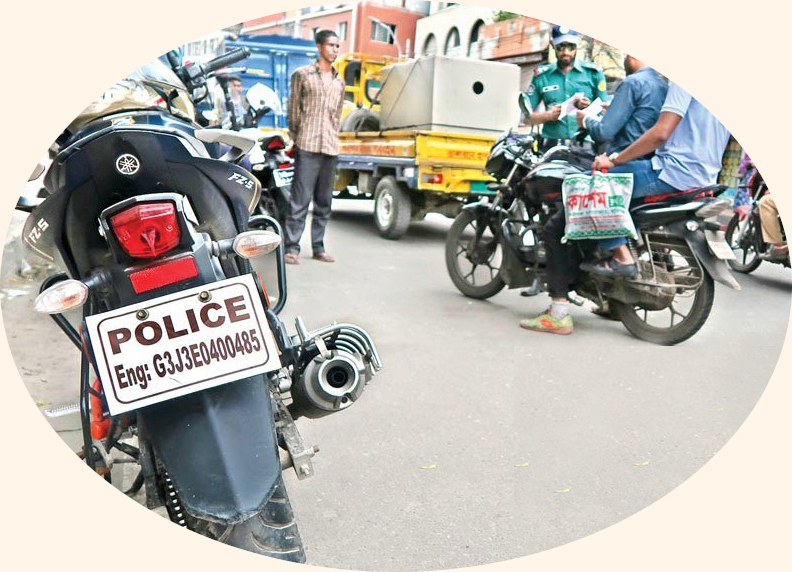 does not permit such use. The Road Transport Act 2018, the main legislation regarding the road transport system and traffic management, has not given the police any exemption from the provision of the law concerning registration of vehicles. Section 16 of the Act stipulates that "no person or owner of a motor vehicle shall drive or give permission to drive a motor vehicle on roads, highways or public places without a registration certificate." Section 72 of the same law provides for the punishment of the offence. It says, "If any person violates the provisions of section 16, the violation shall be an offence, and for that, he shall be punished with imprisonment for a term which may extend to 6 (six) months, or with fine which may extend to 50 (fifty) thousand taka, or with both."
Bangladesh's record on adherence to rule of law is far from satisfactory. It is among the worst performing countries of the world in the field. The country ranks 127th among the 142 countries surveyed by the Global Justice Project, an international civil society organisation, in the rule of law index with 0.39 score on a scale of 1. Traffic law is no exception to the overall rule of law enforcement. Still members of the public sometimes face penalties for violation of traffic law, but it is rare for anyone in the government, particularly in law enforcement agencies, to face penalties for the offence. It is obvious that law enforcement agencies flouting traffic law will act as a disincentive for citizens to abide by the law. In today's world nobody will accept that some people are more equal than others in the eye of law.
To stop movement of unregistered vehicles, a combination of strong enforcement, policy measures, and public awareness is necessary. The government must introduce a strict, transparent, and accountable framework to this end. The Ministry of Home Affairs should issue a clear directive prohibiting all police personnel--- on or off duty ---from using unregistered or improperly registered vehicles. Police personnel found using unregistered or improperly documented vehicles must be subjected to the same fines, seizures, and legal action as private individuals
pay or face.
rahmansrdk@gmail.com
© 2026 - All Rights with The Financial Express

