The 13th parliamentary elections, slated for February 12, 2026, mark a watershed moment in the country's history. The election is crucial as it is expected to pave the way for Bangladesh's return to democracy after more than a decade and a half of authoritarian rule under the Sheikh Hasina-led Awami League government, while also bringing an end to the nearly two years of what many describe as "mob rule" under the post-uprising interim government led by Dr Muhammad Yunus. The election assumes added importance because it will also shape the future trajectory of the country's politics, system of governance and constitutional order, as a referendum on constitutional reform is going to be held alongside the polls.
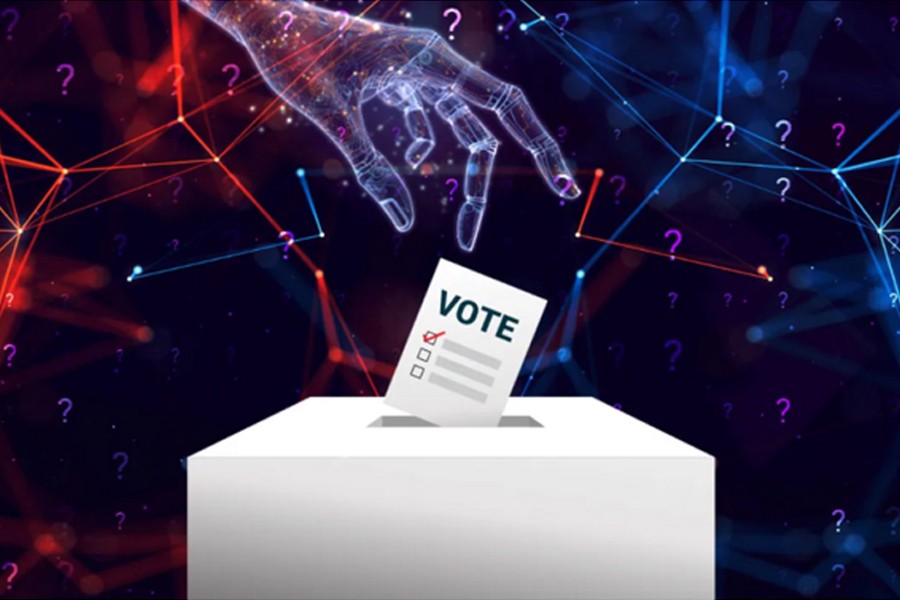
Given the far-reaching implications, elaborate and foolproof measures are expected to uphold the credibility of the election as free, fair and transparent. Only time will tell to what extent the Election Commission (EC) could prove its effeciency by preventing vote rigging, ballot stuffing and other irregularities, while ensuring fairness and transparency. It is, however, deeply concerning that attempt to manipulate the election has already begun on the digital front by misleading public perception. Social media sites are flooded with hundreds of artificial intelligence (AI)-generated political campaign videos and images. These videos are creating quite a stir on the social media, garnering millions of views. Few realise that these images and footage are actually 'deepfakes'.
Deepfakes refer to near-real images, audio, or videos generated using AI. Deepfakes were initially created for comic or entertainment purposes, but today they are increasingly being used for political propaganda and character assassination. There are still some clues to identify deepfakes, but with the advancement of technology, it is feared that, it will become increasingly difficult to tell facts from deepfakes.
Adding to the problem is the growing trade in fabricated online reactions such as "like," "love," and "haha" on social media posts. An investigative report by a leading English newspaper revealed how such reactions are being purchased online and deployed to attack opponents and manufacture artificial support.
Beyond automated bots, political parties and certain right-wing elements are also deploying so-called 'bot bahini": clusters of diehard supporters who are mobilised to swarm specific social media posts with reactions or abusive comments as directed. Through the combined use of automated bots and coordinated online gangs, these groups ridicule posts that deserve serious public consideration while artificially amplifying their own narratives.
This practice creates several problems. First, it can be deeply demoralising for those who share posts in good faith. Second, it misleads users who judge content not by its merit but by the volume and nature of reactions and comments, which are often far removed from reality.
With elections approaching, the abuse of deepfakes and the deployment of both online and human bots have reached alarming levels. The country's low digital literacy rate makes it all the more difficult to tackle this digital manipulation, as many users mistake fabricated content for authentic material and coordinated activities for genuine public engagement.
Bangladesh is no stranger to political propaganda, lies, and falsehoods used to garner support or malign opponents. But political rhetoric aimed at outsmarting rival candidates is one thing; creating outright fake videos that depict individuals saying things they never said is quite another. It has taken the propaganda machine to a new, frightening height. Deepfakes are being used to malign rival candidates, promote hate speech as well as to justify mob lynching. Who can say that deepfakes will not be used to sow confusion and mistrust over vote casting or counting, misleading the public and raising a serious risk of conflict?
Taking this into cognizance, the Election Commission has included AI-related guidelines in the electoral code of conduct. The draft National Artificial Intelligence (AI) Policy emphasises transparency, accountability, the protection of human rights, and the regulation of high-risk AI applications. However, a significant gap remains between policy and ground reality. With the election approaching, social media are flooded with AI-generated malicious videos. This is raising concerns about the interim government's ability to manage the situation.
For elections to be fair, people need to know the truth. When they have the facts, they can make up their minds about who they want to vote for. But when they are systematically fed falsehoods, the very foundation of free and fair elections is undermined. The creation and dissemination of AI-generated content designed to portray a particular politician in a negative light to influence voter choice is tantamount to election fraud, as it subverts the will of the people.
Today, a large segment of the population relies on social media for news and political information. This has made it easy for vested interests to spread falsehoods, manipulate narratives, and mislead voters through fabricated or distorted content. Over time, such nefarious activities are likely to increase, making it increasingly difficult for voters to form informed opinions amid a flood of misinformation and disinformation. Many therefore fear that AI-generated deepfakes could weaken, and ultimately demolish democracy, offering space for authoritarian takeover.
This highlights the grim challenge posed by AI. The question now is whether we will allow AI to drive our political destiny, or confine it to its rightful place. Technological advances must be embraced, but their dark and malicious sides must be carefully monitored. The Election Commission's inclusion of AI guidelines is a necessary first step, but no policy document can address the crisis without effective enforcement, cooperation from political parties, and the promotion of digital literacy among citizens. Without such measures, the sanctity of the ballot may be lost. The voters may still cast their votes, but the minds that guided their decision could well be shaped through digital manipulation.
aktuhin.fexpress@gmail.com
© 2026 - All Rights with The Financial Express

