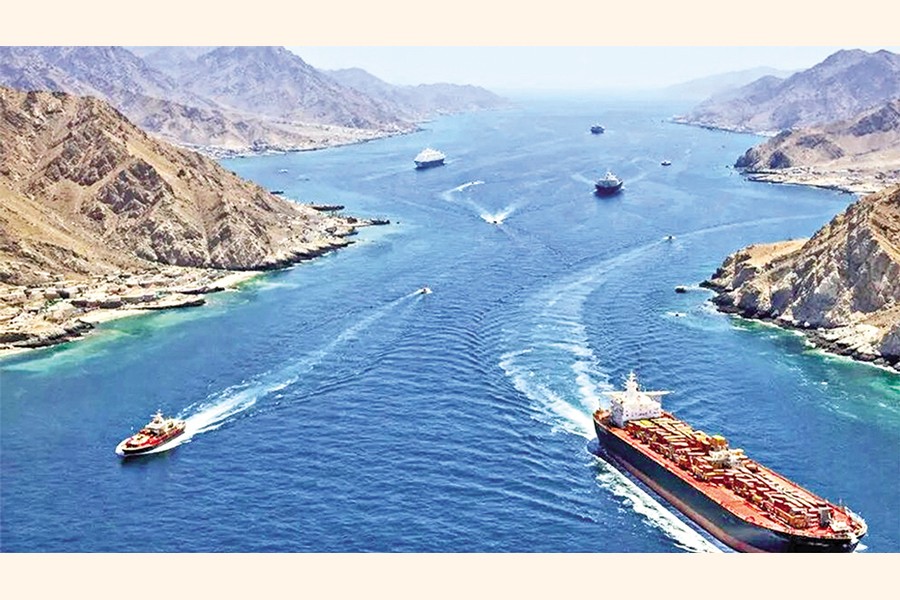
 The strait of Hormuz
 Prime Minister Tarique Rahman has instructed the home minister to adopt stern measures against oil smuggling as well as creation of any artificial energy crisis. For a country critically dependent on imported fossil fuel, such strict directive from the government's highest level is a welcome step. And that is particularly so when, according to the prime minister himself, there is already sufficient stock of oil in the country. Therefore, there should be no reason to be worried about oil shortage. Such pronouncements from the government to reassure the public about the stock and supply situation of fossil-based oil, a vital source of energy, is obviously prudent and well-timed. This should dissuade the people from panic buying of fuel oil. Though the public may be made to see the reason, the traders may not be. So, it is believed, the government would not confine its directive to words only. For hoarding of the fuel oils started as soon as both genuine and fake pundits started to make forecasts about the impending war in the Gulf and its immediate fallout --- scarcity of energy and a sharp rise in its price in the global market. The media, the mainstream as well as the social, were and still are abuzz with the rumours, speculation and also some reports that were not fake. Under the circumstances, an unscrupulous and greedy section of traders cannot be expected to miss such a once-in-a-lifetime opportunity to make windfall gains out of public misery!
And so, stockpiling of oils began to take place not only at the secret corners of oil pumps, shops, houses or below the ground. Hoarders, according to some reports, even hid now-scarce flammable substance in the odd places like cowsheds. No doubt, it was to the utter amazement of the innocent graminivorous, hooved quadrupeds! The state-owned news agency 'Bangladesh Sangbad Sangstha (BSS)' was the source of the report that was carried by one of the English dailies on the 14th of this month (March). It went like this: 'The Directorate of National Consumers' Right Protection (DNCRP) has seized 1,500 litres of petrol and octane illegally stored in a cowshed in the Chinakhara area under Sujanagar upazila of Pabna'. Needless to say, the said act of hoarding took place amid the government-run drive against illegal stockpiling of fuel oils. So, one should not be surprised if the hoarders return to their illegal activities as soon as the drive is over. This is a never-ending cat and mouse game in which the culprits always win. So, to get around this predicament, the punishment for hoarding should be harsh and the raid should not be on-again, off-again, but a relentless one. Also, those in charge of the raids need to be above board.
In fact, crisis of energy or for that matter fuel oil including Liquefied Natural Gas (LNG), at the moment, is not a local, but a global concern. In the global market, oil is now the most volatile commodity. As of March 29, Brent crude oil was trading at approximately US$112.57 per barrel. Fuel oil (heating oil) prices were recorded around US$4.50 per US gallon. Notably, one barrel is equivalent to 42 US gallons. This obviously marks a significant rise in the prices of fuel oils in the market. The reason, as everybody knows, is the unjust war that the USA and Israel have imposed on Iran and, as a result, the de facto closure of one of the world's key oil route, the Strait of Hormuz, by Iran in retaliation. Notably, the Strait is the only passage for any vessel that in peace time in the past would use to load cargoes like oil, LNG or fertilizers from the ports of the Persian Gulf countries and pass through the Strait of Hormuz and then out into the open sea. But the passage through both the Persian Gulf and the Strait is now under the strict control of the Iranian forces.
Countries that Iran considers friendly to it can now use the Gulf and the Strait for the passage of their ships. Fortunately, Iranian authorities consider Bangladesh a friend. Now as there is no end in sight of the war and the US has been issuing one ultimatum after another demanding that Iran open the Strait of Hormuz or face more devastating consequences like fresh assaults on its vital infrastructures and Iran countering those threats with promise of inflicting equal damage to US assets and those of its allies in the Gulf states, it cannot be said the Gulf, at the moment, is safe for use especially by a peaceful country like Bangladesh. That is true, even if, Iran might allow any Bangladesh-owned vessel to pass through the critical oil route. That is because the vessel might inadvertently be caught in crossfire as the entire Gul region is now a war zone. As it happens in any war, the ports and the fuel terminals either get damaged or are shut down to avoid any damage or dislocation. As reports go, a number of oil and gas facilities owned both by Iran and some Gulf countries have suffered considerable damage. In that case, it would be wise for Bangladesh to avoid the Strait of Hormuz for sourcing its energy like oil and LNG until the situation stabilizes in the Middle East. Meanwhile, Bangladesh might look to the East, especially the southeast Asian countries like Malaysia, Brunei, Indonesia and Vietnam which produce and refine significant amount of oil. Countries like Malaysia, Brunei, Indonesia and Thailand also produce natural gas.
However, when it is about energy, the country needs to have a long-term strategy. As we are basically an importer of energy, especially of fossil oil, the policy should be one of building enough stock so the nation can go without importing the vital commodity for at least six months. China, for instance, has an estimated 1.2 to 1.3 billion barrels of crude oil in combined strategic and commercial storage. Consider that China is not entirely dependent on imported oil to run its economy. In fact, renewable energy accounts for more than 60 per cent of China's total installed power generation capacity. In that case, Bangladesh should be more serious about building its energy storage capacity to survive unforeseen storms like the present one in the global energy market.
sfalim.ds@gmail.com
© 2026 - All Rights with The Financial Express

