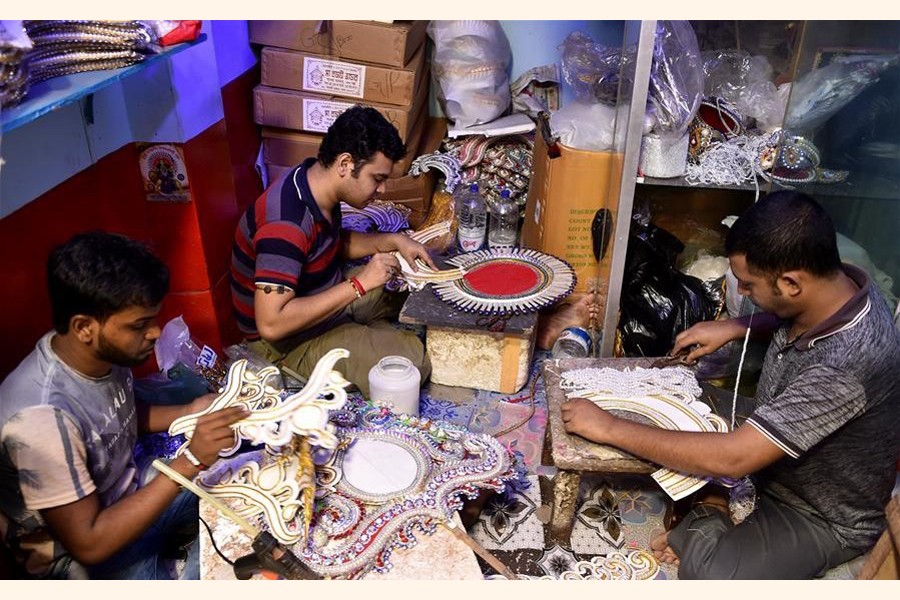
 Artisans make decorations for the Durga Puja festival in Dhaka —Agency Photo
 For Bengalis, Sarodiyo Durga Puja is not just a religious festival. It is a season of colour, music, artistry, and togetherness. Across towns and villages, city streets and riverbanks, the goddess is welcomed home with fanfare, her clay idols crafted lovingly by artisans who inherit centuries-old traditions. In Bangladesh, where Hindus form the country's largest minority, Durga Puja has always carried a special resonance.
Members of the Hindu Community have been celebrating the festival for time immemorial openly and joyfully, with their Muslim neighbours joining them in crowds at the mandaps. It became more than a festival for one community -- it grew into a national celebration, a showcase of Bengal's composite culture, and a symbol of the communal harmony that has been the lifeblood of this nation.
But in the past two decades, this spirit has been tested. Isolated incidents of vandalism or violence at Puja mandaps -- sometimes fuelled by rumours, sometimes by mischief -- have drawn disproportionate attention. Although statistically nominal in a country with tens of thousands of Puja celebrations, these incidents revealed a crack, however small, in the otherwise solid edifice of communal coexistence. Opportunistic political forces seized on these fissures, amplifying them to claim that Bangladesh was unsafe for its minorities. That narrative was always exaggerated, but it has gained traction in the age of digital manipulation.
Since the formation of the interim government in 2024, this propaganda has intensified. Social media platforms have been flooded with fake images and doctored videos purporting to show attacks on Puja mandaps. Many of these originated from sources outside Bangladesh but were circulated locally to inflame tensions. The malicious campaign was clear: to tarnish the country's image, to instil fear in the Hindu community, and to suggest that the state is unable -- or unwilling -- to protect its minorities.
This year's Durga Puja comes with a heightened responsibility. It is not just about the celebrations but also about safeguarding a tradition that embodies Bangladesh's core identity.
Durga Puja is the largest religious and cultural festival of the Bengali Hindu community. The preparations begin at least a couple of months ahead of the event. More than 30,000 Puja mandaps are expected to be erected this year.
But what makes Puja unique here is its inclusivity. Muslim neighbours visit the mandaps, share sweets, and join cultural programmes. Local businesses contribute to the celebrations. Politicians of all parties attend pandal inaugurations. The festival thus transcends religious boundaries -- it is a marker of national identity. As one elderly devotee in Dhaka once remarked: "When the dhak drums beat, we all belong to the same rhythm."
This inclusivity is not accidental; it is also rooted in the liberation struggle. The spirit of 1971 was secular and pluralist, rejecting the communal politics of the past.
Yet history is never static. Over the past 20 years, communal harmony has faced new pressures. Attacks on Puja mandaps in certain districts -- sometimes linked to local land disputes, sometimes instigated by extremist groups -- have shaken confidence. Even when such incidents were localised and rare, they were seized upon by vested quarters to portray a broader pattern of insecurity.
In reality, for every isolated act of vandalism, there were hundreds of examples of solidarity: Muslim neighbours guarding mandaps at night, local youth groups ensuring order, district officials mobilising resources to support Puja committees. But those positive stories rarely went viral. Instead, sensationalist or fabricated claims dominated headlines and feeds.
In recent years, the weaponisation of social media has made the problem worse. A single manipulated video can trigger outrage across communities, eroding trust. Last year, a widely circulated photograph purporting to show an idol desecrated in Bangladesh was later traced to a festival in another country altogether. By the time the fact-checks came, the damage was already done.
Faced with this challenge, Bangladesh's interim government has moved decisively. Chief Adviser Professor Muhammad Yunus, in a recent dialogue with Hindu community leaders, reassured them: "Durga Puja is not just the festival of one community -- it is the festival of all Bangladeshis. Your celebrations are part of our shared heritage, and it is our solemn duty to ensure they take place with joy, dignity, and full security."
His words reflect not only empathy but also a recognition that the festival's protection is a test of Bangladesh's democracy itself.
The Home Adviser echoed this commitment with a more practical emphasis: "We have deployed additional forces at all Puja mandaps across the country. Coordination cells are working at district and upazila levels. Intelligence monitoring has been heightened to detect and prevent any attempt to create mischief."
Such statements are welcome. But they must be backed by visible action -- police patrols, swift responses to rumours, accountability for offenders. Security cannot be symbolic; it must be effective.
What gives Bangladesh resilience, however, is not only state actions but the moderation of its people. Despite provocations, the majority of Bangladeshis remain committed to communal harmony. In village after village, Muslim households contribute to Puja funds. In towns, imams and priests exchange visits. Local committees comprise members of multiple faiths.
This is the real Bangladesh: one that refuses to be divided. As civil society voices have argued, the spirit of liberation was built on pluralism. To undermine that is to undermine the nation itself.
It is worth noting that Durga Puja in Bangladesh stands out compared to some other South Asian contexts. While communal violence has scarred parts of India in recent years, and political polarisation has cast shadows over religious festivals in Nepal and Sri Lanka, Bangladesh's Puja has largely retained its inclusive character.
This difference should be celebrated, but not taken for granted. The same forces that fractured harmony elsewhere -- fake news, opportunistic politics, religious extremism -- are at play here too. Vigilance is therefore essential.
Political leaders across the spectrum must resist the temptation to instrumentalise religious events. Elections may loom, but exploiting communal sensitivities for electoral gain is a dangerous path that risks unraveling decades of harmony.
This year's Puja will unfold against the backdrop of Bangladesh's democratic transition. The interim government has promised free and fair elections. Ensuring peaceful Puja celebration is therefore not only about protecting a minority festival; it is about proving that the state can guarantee equal rights and dignity for all citizens, regardless of faith.
In that sense, the festival is a litmus test. If it passes peacefully, it will send a message to the world that Bangladesh's pluralist spirit remains intact, despite the storms of propaganda and the pressures of transition.
The responsibility lies with the state, yes, but also with every citizen. Bangladeshis must stand together, as they have for decades, to ensure that the beat of the dhak drums this October is not drowned out by discord but amplified by solidarity.
As the Chief Adviser put it, "Your celebrations are part of our shared heritage." Protecting that heritage is not just about the safety of one community. It is about the safety of Bangladesh itself.
mirmostafiz@yahoo.com
© 2026 - All Rights with The Financial Express

