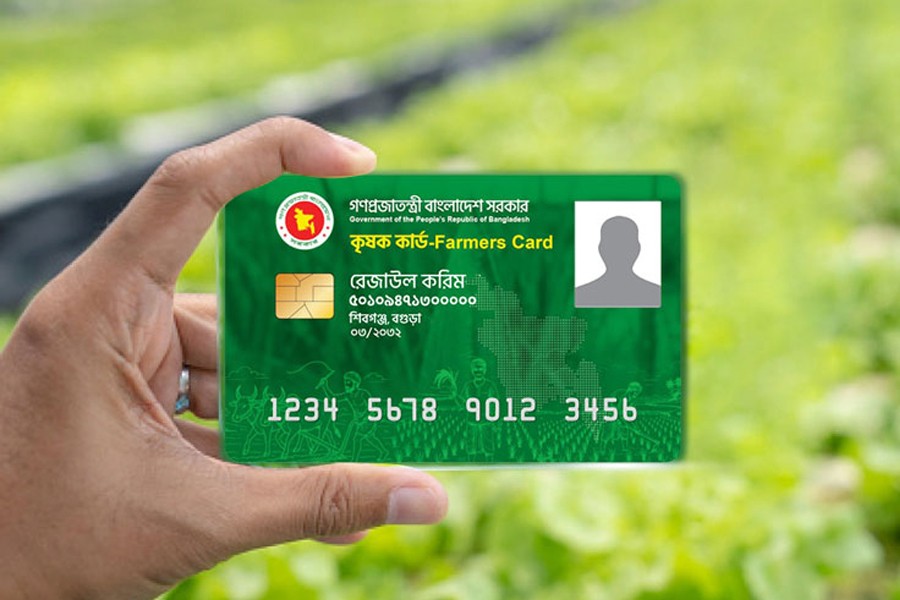
The transformation of Bangladesh from a food-deficient nation into a near self-sufficient one in food production is an achievement built on the sweat and toil of smallholder farmers. But the list of farmers' woes are longer. Instances of farmers being deprived of agricultural subsidies, denied easy access to loans, or being shortchanged when purchasing essential agricultural inputs such as seeds and fertilisers are all too common. Against this backdrop, the government's initiative to introduce 'Farmers Card' could be a powerful tool to reach farmers directly, if it is implemented at scale and genuine farmers are the ones who receive it.
The programme was formally inaugurated by Prime Minister Tarique Rahman on Pahela Baishakh in Tangail. On the first day, 22,065 marginal farmers across 11 upazilas received their cards, adding to the joy of their New Year celebration. The government aims to extend this initiative to 16.5 million farming families nationwide over the next four years. Notably, apart from farmers, fishermen, livestock raisers, and salt cultivators are also included under its coverage. The government has reportedly earmarked an allocation of Tk 6.81 billion to implement the programme, aiming to modernise agricultural support system, as part of its broader national development priorities.
Primarily, the Farmers Card will function as an identity credential designed to ensure authenticated access to subsidies and services. Cardholding farmers will receive a range of benefits, including access to agricultural inputs and irrigation at fair prices, easier access to credit, and the use of machinery at subsidised rates. In addition, they will benefit from government incentives, weather updates and market information via mobile services, training opportunities, and expert advice on crop diseases and pest control. Provisions for agricultural insurance and fair pricing mechanisms for selling produce further enhance the scheme's potential to address long-standing structural challenges in the sector.
A key feature of the initiative is the provision for each cardholding farmer to open a dedicated account with Sonali Bank, into which government subsidies will be deposited directly. Furthermore, the card's integration with secure digital payment technology of VISA is expected to facilitate a cashless ecosystem for disbursing support. This direct transfer mechanism could significantly reduce the long-standing influence of intermediaries who have often diverted benefits meant for farmers.
Under the scheme, farmers have been classified into five categories based on land size, such as landless (less than 5 decimals), marginal (5-49 decimals), small (50-249 decimals), medium (250-749 decimals), and large (above 750 decimals). Initially, landless, marginal and small farmers will be brought under the incentive scheme. They will receive around Tk 2,500 annually as direct financial assistance to meet essential input needs.
However, the success of this ambitious project hinges on overcoming several critical challenges. Foremost among them is the accurate identification of genuine farmers. In many areas, official database of farmers remain outdated, which is likely to create a scope for undeserving individuals or middlemen to infiltrate the scheme if proper verification mechanisms are not enforced.
If past experience is anything to go by, a significant share of government incentives and subsidies intended for farmers is often marred by corruption and irregularities. As a result, farmers are often forced to purchase fertiliser and pesticides at prices higher than those fixed by the government. Likewise, it is alleged that government subsidy for procuring agricultural farm machinery failed to reach intended beneficiaries. In many cases it was found that intermediaries procuring farm machineries at subsidized rate, and then renting out the equipment to farmers at higher costs. Unless these systemic loopholes are addressed through proper monitoring, transparent beneficiary selection and strict accountability measures, the promise of the farmers' card risks being undermined as well.
Only time can tell to what extent the introduction of Farmer Card will be able to end the deprivation of farmers. The card, after all, is only a medium; its real value will depend on sound policy design, a corruption-free implementation process and the effective use of technology. If implemented properly, it could streamline the delivery of subsidies and incentives, making them more accessible and hassle-free, while also bringing much-needed discipline to agricultural credit distribution. However, a crucial question remains: how will the scheme ensure that farmers are getting a fair price for their produce?
If the government is serious about addressing the long-standing issue of farmers being deprived of fair prices by curbing the influence of middlemen, it would do well to introduce a Minimum Support Price (MSP) for major crop varieties each season. MSP is the minimum price paid by the government when it procures any crop from the farmers to protect them from price fluctuations. MSP is set considering production costs, market demand, and other economic factors. Successful implementation of an MSP can ensure financial security for farmers and shield them from losses during market downturns.
To effectively implement the MSP mechanism, agricultural collection centres, along with specialised cold storage facilities, should be established at the upazila level or near major production hubs. These centres will collect surplus crops from farmers based on the MSP or prevailing market rates. Collected produce can then be supplied to other areas, stored in cold storage facilities, or exported.
Ultimately, the farmer card should be viewed not merely as an identity document, but as a commitment of the state to those who sustain the nation's food security. Its success will hinge on the integrity and transparency with which it is implemented. If backed by robust monitoring, zero tolerance for corruption and necessary reforms such as fair pricing mechanisms and improved market infrastructure, the initiative could mark a decisive shift in addressing farmers' long-standing grievances. Otherwise, it risks becoming yet another well-intentioned scheme that falls short in practice. The choice, therefore, lies in execution and in whether policymakers are willing to match ambition with commitment and accountability.
aktuhin.fexpress@gmail.com
© 2026 - All Rights with The Financial Express

