A figurative artwork that portrays indepth the poetics of line and the politics of imagination provokes thought on human destiny here and beyond on a universal scale. Linear images in the paint-and-brush work on display takes a viewer with an art-connoisseur's eyes into what is real, what surreal around. The sum total falls in a form rich in meanings.
The exhibition, titled Rekha Chitra: The Poetics of the Line and the Politics of the Imagination, is currently on view at Kalakendra on September 5-27, 2025. The art show presents reputed artist Shishir Bhattacharjee at his most distilled yet expansive. He is known for his sharp political satire and grotesque figuration in the Bangladeshi contemporary art scene.
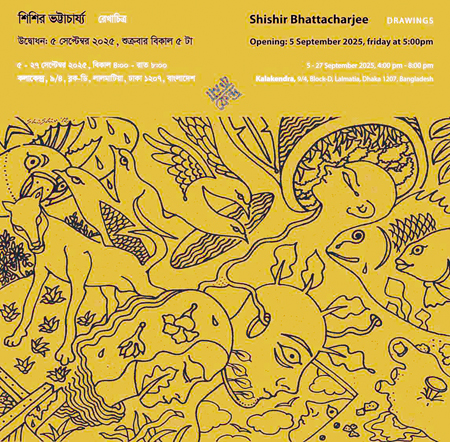
The artist here pares his practice down to the elemental medium of drawing. The works-executed in pen, marker, and ink on sketchbook paper -- emerge not as premeditated compositions but as spontaneous fragments of thought, executed across years and contexts. This very fragmentariness becomes a method, a refusal of closure, a way of positioning drawing as both process and proposition.
The autonomy of line is a salient feature. One is struck first by the linearity of Bhattacharjee's practice. The line in these works is not subordinate to form rather generates form. A single contour transforms seamlessly into multiple entities -- hand into ray of sunlight, fish into human foot, eye into seed. The artist recalls Paul Klee's famous dictum that "a drawing is simply a line going for a walk". Yet his line does more: it wanders not only across the page but across registers of meaning, constantly destabilising fixed categories. This recalls Gilles Deleuze's notion of the "line of flight" -- a line that escapes, deterritorialises, creates new possibilities of being.
Between surrealism and folk visuality: At the level of imagery, the works oscillate between surrealist automatism and indigenous visual idioms. A boy's bowed head dissolves into a face riddled with birds and insects, evoking dream-logic akin to André Masson's automatic drawings. Yet the schematic rendering and ornamental rhythm equally recall patachitra scrolls and Kalighat painting, with their insistence on line as narrative and decorative element. The juxtaposition places Bhattacharjee within a broader genealogy of South Asian modernism, where artists such as Jamini Roy and Zainul Abedin negotiated the tension between European avant-garde and local vernaculars.
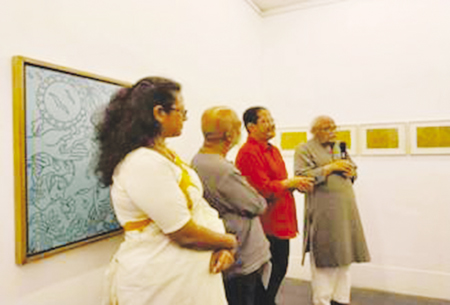
An interplay of dream, automatism, and the unconscious pervades the works. The artist himself admits: "I see with my eyes open, I see with my eyes closed, while sleeping, through dreams." This articulation situates the works within the surrealist concern with the unconscious. Breton's First Manifesto of Surrealism proposed automatism as a technique to bypass rational control. Bhattacharjee, however, transforms automatism into a deeply personal rhythm. His drawings capture what philosopher Gaston Bachelard called the oneiric image -- the image that emerges from reverie and dream, charged with psychic resonance but resistant to rational decoding.
Open work: The artist refuses to provide explanations, insisting instead that "the audience will see them as they will." This echoes Umberto Eco's theorisation of the "open work," which resists definitive interpretation and instead invites the viewer into an active process of meaning-making. Indeed, the works thrive precisely in this openness: a fish with human feet may be read as a humorous metamorphosis, a grotesque allegory of hybridity, or an ecological fable of mutation. The meaning is never fixed, always contingent.
The works embody what is conceived as the politics of imagination. While the drawings are playful, they are not devoid of politics of its kind. Bhattacharjee has long been a trenchant commentator on Bangladeshi society, and even here, in seemingly whimsical sketches, one senses echoes of larger concerns. The recurrent motifs of eyes, mouths, and insects suggest surveillance, consumption, and decay. The human figure constantly merges with nature-trees sprout from heads, rivers run through torsos -- evoking both ecological interdependence and vulnerability. In an era of climate crisis, these images resonate with urgency: they are allegories of entanglement, reminders of what philosopher Donna Haraway calls "staying with the trouble."
Intimacy and universality are dominant as straits. The exhibition's strength lies in its intimacy. These are not monumental canvases engineered for spectacle -- they are sketches, often with visible notebook folds, modest in scale yet rich in suggestion. John Berger once wrote: "A drawing is an autobiographical record of one's discovery of an event." In this artist's case, the "event" is imagination itself -- its unpredictability, its excess, its capacity to reconfigure the visible. By sharing these private reveries, he transforms the personal into the collective. "I am a human being. So, this is for all," he writes.
Ultimately, Bhattacharjee's drawings affirm the radical potential of the line-not merely as a formal device but as a philosophical and political gesture. They traverse dream and waking, folk idiom and avant-garde, intimacy and universality. In their modesty, they resist commodification; in their openness, they resist dogma. They remind us that imagination is not an escape from reality but a mode of engaging with it, differently.
In an art world often obsessed with spectacle, his quiet drawings insist on something more profound: that the simplest of gestures -- a line on paper -- can open worlds, unsettle certainties, and re-enchant the everyday.
Irina is an art critic and
former student, Faculty of Fine Arts,
the University of Dhaka
© 2026 - All Rights with The Financial Express

