 Atacama Desert
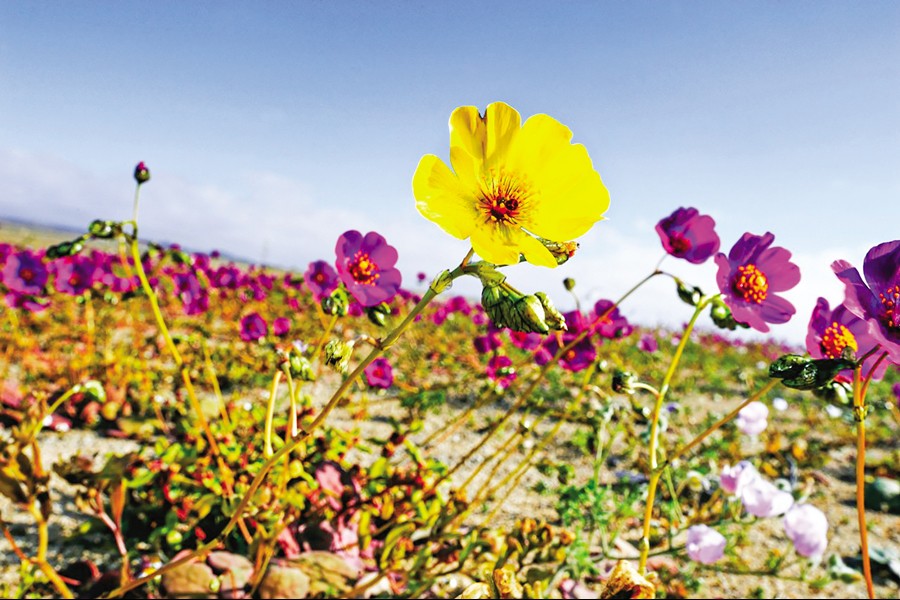
 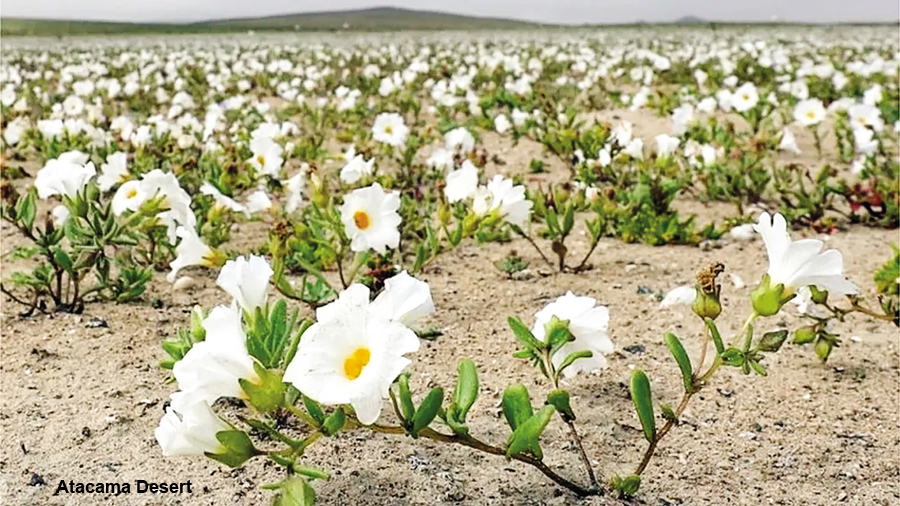 Chile's Atacama Desert, one of the driest places on the planet, has transformed into a rare show of flowers with invitingly vivid colours. Courtesy of heavy rains during the winter months of June to August, the desert has come to life with more than 200 species of wild flowers competing with each other to put up a show of colours. The arid region usually receives 2.0 millimetres (0.08 inches) of rainfall a year but this year it received as high as 60 millimetres (2.3inches) of rain in July and August. Yet mere heavy rain cannot make the magic happen. Four key factors---water, temperature, daylight and humidity ---must have a meeting point activating the seeds to germination. Once this happens, the flower plants grow into brightly coloured blossoms.
Sitting in both northern and eastern hemispheres north of the Equator, Bangladesh is not an arid geographic entity. Rainfall here is moderate to heavy. But this year the month of Aswin, the second month of Autumn on the Bangla calendar, has been quite unusual for the downpours. Autumn here is a sprightly season for clear blue sky with patches of white clouds like huge cotton strips gliding past. But this year is an exception with the sky remaining overcast and rain falling pitter-patter at any time unnoticed. Apart from such light rains, heavy downpours have also become common. Aswin is about to come to an end and Hemanta, the grey and dusky season, made immortal by poet Jibananda, is about to take over.
There is no doubt, this Autumn will be remembered for the rains. Officially, it is likely to be the wettest Autumn ever. The seasonal transformation is more than evident. Nothing of the order of Chilean desert flowering has happened in this country accustomed to receiving excessive watery gift from heaven. But at least the phenomenon has to be studied by meteorologists and the changing patterns recorded for studies. Climate change-induced weather phenomena are going to shape living and livelihoods in a new mould. The Autumn is more like a rainy season now. Its import must not be overlooked.
Weather and climate have become increasingly unpredictable. How the Hemanta will turn out will unfold a new vista before the people here. If people have missed the Autumn in its regal freshness and clarity of celestial panorama, there is no knowing how the Hemanta (often called late Autumn) will unfold its treasure of mist and hidden mysteries. Will the rain continue throughout the next season as well? Or, it will be what it had been---a pale, subdued and dusky surrounding unlike the clear and transparent view of things of Autumn.
If the Hemanta sticks to its beaten path, presenting it in its sombre ambience that haunted poet Jibananda, there will be no complaint but if it appears in an unfamiliar shape, there will be apprehension of changes in Nature the people will hardly like. Climate change will demand more than the people are as yet ready to cope with. If the seasonal cycle breaks down with the winter and summer turning more hostile than before, the people here will have to come to term with the changes sooner than expected.
The Autumnal gift of kashphool (kans grass or katkin) was there but there were not the sharp and melancholic mid days with the oppressive sun setting the tone of making one absent-minded and nostalgic. People who delve deep into season's charms know that in the heart of the Autumn, there is a troubadour playing a tune of separation from something so dear to one's soul. Despite its clear and fresh setting, people miss something even unknown to them.
On that count, the opaqueness of the Hemanta is less accessible to most people. People with super sensitive minds like that of Jibanananda can immerse themselves in the mysteries of the season. The grass blades on which drops of mist gather and the haze that surrounds the horizon are there for all to see with the naked eye but to discover the mystery of a Hemanta night when an owl swoops on a rat, one must have a different eye---an inner eye. Thus the seasonal cycle's importance is more intrinsic to those who love Nature. In this respect Jibananda Das was a pioneer of redefining the closeness between man and Nature. Such appreciation is different from the evaluation of weather and climate by meteorologists. People who can connect with Nature should promote the connectedness for the sake of preserving at least the local environment.
© 2026 - All Rights with The Financial Express

