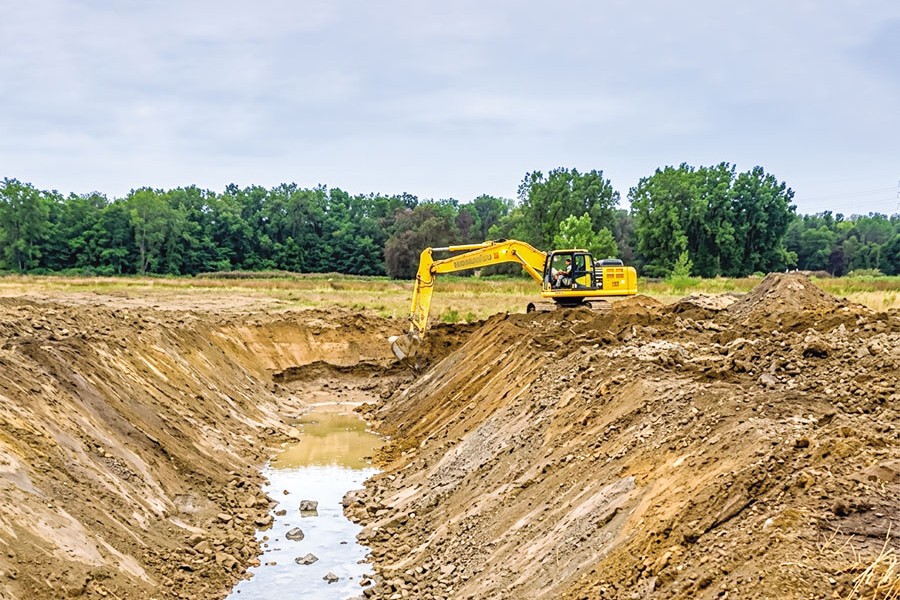
Prime Minister Tarique Rahman recently inaugurated the Khal Kata, or Canal Excavation Programme, promising to improve water flow, support farmers, and strengthen irrigation nationwide. This initiative reminds us of the widely popular canal excavation programme launched by his father, Shaheed President Ziaur Rahman, in the late 1970s, which boosted agricultural productivity, created rural employment, and inspired public pride. After 35 years, the question remains whether Khal Kata can deliver a lasting impact or repeat the limitations of its predecessor.
Following Bangladesh's independence in 1971, the country faced severe food shortages, flooding, and weak rural infrastructure. Ziaur Rahman's Khal Kata Programme sought to address these challenges by digging new canals and rehabilitating old ones to improve irrigation, drainage, and agricultural output. The immediate results were evident. Waterlogged fields became cultivable, villagers gained temporary jobs, often through food-for-work schemes, and communities took pride in participating in development efforts. Restored canals regulated water flow, reduced seasonal flooding, and enabled better crop cultivation. For a generation, Khal Kata symbolized grassroots development, linking infrastructure, agriculture, and employment in a single initiative.
However, many canals silted up within a few years, limiting long-term benefits. Experts cite several reasons. Without regular dredging, sediment quickly blocked canals. Local authorities often lacked resources and technical skills to maintain them. Villagers contributed labour but were not empowered to manage the waterways sustainably. Canal excavation was rarely integrated with broader irrigation, flood control, or river basin planning. Government funding for maintenance was limited after the initial phase, and Bangladesh's deltaic landscape, with shifting rivers and high siltation, naturally undermined short-term interventions.
Environmental considerations are critical for any revival of Khal Kata. Poorly planned canals can accelerate soil erosion, disrupt wetlands, reduce biodiversity, and alter groundwater recharge patterns. Modern programmes must account for sedimentation, changing river courses, and climate-related risks such as erratic rainfall and stronger floods. Integrating environmental safeguards, such as preserving wetlands and planting vegetation along canal banks, ensures that waterways are resilient and ecologically sustainable.
Local community ownership is another key factor. Historical experience shows that canals fail when long-term management is absent. Reviving Khal Kata today requires establishing water user groups, farmer associations, and local committees empowered to oversee maintenance, manage irrigation schedules, and prevent encroachment. Engaging villagers in planning and decision-making strengthens both the social and economic value of canal networks, ensuring that local populations benefit directly while protecting water resources.
Bangladesh can learn from international experiences. In the Netherlands, centuries of canal networks are maintained through coordinated water boards, combining government oversight with local stakeholder participation to prevent flooding and ensure irrigation. In India, the Pradhan Mantri Krishi Sinchai Yojana programme uses community irrigation committees to operate and maintain canals, ensuring equitable water distribution and farmer participation. Vietnam's Mekong Delta integrates canal management with aquaculture and wetland protection, balancing agriculture with environmental sustainability. In the United States, the Central Valley Project combines canal networks, reservoirs, and community water districts to provide irrigation, flood control, and groundwater recharge. These examples demonstrate that canal systems succeed when they are embedded in long-term planning, climate adaptation, environmental safeguards, and local ownership.
Modern Khal Kata projects in Bangladesh could generate significant socioeconomic benefits if designed similarly. Improved irrigation and drainage boost crop yields and food security. Reconnected water systems reduce flood damage and support fisheries and aquaculture. Groundwater recharge enhances water availability for drinking and farming. Multi-purpose canal networks can also provide transport pathways, recreational opportunities, and habitats for aquatic biodiversity. These benefits extend far beyond the temporary employment generated in the 1970s programme.
Sustainable Khal Kata 2.0 requires integrating scientific water management, long-term maintenance, and climate-adaptive infrastructure. Earthen canal banks reinforced with vegetation or geotextiles can be cost-effective and environmentally friendly. Brick or masonry lining may be used selectively in high-flow or erosion-prone areas. Maintenance, including regular desilting and monitoring, is essential for canal longevity. Linking canal networks with floodplains, rivers, and natural wetlands ensures efficient water distribution and reduces stagnation, supporting both agriculture and ecosystems.
Khal Kata 2.0 is an opportunity to transform rural Bangladesh. Beyond agricultural benefits, it can strengthen community resilience, create permanent local management systems, protect ecosystems, and enhance livelihoods. The programme can serve as a model for integrated rural development if it balances human, environmental, and technological considerations. Historical lessons from Ziaur Rahman's era remind policymakers that success depends on more than digging canals-it requires institutional responsibility, community engagement, environmental foresight, and long-term funding.
In conclusion, canal excavation is not inherently wasteful. Its success lies in thoughtful planning, climate-adaptive design, environmental safeguards, and local ownership. Properly executed, Khal Kata 2.0 can improve irrigation, reduce flooding, support fisheries, enhance groundwater recharge, and strengthen rural livelihoods. If lessons from history are applied, modern technology and community participation are integrated, and environmental impacts are managed, canal digging has the potential to become a cornerstone of sustainable rural development in Bangladesh.
© 2026 - All Rights with The Financial Express

