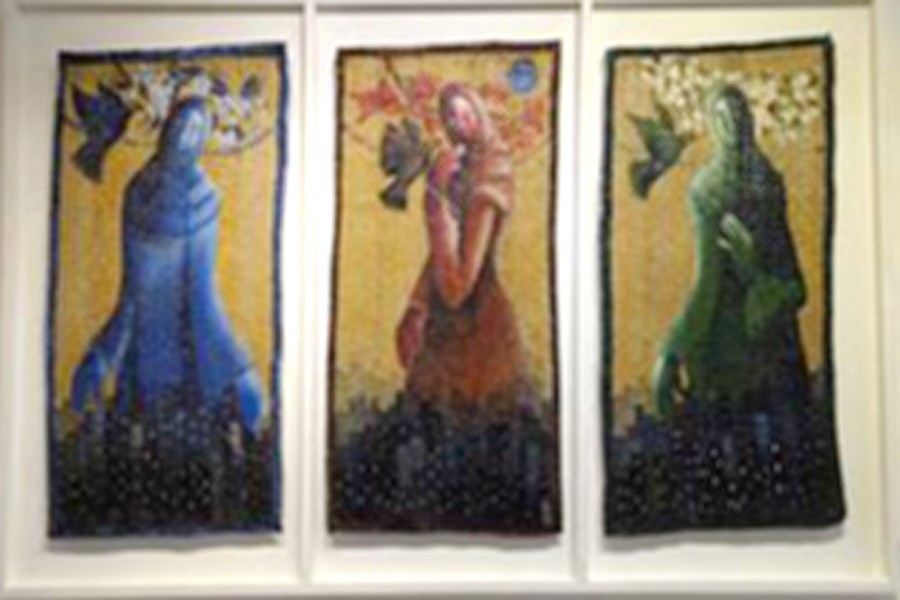
 Human society has passed through epochs of changes -- distinctly from early agrarian stages to this day of wisdom-teasing artificial intelligence (AI) wonders. What persists up till now, however, is women's struggles for self-identity and self-esteem. Here comes 'Hawabibi In This City' to personify this straight. A solo art exhibition under this title is going on at Alliance Francaise de Dhaka, Dhanmondi. The show stays open till 3 September 2025, everyday from 3.00pm to 9.00pm.
It is a must-see for art enthusiasts who appreciate modern contemporary art. The uniqueness of the artworks lies within the touch of mythical stories while challenging the social norms. Visiting this exhibition was a very pleasant experience.
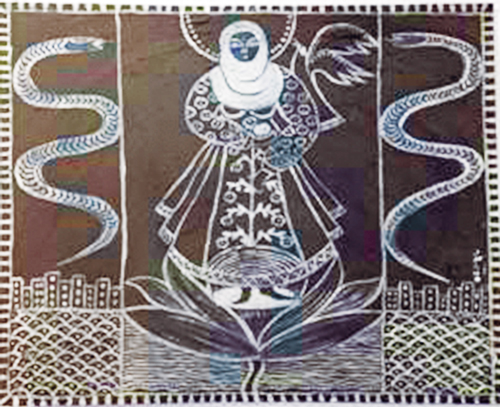 The battle for women's freedom has never truly ended -- it has only shifted shape. What once appeared as household walls, restrictive veils, or endless field labour has reemerged as silent stares, unspoken rules, and the weight of law. Across centuries, women have carried the invisible chains of guilt, suppression, and erasure.
It is against this backdrop that the artist's latest solo exhibition introduces Hawabibi, a mythical figure born out of both history and imagination. She is the embodiment of women silenced through time, yet she raises the question that still lingers: What does freedom mean to a woman who has never been allowed to tell her story?
Hawabibi draws from the arc of women's struggles -- from early agrarian societies where ownership curtailed female autonomy to today's persistent patriarchal structures. The exhibition does 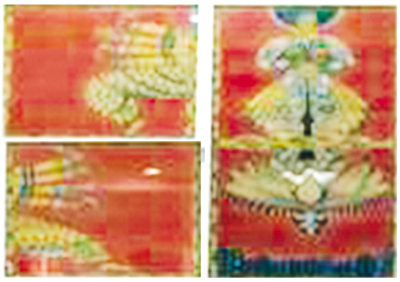 not dwell on the veil itself but rather on the systems that turned it, and countless other cultural tools, into instruments of control.
Yet Hawabibi is no passive muse. She resists. She remembers. She reimagines. Through her, the artist reclaims narratives of silence and obedience while celebrating the quiet acts of defiance that have always sustained in women's lives.
The exhibition showcases nearly 50 mixed-media works -- ranging from acrylic and watercolor to clay and locally sourced materials. Traditional Orientalist aesthetics are recast through contemporary forms, creating a dialogue between myth, memory, and modern urban life.
In a cityscape crowded with noise and steel, the paintings of the Hawabibi series arrive like whispers from another realm. 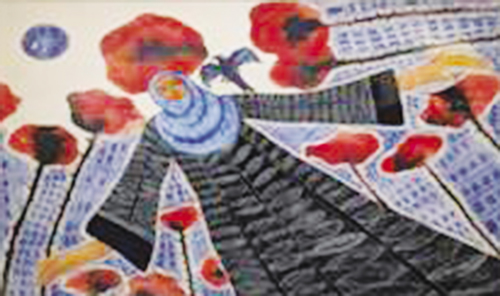 Rendered in watercolor washes and mixed media, these works seem at once ancient and startlingly modern, evoking both medieval manuscripts and contemporary street iconography. Across the canvases, a veiled woman recurs -- stoic, solemn, and sovereign -- her presence anchoring a visual narrative that feels both personal and universal.
The earliest of the set, Hawabibi in this City-2 (2018), introduces her as a near-mythical figure. Draped in patterned robes, staff in hand, and haloed like a saint, she is flanked by a tiger -- a guardian, perhaps, or a reminder of the feral energy beneath urban life or how she controls the beast with the great 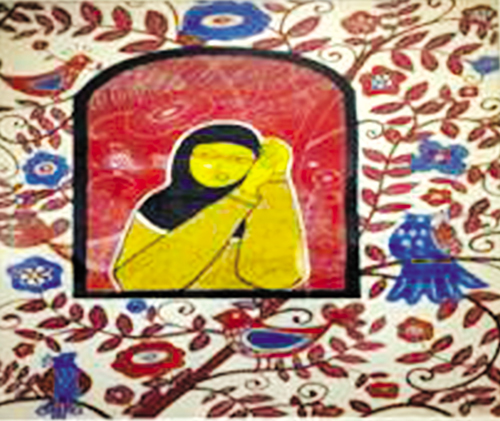 power hidden within her. The backdrop of branching vines suggests an untamed nature pressing against the boundaries of the city, a reminder that civilization and wilderness are forever entangled.
By 2021's Hawabibi Miniature-3, the palette grows sharper, the symbolism starker. A lone woman clutches a potted plant beneath a blood-red sky. Behind her, a barren tree sprouts what look like floating tags -- price labels, perhaps, or fragments of lost identities. At her feet, the ground cracks like drought-stricken soil. The scene is unnervingly still, punctuated only by watchful crows. Here, the woman's quiet dignity feels weighted with loss, her plant a fragile act of defiance against the desolation.
In Hawabibi in This City-31 (2021), the artist breathes new life into traditional folk motifs with a bold modern twist. Painted in 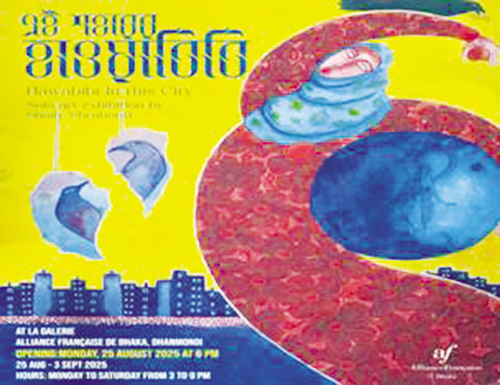 watercolor wash on brown paper, the work unfolds like a shrine -- symmetrical, commanding, and layered with symbolism. At its heart stands a regal figure adorned in floral patterns, serene yet powerful, flanked by disembodied arms brandishing weapons -- a striking contrast between nurture and violence. Below, a lotus blooms above a cityscape, suggesting resilience amidst urban chaos, while the red backdrop intensifies the drama. While Durga's hands holding weapons portray power and strength, the apple in Hawa's hand portraying the curse. Deep inside Hawa bibi is strong enough the break the curse. She is as fierce as Durga. Probably she has to explore that within herself. The piece reads as both a cultural homage and a contemporary commentary, where myth and modernity meet in one frame.
The latter works deepen the allegory. Hawabibi in this City-44 (2025) transports the figure into a dreamlike chessboard world. A winged sentinel perches beside her, while Roman numerals crown her halo, turning her into a timekeeper. The black-and-white floor echoes the eternal struggle of strategy and survival, while in the distance another woman disappears through an arched doorway. The distance woman is the past of her ancestors, Hawa! Passing her the curse of the apple through the generations. If the earlier works depicted endurance, this one meditates on choice, time, and the labyrinthine power dynamics of the city.
In the city, Hawabibi wanders -- not just as a mythical presence, but as a mirror of the cultural, social, and symbolic forces that continue to define women's realities. The exhibition invites viewers to see these legacies not as relics of the past, but as living struggles, as women continue their search for voice, identity, and freedom.
In the world of contemporary art, Shaily Shrabonti stands out for the way she transforms age-old myths into modern narratives. A graduate of the Faculty of Fine Art at the University of Dhaka, with both BFA and MFA degrees in Oriental Art, Shrabonti has carved her own path in the genre. Her canvases speak in metaphors, often addressing the challenges and crises women endure in society. Through delicate yet powerful imagery, she gives form to voices that are often unheard. As an artist and a woman, Shrabonti balances strength with fragility, drawing from both personal memories and shared cultural experiences to shape her evolving body of work.
Irina is an Art Critic and Former Student of History of Art, Fine Arts, University of Dhaka
© 2026 - All Rights with The Financial Express

