Health is an amazing component of our life. When good, nothing is known about it. When bad, it hurts everywhere from body to mind. The tiny pimple that was once a beauty spot turns into a hurt.
'Health is Wealth' is a saying under which we grew up. One had to take care of this wealth through physical exertions such as exercises. When young, one could get away from such needs through various activities from sports to running errands. Much of these go as one ages. Hence, there is need for other activities to keep the body functional. A minimal requirement is morning walk, for example. One has to be careful about food as well and refrain from habits such as smoking and drinking, even soft drink. And then there is diabetes and blood pressure. So many things to keep in control. In spite, we now live long. Hundred years is not too long for one to live, even stay active.
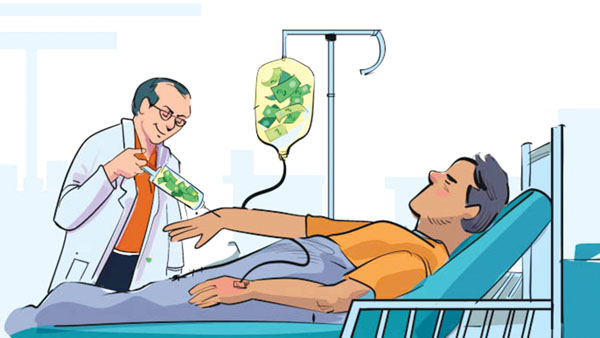
We have so many medical facilities in the country. Each high street abounds with clinics, pharmacies and hospitals. But complaints are many about quality in each. Adulterated and out of date medicines are not uncommon and extortion through bloated prescriptions. As a result, people are hesitant to the extent of seeking medical help from neighbouring countries. I have one such experience in a hospital where I was a patient due to mild discomfort in chest. I was put on a Halter machine. I was released after a day and there was a prescription with a number of medicines. Not satisfied, I made a trip abroad. The doctor there was surprised as my problem was slightly raised blood pressure and that would not need medicines such as beta blocker. The doctor at the hospital, an acquaintance, explained it as a precautionary medicine. But a likely reason is collusion between sellers and prescribers of medicine. This continues unabated due to regulatory weakness.
The country has done well economically in terms of per capita GDP. This has happened mainly through the rise of exports in some sectors of economy. Garments stand out prominent. How did it happen in spite of so many negatives? To examine, one has to differentiate between products and services. The garments have risen as each company dealt with the buyer on one-to-one basis. At the initial stage, the two parties worked together as problems were sorted out at successive stages of production. This is learning. We now have reached a stage where our products are able to meet global standards. It would have been better if the same attention was given to the internal market. The brand value would have been higher. The services are a different ball game as it is mostly behavioural requiring different attention such as patient care in a doctor's surgery. The same goes for many other areas such as education, in particular, universities. The same teacher, many with weak academic profile, does everything from teaching to setting questions to marking the script. This is a scenario in most private universities. In a similar manner there is an inverted pyramid in public universities through the misuse of promotion rules. A popular joke is having more generals than soldiers in a battle field. However, there is an alternative model, though not desirable, as used in some universities elsewhere,where promotion is a right as per years of service.
We now have a fractured economy that is bleeding at the seams in many areas, human resources in particular. Unease is a consequence as we target the next stage of economic development. Against this background consider countries in the region, with similar background, that are doing better. Not long ago Thai baht was at par with Taka. Now it is four times higher. Vietnam has risen from the ashes of a war, as we did in the seventies. The only difference is the extent of their sufferings, longer and more severe. One reason may be the absence of a helping hand. Help can be bad at times. When a child accidentally falls, we all rush to help. A better approach is not to help, as in some countries, so that the child learns to take care of herself. These are behavioural differences that may affect performance in many areas of activity. It must be understood and acted accordingly. A dedicated television channel is one way to spread the message. The viewer interest will be initially low, but increase gradually with good anchoring and skilful presentation such as in Channel 4 of the BBC. This is like feeding bitter gourd to a child in spite of unwillingness. It should in turn reduce much of the weaknesses that prevail. This is not to undermine those who have done well but to spread it further into broader areas of economy.
chowdhury.igc@gmail.com
© 2026 - All Rights with The Financial Express

