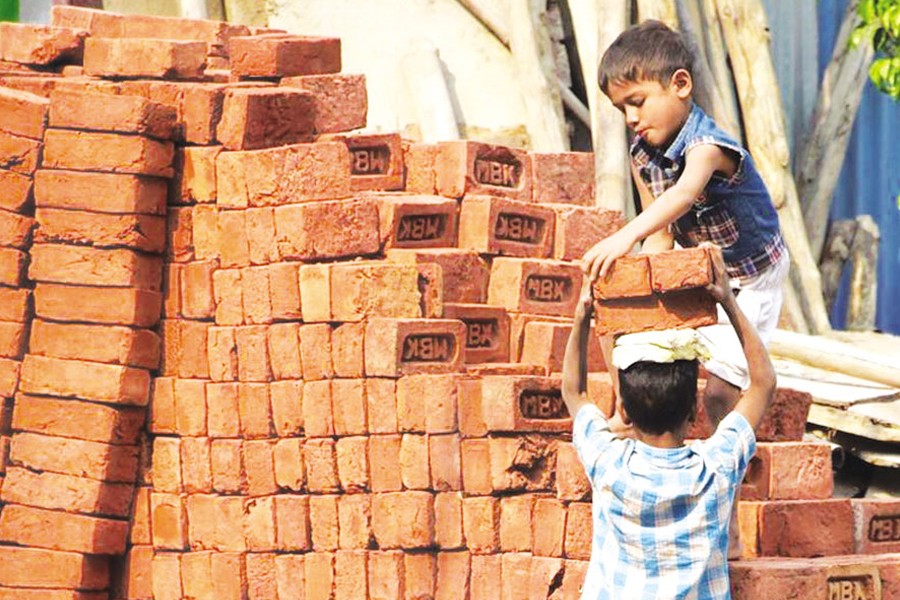
When child labour in Bangladesh is discussed, the images that usually come to mind are children working in brick kilns, factories, workshops, tea stalls, or roadside shops. Yet beyond these visible sectors lies another vast world where thousands of children work every day, while their labour remains largely invisible in official statistics, law enforcement, and public discourse. These children work as domestic workers, street vendors, assistants in hotels and restaurants, waste collectors, farm labourers, workers in small family-based production units, and in various other informal sectors. They often have no fixed working hours, receive little or no fair wages, and lack safe working conditions or social protection. As a result, the most hidden and severe forms of child labour are concentrated within the informal economy.
Bangladesh has achieved significant progress in economic development, yet many children still lose their childhood to labour. Instead of holding books and attending school, they spend long hours working for survival. This reality denies them education, health, and a safe childhood. Child labour is not only a social concern but also a major obstacle to human rights, sustainable development, and the country's future prosperity.
One of the most invisible and exploitative forms of child labour is domestic work. Hidden inside private homes, child domestic workers often remain beyond the reach of society and law enforcement. They work long hours with little rest, poor nutrition, low wages, and no opportunity for education or a normal childhood. Many also face physical, psychological, and sexual abuse. Fear, economic dependence, social stigma, and the absence of safe complaint mechanisms keep most cases hidden and unreported.
Children working in the informal economy face serious risks. Some collect scrap, handle hazardous chemicals, carry heavy loads, or sell goods on the streets. These jobs expose them to accidents, injuries, chronic illnesses, and psychological trauma. Most have no access to health care, workplace protection, compensation for injuries, or adequate occupational safety measures, leaving them highly vulnerable to exploitation.
Although poverty is a major cause of child labour, other factors also contribute. Family hardship, unemployment, school costs, migration, disasters, and social inequality push children into work. Many families depend on their earnings, while employers often hire children because they accept lower wages, are easier to control, and work longer hours.
Girls are particularly vulnerable, as they often face a double burden of discrimination. In addition to being engaged in domestic work, they are at greater risk of gender-based discrimination and violence. Many girls drop out of school to work as domestic workers and are exposed to various forms of exploitation from an early age. As a result, their future is often confined to a cycle of illiteracy, poverty, and insecurity.
In many developed countries, children are encouraged to participate in limited household chores within their own families as a way of fostering responsibility and independence. However, employing children as domestic workers in other people's homes, or engaging them in work that involves long hours or interferes with their education, is effectively prevented through strict legislation, better social awareness, and robust enforcement mechanisms.
Child labour harms not only children but also national development. Long working hours, fear, and exploitation undermine children's physical and mental growth while depriving them of education. As a result, many fail to develop into skilled human resources. This reduces national productivity, perpetuates poverty across generations, widens social inequality, and makes achieving the Sustainable Development Goals (SDGs) more difficult.
To eliminate child labour, Bangladesh has adopted the Bangladesh Labour Act, 2006 (amended in 2018), the National Child Labour Elimination Policy, 2010, and other child protection measures. These laws prohibit child labour and protect adolescent workers. However, implementation remains weak, particularly in the informal sector, domestic work, and other hidden workplaces, where monitoring and law enforcement are limited despite Bangladesh's national and international commitments to children's rights.
Eliminating child labour requires more than laws; it demands effective implementation. A comprehensive national database on working children is essential. Reliable information on where children work, the risks they face, and their family conditions will enable the government to design targeted policies, strengthen enforcement, and provide appropriate support.
Second, social protection for low-income families must be strengthened. Cash assistance, food security, healthcare, and education support can reduce child labour by easing financial pressure and encouraging families to keep children in school instead of work.
Third, schools must become more inclusive and engaging. Better education, skills-based learning, free materials, and counselling services can reduce dropout rates and keep children in school.
Fourth, alongside the effective implementation of a dedicated policy for protection of child domestic workers, accessible and child-friendly complaint mechanisms should be ensured through child protection apps, the Child Helpline (1098), and the National Emergency Service (999). These helpline numbers should be widely publicized so that children and the general public can easily access support. In addition, complaints must be investigated promptly, and victims should be provided with protection, legal assistance, and rehabilitation.
Fifth, changing social attitudes is essential. Public awareness through media, schools, religious institutions, and civil society can help prevent child labour and protect children's rights.
Sixth, technology can help reduce child labour by lowering dependence on manual work in households and labour-intensive sectors. However, technology alone is insufficient and must be combined with poverty reduction efforts and stronger social protection programmes.
Seventh, NGOs, development partners, and businesses should expand education, vocational training, rehabilitation, and family support while ensuring child labour-free supply chains through responsible business practices.
Eighth, local governments should strengthen child labour monitoring, identify vulnerable families, expand community rehabilitation, and reinforce child protection mechanisms at every level.
We must remember that child labour is not merely a violation of the law; it is the theft of a child's dreams, potential, and human dignity. A child who is working today in someone else's home, collecting waste on the streets, or labouring in hazardous conditions could one day have become a skilled teacher, doctor, engineer, entrepreneur, or national leader. Premature labour, however, deprives them of that opportunity and closes the door to their future.
Therefore, making invisible child labour visible is now an urgent national imperative. Without ensuring the protection and rights of children engaged in domestic work and the informal sector, the vision of a child labour-free Bangladesh will remain nothing more than words on paper. The government, employers, families, educational institutions, civil society, and the public all must carry out their respective responsibilities. Every child has the fundamental right to a safe childhood, quality education, healthy development, and a life of dignity. Instead of placing the burden of labour on children's shoulders, our collective social and moral commitment should be to equip them with knowledge, hope, and opportunities. Only by fulfilling this commitment we can build a Bangladesh where no child will be forced to remain an invisible worker, but instead grow into an educated, skilled, empowered, and dignified citizen.
Dr. Sohel Miah is a labour relation specialist, columnist and researcher
© 2026 - All Rights with The Financial Express

