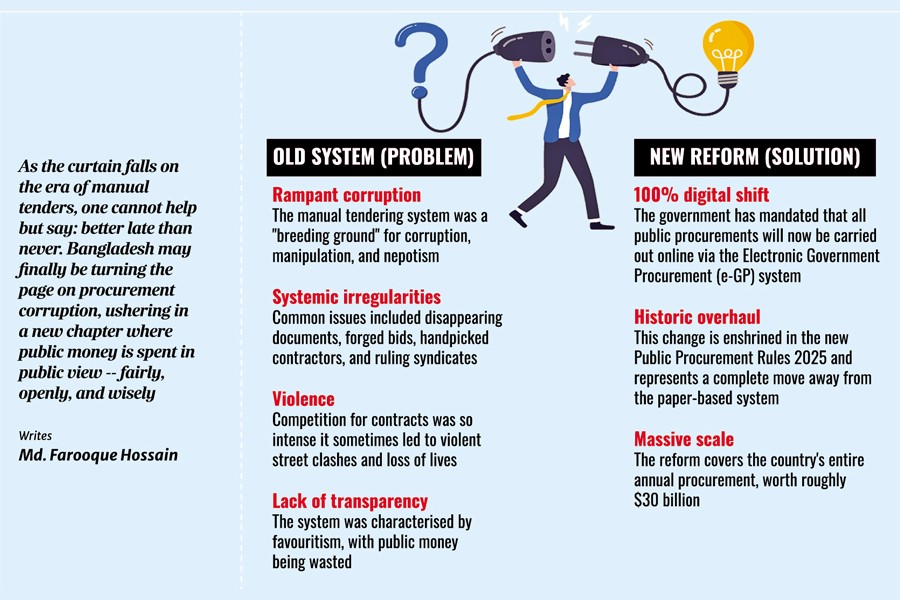
For decades, the country's public procurement system had been a breeding ground for corruption, manipulation, and nepotism. The archaic manual tendering process was notorious for irregularities -- papers mysteriously disappearing, bids forged, contractors handpicked, and syndicates ruling the roost. At times, tender politics even spilled over onto the streets, where violent clashes over lucrative contracts claimed lives. It was a system where transparency was eclipsed by favouritism and public money often went down the drain.
Now, the winds of change are blowing. Thanks to the government's latest bold move, all public procurements will now be carried out online, putting an end to the decades-old ritual of paper submissions. In one stroke, it has scrapped the manual process and shifted the country's annual procurement -- worth roughly $30 billion -- into the digital realm under the Electronic Government Procurement (e-GP) system.
This reform, enshrined in the new Public Procurement Rules 2025, is nothing short of historic. What began in 2011 as a gradual experiment with e-tendering has now culminated in a complete overhaul: not a single brick, book, or bundle of stationery will be bought without passing through the e-GP portal.
One of the most significant shifts under the new rules is the abolition of the long-debated "price cap," which allowed bids 10 per cent higher or lower than the estimated cost. While designed as a safeguard, the cap often became a loophole, opening the floodgates for manipulation, inflated pricing, and cartelisation. By eliminating this provision, the government has pulled the rug out from under syndicates that thrived in the grey zone.
Selim Raihan, economist and executive director at SANEM, called this "a decisive shift away from outdated practices that had allowed manipulation and political influence." His words sound true: when the playing field is level, competition becomes real, and taxpayers get value for money.
Critics might argue that simply moving tenders online cannot uproot entrenched corruption. But the Public Procurement Authority insists that the reform is more than cosmetic. SM Moin Uddin, chief executive of the Authority, called it a "comprehensive reform that embeds sustainability, digitalisation, and international best practices."
Indeed, the new law does not merely digitize old flaws; it redefines procurement itself. It introduces clearer roles, streamlined procedures, and strong accountability measures. For the first time, physical services such as security and maintenance are recognised as distinct categories of procurement. Blacklisting through a new debarment board will keep habitual offenders out of the system. Even the disposal of state assets -- long a grey area ripe for misuse -- will follow stricter guidelines.
In short, the new rules seek to leave little wiggle room for corruption. Or, as the old saying goes, they aim to "cut the Gordian knot" of chaos in public spending.
Another refreshing element is the inclusion of sustainability. No longer will procurement be a mere number game of lowest bids and highest profits. From now on, environmental and social responsibility will weigh on purchasing decisions. Agencies will be required to prepare strategic documents before initiating purchases, embedding foresight and responsibility into the very foundation of spending.
Policy Exchange chairman M Masrur Reaz noted that the introduction of beneficial ownership disclosure and sustainability was a game-changer, but cautioned that ministries needed technical and administrative muscle to make these reforms click. After all, even the best-written rules are worth little, if not backed by capacity and commitment.
Still, the road ahead is not without bumps. Transparency International Bangladesh (TIB) has rightly warned that loopholes may persist if internal controls are poorly designed or selectively applied. Iftekharuzzaman, the watchdog's executive director, stressed that equality of application is paramount. "Equality is more important because within the process itself, there are segments that obstruct open competition," he said.
His warning is timely. Bangladesh's governance history is littered with well-meaning reforms that stumbled in practice. Rules look fine on paper, but "where the rubber meets the road," enforcement often falters. Without strong monitoring, audits, and capacity-building, the system may again become prey to manipulation under a different guise.
Despite the challenges, the shift to 100% e-GP is undeniably a milestone. It signals the government's resolve to "clean the stables" of procurement -- an arena that drains vast sums of public resources. Economists, governance experts, and civil society voices have largely applauded the reform. Md Kamal Uddin of IMED called it "a great step forward in ensuring competition and fairness."
This optimism is not misplaced. For the first time, the tendering battlefield -- once littered with corruption, intimidation, and even bloodshed -- is being replaced by a digital platform where bids compete in the open, auditable in real time. The days of thugs at tender offices may well be over, replaced by the quiet hum of servers and the scrutiny of algorithms.
What lies ahead is the building of a new culture of transparency, discipline, and accountability. The reforms will need vigilant oversight, consistent enforcement, and continued public scrutiny. Independent audits and civil society engagement can act as watchdogs, ensuring that the promise of reform does not wither into yet another case of "old wine in a new bottle."
Bangladesh is at a crossroads. With $30 billion in annual procurement on the line, the stakes are sky-high. If properly implemented, the e-GP system can save billions in wastage, ensure better services for citizens, and rebuild public trust. But if neglected, it risks becoming yet another shiny tool gathering digital dust.
For now, however, hope outweighs cynicism. As the curtain falls on the era of manual tenders, one cannot help but say: better late than never. Bangladesh may finally be turning the page on procurement corruption, ushering in a new chapter where public money is spent in public view -- fairly, openly, and wisely.
Md. Farooque Hossain is an IT Professional and he works for Thakral Information Systems Pvt. Ltd, Dhaka, Bangladesh.
mailfarooque78@gmail.com
© 2026 - All Rights with The Financial Express

