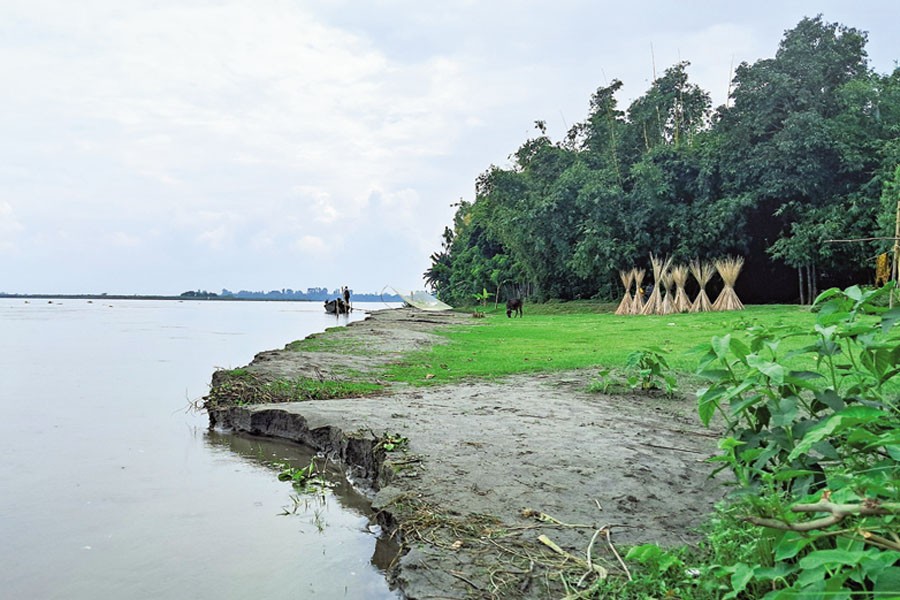
 Erosion has destroyed the bank of the Dharla River —FE Photo
 Flanked by a blend of dense greenery and rustic beauty, our autorickshaw speeds towards Mogolhat from the Mission intersection, the heart of the Lalmonirhat district. Cows and goats graze in fields despite an intermittent drizzle on a September morning. Bamboo, betel nut, and banana are among the trees lining the paved road that bends often.
Villagers here live in tin-roofed houses that have walls made of both tin and brick. Male and female garments hang from slender tree branches cut and slung between betel nut trees - a nice improvisation for drying clothes in the sun. We cross the small Ratnai Bridge, its parapet painted in red and white stripes.
The driver slows down, and a body of water looms ahead. This is Dharla, a transboundary river flowing through Bhutan, India, and Bangladesh. Standing on the riverbank, the land and hazy tree lines I see on the other side belong to India.
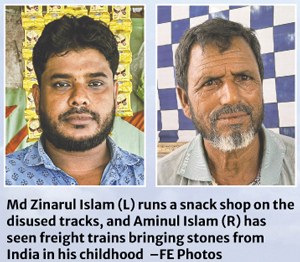
 "The bank was there in the past, until erosion ate it away and widened the river over time," says Md Zinarul Islam, gesturing into the distance.
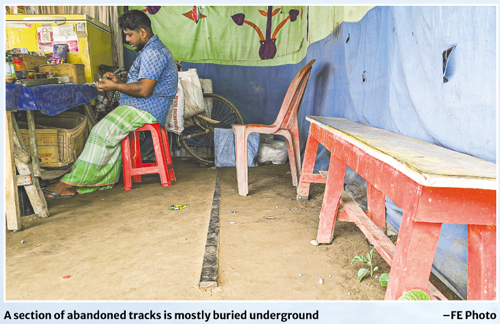
He lives a kilometre away and has not been affected by erosion. But he knows people who have had their property devoured by the river that becomes turbulent in the monsoon. He has been running a small shop on the current riverbank for nine years, selling snacks and beverages.
His shop lies on abandoned tracks that are mostly buried underground. Only the top surface remains exposed in a corner, where customers can sit on a red-white wooden bench. It looks like the end of the line as the tracks are severed, but it is not.
The tracks continued all the way to India through the Gitaldaha railway bridge, now a disused structure on the Singimari River. This river, originating in the Himalayas, takes the name of Dharla upon entering Bangladesh. Gitaldaha, under India's Cooch Behar district, got connected to Mogolhat via railway in the British era, with the Lalmonirhat-Mogolhat section opening in 1882.
"A large stretch of the river you see from here was solid ground that held the tracks. The Gitaldaha bridge and the tracks were heavily damaged in the 1988 floods, halting cross-border train services. The Mogolhat-Lalmonirhat line still functioned, but that also closed in 1995-96," Zinarul explains.
Mogolhat also had a land port and an immigration office, which enabled Bangladeshis with valid visas to travel to India. Immigration services continued even after railways were closed, with travellers taking boats to reach the Indian shore. Land port and immigration operations were later relocated to Burimari in Lalmonirhat's Patgram upazila, gradually rendering Mogolhat a forgotten border link.
 Rectangular concrete blocks have been laid out on the riverbank to make a walkway. Several white concrete benches line the walkway, inviting visitors to sit and soak in the riverside greenery. Rubbish is scattered on the grassy embankment.
A red-black gazebo with a green roof stands where the walkway bends. A path from there leads to a Border Guard Bangladesh (BGB) camp, which is fenced with barbed wire and overshadowed by tall trees. Nearby, a blue-white BGB motor boat with a black canopy and a small Bangladeshi flag is anchored.
Several passenger boats with multi-coloured canopies also sit in the water. Beyond the gazebo, the scarred, muddy riverbank testifies to the erosion that has shifted the course of the river over time. The serenity of the surroundings is occasionally broken by the thrum of boat engines.
"I remember steam-powered freight trains bringing stones from India when I was a little boy. When the fireman would shovel coal into the firebox, I would collect the pieces that spilled on the ground," says 58-year-old Aminul Islam, a fisherman from Falimarir Char, which is a sandbar in the river.
Seeing him perched on a riverside bench, I start chatting with him about Mogolhat's heyday when it was a vibrant border town. As far as he can remember, a freight train had 10-12 wagons and would arrive in Mogolhat in the morning. Only the locomotive would return to India in the afternoon.
"I heard that passenger train services on this route had stopped even before the 1971 liberation war. But I am not sure about that," he says.
 Under an overcast sky, I hear the sound of the murky Dharla water flowing gently. Only a handful of people are around, including visitors boarding tour boats. I have not yet seen a single BGB official, but Aminul assures me they are keeping watch.
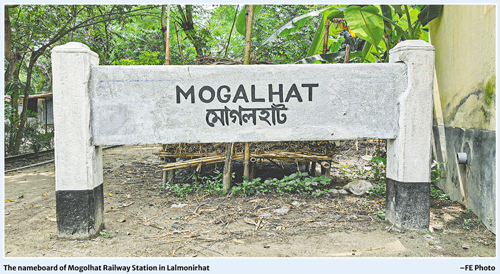
A short walk from the riverbank takes me to the Mogolhat Railway Station nameboard. It appears to have been painted white recently because the one I watched on YouTube videos was weather-beaten. It should mark the edge of the platform, but I only see tin shacks on both sides of the abandoned tracks.
The tracks have rusted away, and the sleepers are gone. Cows tethered to the tracks eat hay from large bamboo baskets. Betel nut and other trees have grown in the space once occupied by sleepers.
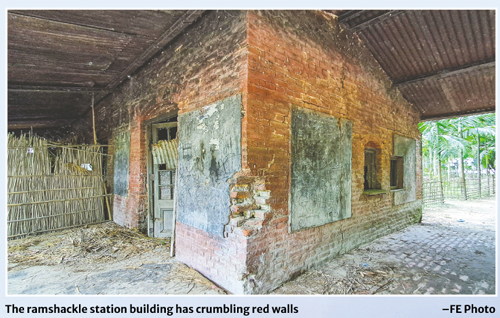
All that is left of the Mogolhat station is a ramshackle, single-storey structure with crumbling red walls and a rusty tin roof with large holes. Fitted in a displaced doorframe, the glazed double door is padlocked, some of its panes missing and others thick with grime. A haphazard mass of hay in the doorway makes it look like a cowshed.
 A long crack runs vertically down the wall on one side, cutting through a rectangular board marked with faded chalk writings, possibly train schedules. The wall has two windows - one with a ripped mesh and the other with missing iron bars. Behind them, the dark interior deepens the sense of abandonment.
Opposite the wall is a double-sided concrete bench with broken edges and cracks. Dry leaves are scattered on its weathered red surface, and moss has grown sparsely. Behind it is another deserted building, its front so overgrown with trees and plants that the thought of getting inside gives me a scare.
On the way back to the Mission intersection, a long stretch of the Mogolhat-Lalmonirhat section can be seen from the autorickshaw. A rail bridge appears on the left of the Ratnai Bridge, with two men cycling on it. I ask the elderly autorickshaw driver if he remembers the time when trains rumbled on this line.
"Yes, I do. That was a long time ago.
There is no train in Mogolhat now."
r2000.gp@gmail.com
© 2026 - All Rights with The Financial Express

