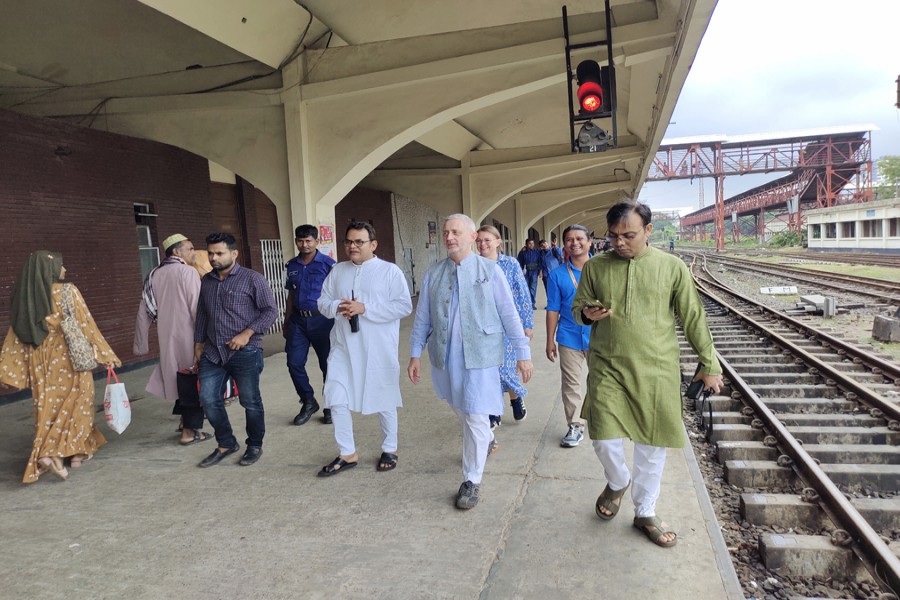
 Master of Dhaka Railway Station at Kamalapur Anwar Hossain and other officials give EU Ambassador to Bangladesh Michael Miller a tour of the country's busiest rail hub. Photo: Md Zahirul Islam
 As a child in Europe in the 1970s, Michael Miller loved playing with a train set that had a Flying Scotsman locomotive. Decades later, he sits in a snug sleeping car of the Jayantika Express as the European Union (EU) Ambassador to Bangladesh and says his fascination for trains remains, but it now carries greater significance. In an age dominated by air travel, he sees rails as more than nostalgia.
“I think trains are the transport of the future,” he tells The Financial Express, pointing to electrified railways as clean, green, and energy-efficient.
It is May Day, and he is travelling with his wife Philippa Wood and teenage son from Dhaka to Bhanugach, a locality in the northeastern Moulvibazar district. His traditional Bangladeshi outfit - an ash blue waistcoat over a powder blue panjabi and crisp white pyjamas - blends professional elegance with dignified authority. After arriving at Dhaka Railway Station in Kamalapur in the overcast morning, Station Master Anwar Hossain and law enforcement officials gave him a brief tour of the country’s busiest rail hub.
The Irish-Scottish diplomat is as old as independent Bangladesh is. His earliest memory of a train ride dates back to late December 1977, when he travelled overnight with his parents in a dark burgundy sleeping car with a grey ceiling. His father had a teaching job in Bulgaria, and the family had to travel across Europe by car and rail.
He did not grow up near any railway station. However, he lived near Schaerbeek station in Brussels before taking up the post in Dhaka. The Train World museum, which he admires, is housed in the old station building, displaying the history of railway expansion in Belgium, locomotives, and carriages, including the royal one carrying the King of the Belgians.
Philippa, seated across from him, shows me pictures of Schaerbeek station on her phone. It is a very old building, she says. Michael extols it as an absolutely beautiful building that resembles a castle.
“The Belgians decided that rail was the future. They wanted to demonstrate that they were an ambitious, future-oriented society and then built this incredibly impressive station. The fact that it [the vision] was the same in Dhaka is striking,” he says.
Drawing parallels between Kamalapur and Schaerbeek, he says the investment in the former was about art, culture, and imagination. He sees Kamalapur as much more than a functional station. In his view, it represents an era when stations needed to be impressive to offer a lasting first impression of the towns they were built in.
I take a break and step into the adjacent cabin, where photographer Md Zahirul Islam, EU Media Adviser Towheed Feroze, and Towheed’s friend Dipok Chowhan banter, listen to music, and scroll their phones. An aura of bliss fills the space, as if three friends travelled back to their carefree days. I join in, singing Guns N Roses’ power ballad Don’t Cry using karaoke, followed by Wind of Change, another 90s smash hit from Scorpions.
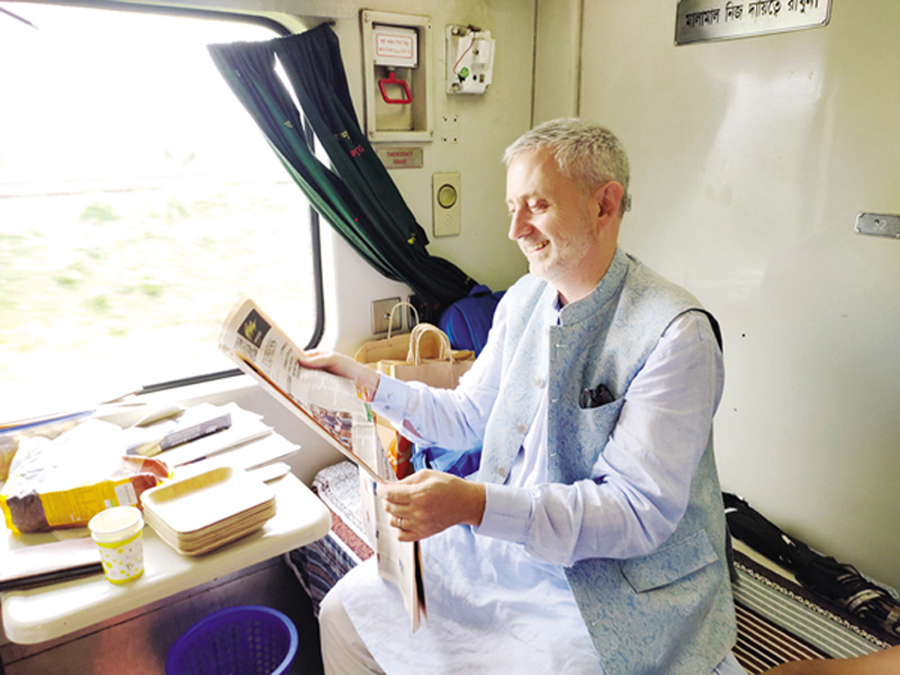
The Ambassador reads The Financial Express in his Jayantika Express cabin. Photo: Md Zahirul Islam
When I return, Philippa mentions hearing Wind of Change, noting the track’s symbolic connection to the fall of the Berlin Wall. I do not tell her I sang it. Instead, I say I will sing a song later, and she and Michael can rate me.
Train travel has a charm, Michael says. The idea of taking an overnight train and waking up far away or in a different country is very attractive to him. He explains why trains allow us to relax, reflect, and also interpret society by observing how people interact, talk on the phone, and drink tea.
“It is fascinating that the chaiwala [tea seller] comes along and serves you tea. That is a luxury for me. Normally, you would have to go and find your own tea,” he says.
Indeed, chaiwalas do not just sell tea on Bangladeshi and Indian trains; they carry around the social lubricant that facilitates fleeting camaraderie among strangers. A chaiwala visited Michael’s cabin when I was outside. His Excellency not only bought tea from him, but also had a “nice chat” with him.
“I do not think the chaiwala spoke English,” I say.
“No,” Michael laughs. “But we tried. Ektu, ektu. A little bit of Bangla. Ektu Bangla. There was a lot of sign language!”
He argues that flights are not necessarily faster than trains, especially over short distances. Lengthy airport waits and check-ins, as well as the time spent getting to and out of the airport, often cancel out the advantage of flying. Even for up to 500km journeys, a high-speed train can be a better option.
This shift is already underway in the EU as airlines and train operators are facing pressure to no longer compete for short trips, he says. Short-haul flights are in places being phased out and to be replaced by fast intercity trains. The added benefit of trains is that they provide an escape from the rush of modern life.
“When you are on a train, you can sit, read, and look out the window. That means slowing down a little bit, which is very necessary from time to time in this fast-paced world,” he says.
He recalls commuting by train in Brussels before moving to Dhaka. This allowed him to prepare mentally for the day without the stress of driving - something he describes as fundamentally quite healthy. His experience matches the findings of a 2021 study, done by University College London (UCL) neuroscientists and the UK rail industry, that train travel has positive impacts on cognitive performance, well-being, productivity, and motivation.
“It is actually good when you have public transport that you can take. You sort of ease yourself into a different way of life,” he says.
If life is a train journey, he says he is halfway through it and has reached “cruising speed”. No one ever considers that they are at the end of their journey, he stresses. With responsibilities spanning the political, commercial, developmental, and humanitarian domains, this is by far the most interesting, productive, and meaningful phase in his 30-year career.
As we talk, the Ambassador’s son remains glued to the phone, which prompts a conversation about the generation gap. Philippa explains how she and Michael are quite happy to just sit on the berth and look out the train window, getting inspired by what they see. By contrast, Michael says, their children need stimulation and the dopamine hit from digital content and social media.
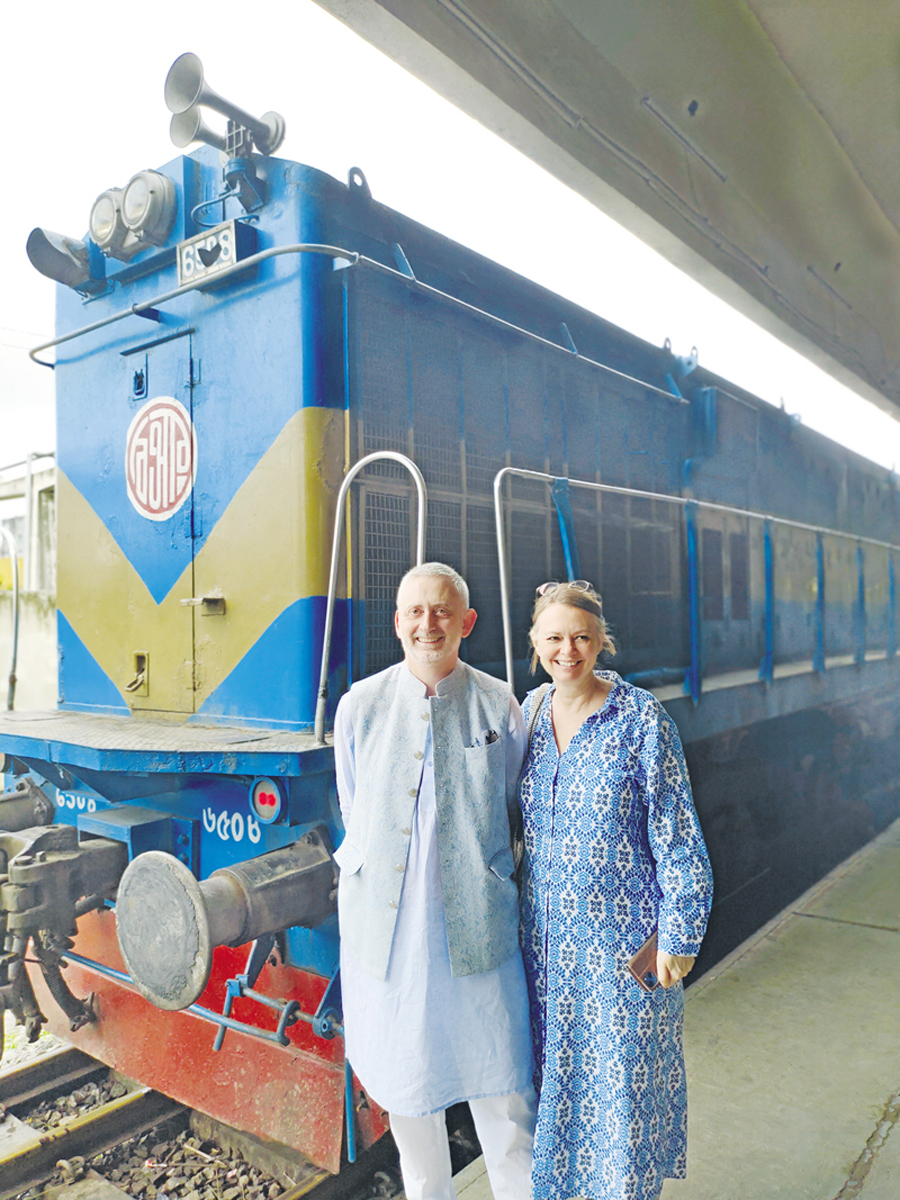
The Ambassador and his wife Philippa Wood stand on a platform next to a locomotive at Dhaka station. Photo: Md Zahirul Islam
Philippa sings the praises of Bangladeshis, describing them as hard-working and resilient. It is always humbling to see what people here do to put food on the table, she says, drawing a contrast with how her Western upbringing gave her a head start in life. This strength, she hopes, will shape the future of Bangladesh.
Michael, who had worked on EU-Russia ties for many years in the late 90s and early 2000s, talks about his train travels across Europe and most of the former Soviet Union. He has also boarded trains in Canada, the US, Peru, and four African countries - Egypt, Morocco, South Africa, and Kenya. “I’ve been so lucky,” he says twice, highlighting his fondness for long train rides because they are more interesting.
More interesting in the sense that such journeys, unlike flights, give him an idea of the geography. He loves geography, which he studied at university, and landscape. He sometimes sees landscape as a determinant of a country’s political system, social organisation, and even economy.
“For me, I love to know where I am. That is another reason why train travel is so attractive. You understand things better on a train,” he says.
To substantiate this claim, he says his previous flights to Sylhet gave him no idea of the landscape. But today, he can see the expanse of green and yellow crop fields, trees, and village life right out the window. The train, rumbling on the Tongi-Bhairab-Akhaura line built in the 1910s, also gives him a sense of distance between Dhaka and Sylhet, which the 40-minute flights could not provide.
The train ride he enjoyed the most in his life lasted 27 hours, taking his family to Cape Town from Johannesburg. From the highlands to the coastline, the changing scenery held his attention. It was a “very safe” journey and could have also been the longest of his life had he not gone on another one when he was 18.
That one was a two-day connecting journey from Istanbul to Brussels via the Greek city of Thessaloniki and Vienna. He spent the night at Thessaloniki station, sitting with his rucksack on the platform and waiting for 10 hours for the next train. He did not mind it because “when you are young and you have no money, that is what you do”.
He only had a 10-pound Scottish note, which he struggled to convert to Greek drachma in Thessaloniki. Uncertainty loomed over getting the ticket for the next train. A long debate with a money changer finally ended when he accepted a very low rate.
“But it did not matter as I only had the tenner and badly needed drachmas. Even with the low rate, I got enough drachmas to buy the ticket,” he reminisces about his difficult interrailing experience in the late 80s.
It was a far cry from what young Europeans can do now. They can participate in a raffle when they turn 18, and the winners get an interrail pass to travel around the EU for a month for free, which Michael thinks is fantastic. His eldest daughter used the pass to ride trains in Brussels, Berlin, Vienna, Milan, Paris, and Prague.
In fact, European railways largely benefited from EU funds in recent decades. In July 2025, the European Commission selected 94 transport projects for nearly 2.8 billion euros in EU grants under the Connecting Europe Facility (CEF). The largest share (77%) of the investments went to rail transport.
Michael sees some investments, including electrifying cross-border lines, easing international ticket purchases, and making various systems interoperable, as important progress. They will make passenger travel more efficient and allow trains to easily compete with airlines for short- and medium-distance trips. Another major improvement will be the shift of freight from road to rail.
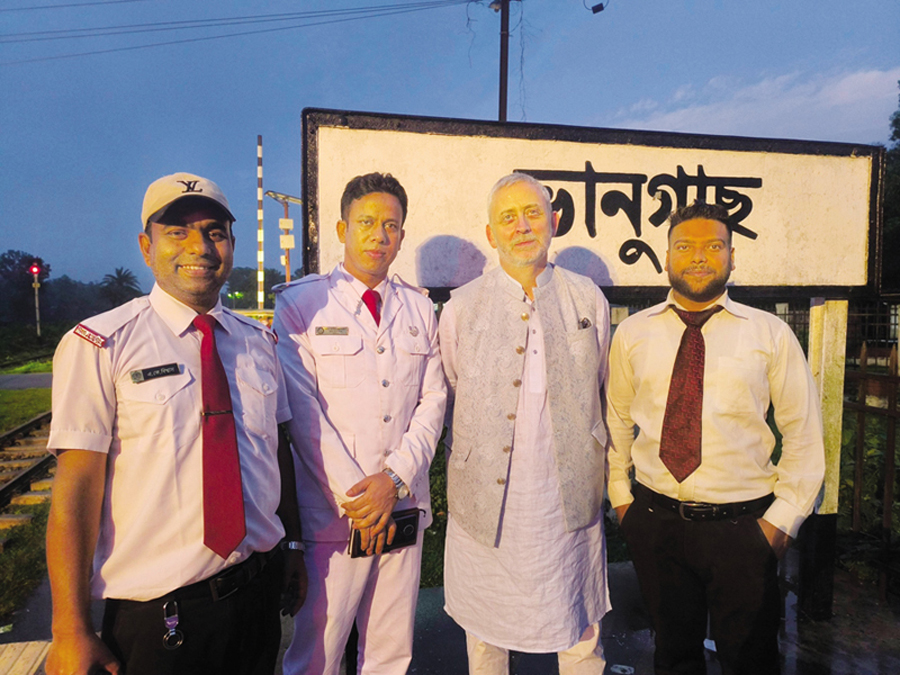
The Ambassador poses for a photo with members of the train crew at Bhanugach station in Moulvibazar. Photo: Md Zahirul Islam
“We aim to have a carbon-neutral economy by 2050, which means getting freight traffic off the roads and onto electrified railways. Electrification always helps us reduce carbon emissions,” he says.
He also underscores how Bangladeshi rail is set to enter the electric era with EU funds. The EU has planned 825 million euros of investments to electrify the Narayanganj-Joydebpur stretch, upgrade the Laksam-Chattogram section, and implement other development schemes, such as modernising the rolling stock and bringing more lines under the broad-gauge network. The first batch of rolling stock, comprising in total 200 new passenger carriages built in India, is due to arrive in June.
“This carriage we are travelling in is perfectly decent, but a modern rolling stock will make the railways more attractive. I am looking forward to seeing the new carriages in use,” he says enthusiastically.
Our train rolls on the Bhairab Railway Bridge, the Meghna River flowing underneath. Michael observes the weathered red trusses sliding by, while I explain how train passengers in the distant past crossed the river by ferry to resume the journey from the other side when the bridge was not there yet. Soon emerge the plains as the train leaves the river behind and speeds toward Ashuganj Railway Station in Brahmanbaria.
Over the past decades, the change in European train travel that impressed Michael the most is the speed. When he was young, Japan wowed the world with its high-speed trains, also known as bullet trains. But France, Germany, Italy, Spain, and other countries now have equivalent trains that can clock more than 300km per hour, making it possible, for instance, to travel from Brussels to Paris in an hour.
Further down south in Avignon or Marseille, it will take five hours. Michael calls these fast trains a “revolution”. When asked about the expense of tickets, he says he sees it as a trade-off for those who value time.
“Time is money to an extent. You sometimes have to factor that into the ticket cost. I think international rail travel will become progressively cheaper,” he says.
For him, the biggest issue with cross-border trains is not the ticket price, but the capacity. There are direct trains between Brussels and the Alps, but the demand is so high that tickets sell out really fast. That, he says, is a bit like Bangladesh, and only more rolling stock can solve the problem.
Growing up in Europe in the 70s and 80s, he saw diminished importance of trains in everyday life as cars had already taken over. But now, public transport is more prominent because it is expensive to have a car. Besides, green initiatives encourage citizens to use public transport.
His memory of the last time he took a train in Scotland is fading because it happened around 18 years ago. He took his family on holiday to the Isle of Mull, where a narrow-gauge train transported them from the ferry terminal to Torosay Castle. They strolled through the castle’s spectacular gardens covered with roses and other climbers.
He is aware of the scenic appeal of Scotland’s West Highland line and how the Harry Potter films boosted its popularity, especially the 21-span Glenfinnan Viaduct. But he never travelled on the route. He never boarded the Jacobite, the famous steam train running on the line, either.
I come back after another break and start singing 500 Miles, the melancholic ballad associated with the 60s folk revival in the US. Philippa grooves to the music with both hands, while Michael enjoys the vibe. She asks him to rate me after the rendition, and he gives me 8.5 out of 10.
She shows a video of some Bangladeshi children jumping around on train roofs, expressing concern about their safety. Michael is quick to ask me if I ever did that. “Nope,” I laugh, and he reminds me of how dangerous it is.
The couple are chatty and witty, having sharp observations about Bangladesh. The 70-minute departure delay from Dhaka due to a glitch in the power car has not bothered them much, with Philippa saying they faced it in the West as well. They are travelling like average Bangladeshis without any special on-board security protocol, which is possibly unprecedented for an EU envoy in Bangladesh.
Lush, terraced tea gardens now stretch along the tracks. To transport this very tea to the Chattogram port, the metre-gauge tracks beneath us were laid by Assam Bengal Railway in the 1890s. Michael catches a glimpse of the Finlay tea garden nameboard as the train advances towards Sreemangal, the country’s tea capital.
After Michael and I disembark at Sreemangal station, Train Guard M Zahid Hossain walks us to the locomotive, asking a catering worker to prepare pineapple while passing the buffet car window. Michael climbs the locomotive steps, and Locomotive Master Anal Kumar Biswas greets him in the cab. His Excellency takes the empty seat of Assistant Locomotive Master Shahjalal Bapary, who arrives after a while, carrying a plate of pineapple chunks and a box of tissues.
Tracks in the Sreemangal-Bhanugach section cut through the Lawachara National Park, a reserved forest where part of the 1956 Oscar-winning Hollywood movie Around the World in 80 Days was filmed. Michael, who is experiencing a cab ride for the first time, watches the line unfold ahead, taking pictures with his phone as rubber and tea gardens give way to the deep forest. The train curves a few times while traversing the forest in the twilight, the dense clusters of trees on both sides growing ominously darker every minute.
r2000.gp@gmail.com
© 2026 - All Rights with The Financial Express

