 Mona Lisa, an immortal painting by Leonardo da Vinci, remains an inexplicable artwork embodying truth and justice of all time. The Renaissance-time Italian painter's paint-and-brush work, however, comes at a latter day in comparison with a piece of classic parable created in far-off medieval period. It's a painting that can even challenge the way we see things in human relations to this day, when remnants of class distinctions and colour bars still persist.
As an art enthusiast, I often analyse different paintings, which gives a strong message to society.
In our modern world, even in Bangladesh, racism is a problem we often see time to time. Women are the prime sufferer of this chauvinistic outlook. But did you know that way back in medieval period, there could be a revolutionary painting about this topic!
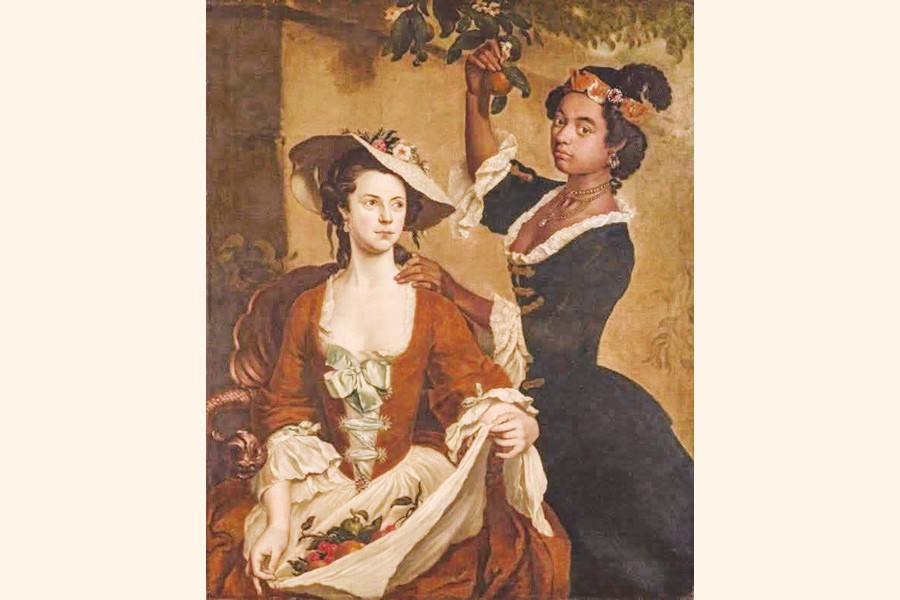
The title of the painting given below is 'The Young Woman and her Servant'. The painting was painted by medieval painter Stephen Slaughter. This painting was discussed as a very unusual, thought-provoking allegory at the time. That is, according to the enigmatic subject matter of the work, a storm started as to who is the 'young woman' and who is her 'maid or servant'.
What do you think? Who is the main character of the piece -- the sitting white woman or the black woman standing next to her? At first glance, anyone would think that the sitting white woman -- as usual -- is the young woman portraying the main character. Because of the deep-rooted racism that exists among us, in this era and in that era, in the medieval period, everyone assumed that the sitting white one was the main character.
Let's analyze the painting a little for insights. If you look closely, you will see that the standing black woman is wearing precious jewelry and a neckpiece while the white woman sitting has a bare neck -- no jewelry -- and her earrings are very plain compared to the Black's. The black woman is plucking fruits from the tree and the white one is holding them in her clothes. If you take a close look, you will see that the white woman is looking somewhere in the distance, but the black woman is looking directly at the audience. Which makes her the main focus of the painting.
Some other things are noticeable, too, such as the hat the white woman wearing is a very typical flower hat of that time. On the other hand, the black woman is wearing a fashionable feather headdress of that time that even has jewels. Another distinct feature is that the black woman has her hand on the white woman's shoulders, touching her bare skin in the painting. Would any servant or maid be allowed to do that fondling? Definitely not!
So, we understood from our observation of the painting and came to the conclusion that the black woman is the protagonist of the piece, who is called Young Woman in the title. Voila! If you have come this far, you have decoded this interesting part of art history!
Now one may think why this was so talked-about artwork in that benighted Middle Ages. Until this year of 2025, people go on falling victim of racism or behave racist, more often than not, in bizarre manifestations at times. However, things are going to change day by day with rising social and moral awareness. But in that medieval times, when racism was at its peak, slave trading and inhuman torture and torture of them were the norms of society, making such a farsighted painting was a revolutionary thing. How wonderfully the artist has created this psychological confusion and highlighted the progressiveness of his thinking. Through the painting, the painter has highlighted equality, equality which is our lifelong dream, war.
Irina is an art critic and former student of the Dept of History of Art,
Faculty of Fine Arts, University of Dhaka
© 2026 - All Rights with The Financial Express

