 'Development' of any country can be defined as 'growth plus changes'. Simultaneously sustainable development means registering a reasonable growth persistently over time and happening positive changes in the people's standard of living. Growth occurs when real value of goods and services increases over time. But what does quality of growth actually mean?
Higher growth is a necessary condition to bring meaningful changes in people's life. But quality of growth is more important for quality of life. It can be ensured through inclusive growth, that speaks growth for all. When benefits of growth reach to the people at the subsistence level through trickle-down effect we mean it quality growth. On the contrary, if growth raises income inequality and rich people become richer widening the gap between poor and rich, we must not call it quality growth.
Over the last decade Bangladesh experienced an accelerated GDP growth at an average rate of 6-7% which is really impressive. It was lauded by every corner including foreign bodies. However, unevenness of income & wealth increases significantly during this period which is evidenced by increasing Gini Coefficient, an economic measure of income inequality, from 0.451 in 2000 to 0.499 in 2024. (Value of GINI coefficient ranges from 0 to 1. Higher the value more imperfect the income distribution. Gini Coefficient of below 30% indicates lower income inequality). The data shows, despite the country had been gone through the development pace over a long period of time and per capita income increased remarkably, the poor people remain poor. They didn't get employment opportunity as expected and their real wage remains far below the national average.
Though Bangladesh experienced economic growth at more than 5 per cent almost every year, its poverty level increased in the last decade. In 2015 our poverty level was 13.80% that, according to World Bank estimation, will reach 22.90% in 2025. This increase is attributed to factors like inflation and the erosion of purchasing power.
Noticeably, in Bangladesh a significant amount of wealth is concentrated among a small percentage of the population, leading to substantial income inequality. The top 10 per cent control a large share of the nation's wealth, while the bottom 50 per cent hold a much smaller proportion. This disparity is also reflected in the rising trend of the Gini Coefficient.
Factually, this is a big concern for our country. Government as well as other allied bodies need to have an intense attention to the matter. Long-term sustainable growth with social stability is much desirable if we want to meet the UN's Sustainable Development Goals [SDG] by 2030.
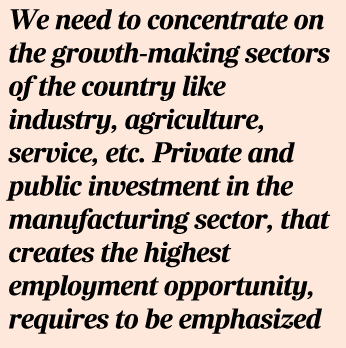
We need to concentrate on the growth-making sectors of the country like industry, agriculture, service, etc. Private and public investment in the manufacturing sector, that creates highest employment opportunity, requires to be emphasized. Village economy should be more integrated to national economy through modernization of agriculture and establishment of agro-based industries. Financial inclusion initiatives need to be strengthened. Overall discipline, culture and governance of banking sector need to be brought back immediately before it is destroyed severely. Lastly, good governance in every private and public sector should be established for attainment of quality growth for the economy and quality life for the people.
The writer is a banker and columnist
kzaman906698@gmail.com
© 2026 - All Rights with The Financial Express

