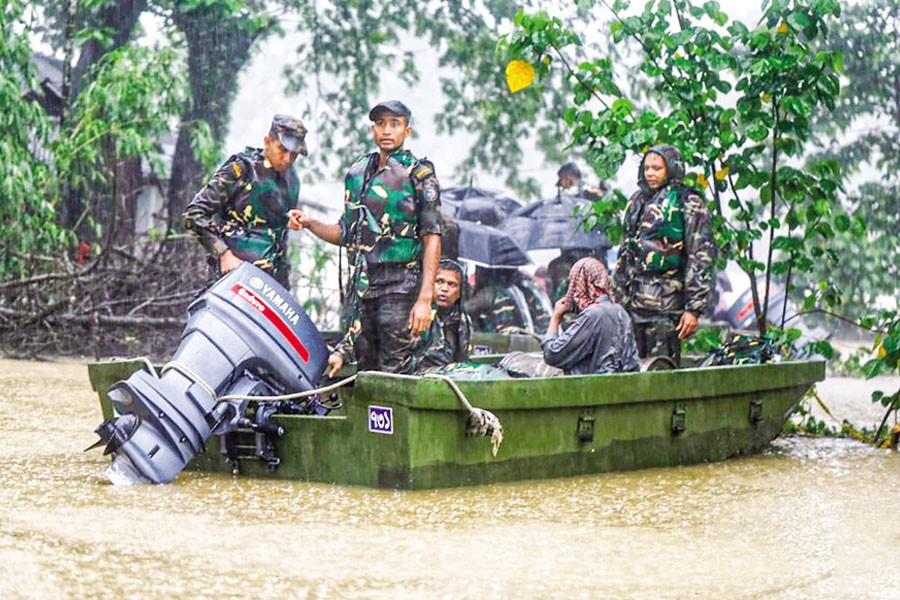
Bangladesh Armed Forces contribute significantly to relief operations in disaster management, in both national and international environment. The major mission of the Bangladesh Armed Forces is to preserve the operational continuity of the Bangladesh Army in both domestic and foreign environments, and to maintain effective military action and security of the state, including safeguarding the possessions of concerned areas. We know that emergency management ensures proper coordination and integration of supporting activities to sustain the capacity to control harmful disasters, terrorism, and other man-made hazards. The word disaster comes from the French word 'Desetre' i,e. bad or evil star. A disaster occurs when any hazard affects the functions of our society and lives, environment and infrastructure. National disasters are floods, cyclones, tsunamis, earthquakes, epidemics like Covid 19, etc. Manmade hazards cover fire, industrial accident, etc.
The Bangladesh Armed Forces played a pivotal role in disaster management over the past decade, engaging in various operations to mitigate the adverse impacts of natural calamities. Below is a comprehensive overview of their efforts, structured around the key aspects of disaster response:
During the 2024 flood approximately 2,881 members were engaged, 100 boats and 10 helicopters utilized, 34 relief camps provided prompt relief to the affected regions. The Armed Forces Division (AFD) collaborates closely with the Ministry of Disaster Management and Relief (MoDMR) to develop contingency plans, particularly for earthquake-prone areas like Dhaka. Regular simulations, such as the Disaster Response Exercise and Exchange (DREE), are conducted to enhance the preparedness. Upon occurrence of a disaster, AFD establishes monitoring cells to coordinate with relevant ministries, ensuring a unified response. The Armed Forces operate under the "In Aid to Civil Power framework", providing support to the civil authorities during emergencies. Deployment includes specialised units such as amphibious teams, engineering corps, and medical teams. Assets like helicopters, boats, and high-water vehicles are utilized to have access to remote or inundated areas. The Armed Forces establish relief camps, provide logistic support, and assist in restoring the critical infrastructure. In August 2024, approximately 42,816 flood-affected individuals were rescued by the Armed Forces. During the 2017 landslides, thousands were evacuated to emergency shelters with the assistance of the military. Field hospitals and temporary medical camps are established to provide immediate care, including emergency treatment and surgeries. Medical teams address a range of health issues, from acute illnesses to chronic conditions exacerbated by disasters. The Armed Forces assist in maintaining law and order in disaster-affected areas, preventing looting, and ensuring the safety of both the victims and relief workers. They cordially support local law enforcement agencies in patrolling and securing relief distribution sites. Medical assistance includes the deployment of field hospitals, mobile medical units, and specialized medical personnel. Services provided encompass emergency care, health screenings, vaccination drives, and sanitation awareness campaigns, etc. The Armed Forces distribute essential medicines and medical supplies as part of their relief operations. In 2024, they provided treatment to over 42,113 individuals, indicating substantial distribution of medical resources. Medical teams comprise doctors, nurses, and paramedics. For instance, in August 2024, seven temporary medical teams provided assistance to 864 individuals in a single day. In August 2024, the Armed Forces deployed 2,881 personnel, 100 boats, and 10 helicopters across 34 camps to assist the flood victims. Engineering units were mobilised to restore critical infrastructure, including roads and communication networks.
With the growing emphasis on disaster management at the national level chapters on disaster management have been included in the textbooks of classes 11 and 12. Disaster management & climatic change have been incorporated in the Training Modules of 41 Education Training Institutes. Damage & Need Assessment (DNA) Cell has been organised under The Emergency Cyclone Recovery Restoration Project (ECRRP-D-1). In 64 districts Relief & Rehabilitation Officers and Upazilla Project Implementation Officers have been given effective training based on Damage & Need Emergency Software. Multi Hazard Risk & Vulnerability Assessment (MRVA) cell has also been established. Eight risk maps are uploaded on the website to control flood, cyclone, earthquake, tsunami, drainages, land spoilage, technology & health hazards, etc. Early signals are given by Interactive Voice Response (IVR) System. Disaster management data centres have been organised in 64 districts. Pickup van, m?g? phone, siren, water ambulance, small marine rescue boats, rough sea aquatic search & rescue boat, satellite phones, etc. are made timely available in the cyclone-prone areas. Disabled-friendly 60 multipurpose reserve boats are also available in 24 districts. Supervision/Monitoring in different phases is also significant.
Pre-Disaster: The Armed Forces Division (AFD) cooperates with the Ministry of Disaster Management and Relief (MoDMR) to formulate contingency plans, conduct disaster response exercises like the Disaster Response Exercise and Exchange (DREE), and maintain a web-based disaster management database. These initiatives help enhance the preparedness and coordination among the various agencies.
Post-Disaster: Upon occurrence of a disaster, the AFD establishes monitoring cells to coordinate relief operations with relevant ministries, including Health, Home Affairs, and Civil Aviation. This ensures a unified and efficient response across different sectors.
The Armed Forces are deployed under the "In Aid to Civil Power" framework for rapid mobilisation in emergencies providing Search and Rescue Operations by boats, helicopters, and specialised teams for affected individuals, field hospitals and medical teams provide immediate healthcare services, use engineering units for repairing roads, bridges, and communication networks, logistics support consists of transporting and distributing relief materials in various-affected areas. In August 24 about 9,500 individuals were rescued using 55 boats and helicopters. Total rescues were around 42,816 individuals. Medical teams were engaged in providing general healthcare treatment for common ailments and injuries, specialised care for gynaecology, dermatology, and internal medicine, emergency treatment for critical patients covering pregnant women and other related victims.The Armed Forces ensured Protection of the Relief Operations creating distribution points to prevent disorder, maintenance of Law and Order through local authorities in controlling the misuse and developing public safety. Infrastructure security follows critical infrastructure and other related communication facilities. Medical facilities cover the field hospitals which developed temporary facilities for surgeries and emergency help. Mobile Clinics use medical teams in remote areas lacking healthcare access. Collaborative Efforts are also made with civilian and medical people for better output.
Practically challenges in disaster management are to develop common good to inspire and motivate the talented human resources. Sound Management Skills are to be developed for organizing the resources, proper planning and implementation of the pragmatic strategies. We know that army is a smart fighting force protecting our land, sea and air for which effective training programmes are organized for the elite groups like Army Rangers Special Forces. The main motto of Bangladesh Army is that "we are everywhere for our nation in war and in peace. It shows wide commitment to national protection in war time as well as in peace." Responsibilities of Disaster Control Group are mainly to conduct disaster operations, coordinate the local security efforts, human resource identification in the specific areas, follow the alarm signals and communication with the concerned authorities, and create good awareness for facing the disaster situations and cooperate with the armed forces and civil population for effective rehabilitation tasks.
The vision 2021 provides emphasis on seasonal flood and drought mitigation through effective early warning and evacuation mechanism, disaster insurance scheme for compensating the physical and property damage. We know that Bangladesh Delta Plan and National Sustainable Strategies are related to the implementation of the National Policies for Distribution Management (NPDF). During the 7th Five Years Plan the government distributed food items among 2.1 million people. Through the humanitarian assistance programme under VGF eight million beneficiaries were provided food. Under the Test Relief Programme 10 million rural workers were benefited. In six haors districts, flood-affected families were given good support. On the hill side rice and CI sheets were given for construction of their houses. Two hundred thousand solar panels were developed along with 30,000 solar street lights in rural areas.
In the 8th Five Years Plan, priority is given to delivery of basic services comprising health education and water during disaster. During the Covid 19 pandemic structured MIS was used for monitoring the climate change and vulnerable earthquakes. Now a days a comprehensive policy on the integration of disaster reduction is highly significant. We need good coordination among the Ministry of Planning, Ministry of Environment, Ministry of Disaster Management & Reduction so that effective link between Disaster Risk Reduction and Climate Change Adaptation might be easier. Measures adopted in the 8th Five Years Plan are the promotion of private sector resilience to disaster and climate change through public and private partnership. Applied disaster and climate change issues like better coordination mechanism within the ministry, partnership with NGOs, improved guidelines for water safety, industrial safety, disaster shelter management, risk assessment, emergency fund management, etc. are highly significant. Good use of technology for early warning system, training emergent responder, enhancing the community risk assessment guidelines and information guidelines would be more conformity significance for controlling the adverse effects of multi-dimensional disasters that might happen in our economy. Virtually our Armed Forces have taken a good initiative for implementing the National Strategies for Disaster Management Reduction Programmes. The performance indicators would be human development opportunities, controlling productive resources, participation in decision making, developing institutional capacity and accountability and ensuring good use of ethical code of conduct and social norms. In this context good understanding of the National Legislations and Policies for Disaster Management consisting of Disaster Management Act 2012, Coastal Zone Policy 2005, National Plan for Disaster Management 2008-2015, National Adaptation Program 2005, National Disaster Management Policy 2015, National Plan for Disaster Management 2010-2020, and Standing Order on Disaster 2019, etc might be more contributing for assessing climate change risk, importance of echo system and biodiversity conservation, creating public awareness, capacity building, proper project implementation, disaster risk reduction and emergency management, etc. We also need to understand the national principles of Disaster Management in Bangladesh based on their supporting strategic framework and responsibilities of talented human resources engaged in disaster management efforts at all levels in our economy.
The writer, Colonel Sarker Md Iqbal Hossain, psc, (BA-5560), is Director of Works & Chief Engineer, Bangladesh Air Force. dwceair@gmail.com
© 2026 - All Rights with The Financial Express

