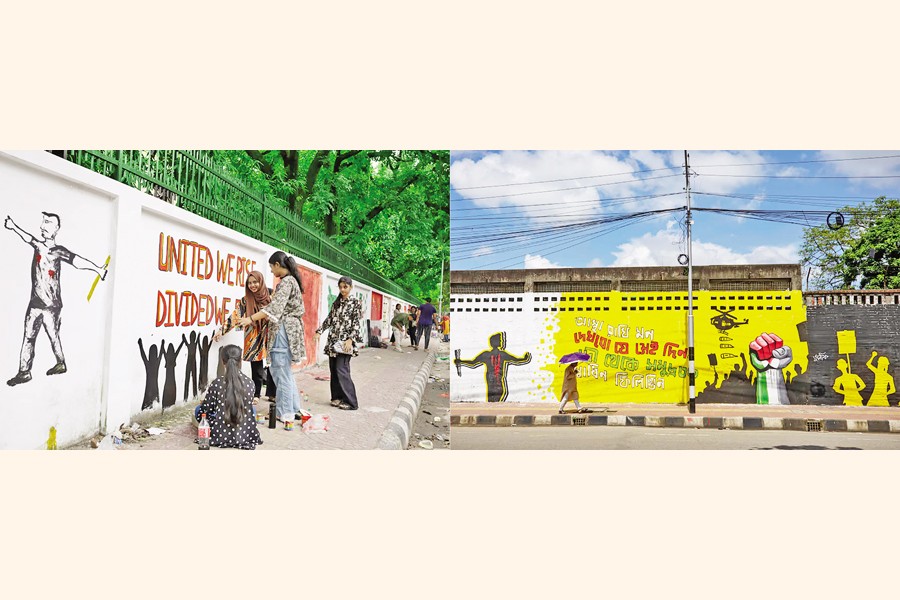
One year on from the historic July-August uprising that brought down Sheikh Hasina's long-standing authoritarian regime, Bangladesh finds itself at a political crossroads. The revolution, hailed by many as a generational awakening and the end of a brutal dictatorship, has yet to translate into deep institutional or constitutional change. While some see signs of optimism in a more politically engaged youth and shifts in party rhetoric, others warn that the foundational structures of oppression remain intact. At the heart of these reflections is a call for deeper structural change-beyond surface-level reforms-towards a truly people-centric republic.
Filmmaker and political activist Ashfaque Nipun believes that one year is too early to evaluate the full impact of the uprising. He argues that the revolution followed 17 years of a deeply entrenched and corrupt dictatorship, and that the collective anger of the people has not yet subsided. "People didn't calm down after the change," Nipun says. "It took other nations years to stabilise after similar revolutions." However, he identifies a crucial shift in political behaviour: from the dominant Awami League to the newly emerged NCP, parties are now gravitating towards pro-people politics, often guided by common consensus rather than confrontation. The emergence of spontaneous public actions-sometimes referred to as "mob justice"-reflects unresolved frustrations and points to growing societal instability. While some superficial political reshuffles have taken place, Nipun notes that entrenched systems within the police and judiciary remain largely untouched. Despite the challenges, he remains optimistic, particularly about the political consciousness of the younger generation. "They've ousted a dictator; they're politically engaged and fearless," he says. "No party will be able to establish a brutal regime like Hasina's again. The long-term impact will be seen in how governance and institutions evolve."
Writer and activist Ahmed Swapan Mahmud, Executive Director of the rights-based organisation VOICE, offers a more critical appraisal. To him, the July Uprising was not merely a political event but a profound human uprising-born from a decade of repression and sustained by hopes for democracy, dignity, and basic survival. While he acknowledges the symbolic power of ousting a seemingly unchallengeable leader, he warns that one year later, those hopes are at risk of fading. "The interim government has failed to deliver meaningful change. Institutional reform has stalled, inflation persists, and the cultural space is muted," Mahmud observes. He cautions that without bold, inclusive action, the revolution could become just another missed opportunity in Bangladesh's long struggle for justice. Yet, he sees the July Revolution as a turning point in the country's political consciousness-its memory already shaping civic institutions and public discourse. "Its legacy will endure," he asserts, "but to fulfil its promise, we need genuine reform, participatory governance, and a politically engaged citizenry."
Academic and political thinker Zobair Al Mahmud, Associate Professor at Dhaka University and a columnist, provides perhaps the most structurally critical view. While he recognises the significance of toppling a fascist-mafia regime, he insists that the core systems of oppression remain firmly in place. "The political settlement of Bangladesh is fundamentally anti-democratic," he argues. According to Mahmud, sovereignty still rests with the state apparatus rather than the people, and the country continues to operate as a security state rather than a true republic. He is especially critical of the interim government, formed under constitutional provisions that limited its scope to routine functions-thus preventing revolutionary change. "The continuation of Article 106 has preserved the undemocratic, fascist constitution," he says. For Mahmud, the revolution's true significance lies in shifting the political conflict toward a binary: preservation of the old order versus the politics of uprooting it entirely. He calls for the abolition of parliamentary sovereignty and the establishment of a new democratic constitution based on popular and individual sovereignty.
Together, the reflections of these three thinkers reveal a complex and evolving political landscape. The July Uprising may have marked the fall of a regime, but the deeper battle-for a democratic, inclusive, and accountable republic-is far from over. While optimism and caution coexist in their assessments, all three voices converge on one point: the revolution has irreversibly changed Bangladesh's political discourse. Whether that discourse can lead to substantive transformation remains the defining question of the post-uprising era.
bdsmile@gmail.com
© 2026 - All Rights with The Financial Express

