 As Bangladesh charts its path toward upper-middle-income status by 2031, few projects encapsulate the country's ambitions more than the National Special Economic Zone (NSEZ) in Mirsarai. Envisioned as a transformative industrial corridor on the country's southern coastline, the NSEZ is more than a manufacturing hub-it is a bold experiment with decentralization, climate-resilient infrastructure, and strategic investment.
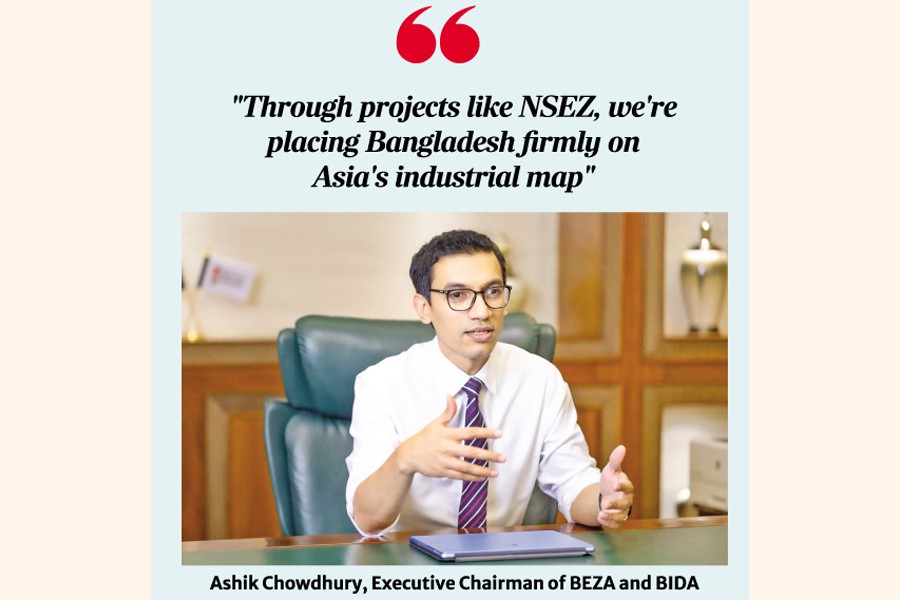
At the heart of this transformation stands Ashik Chowdhury, Executive Chairman of both the Bangladesh Economic Zones Authority (BEZA) and the Bangladesh Investment Development Authority (BIDA). Chowdhury has a far-reaching national vision rooted in robust planning, international cooperation, and inclusive development. As the driving force behind the twin institutions spearheading this industrial agenda, Chowdhury's leadership has become instrumental in shaping not just Mirsarai's future, but that of Bangladesh's industrial identity.
A Vision Beyond Garments and Growth
"The National Special Economic Zone is not just an industrial park," says Chowdhury. "It's a strategic leap forward in our national development-decentralizing economic activity, expanding beyond RMG, and catalyzing regional equity through inclusive, resilient infrastructure."
Inspired by Singapore's post-colonial industrial ascent, Bangladesh is crafting a homegrown model that aligns with its unique strengths: a labor-intensive economy, a thriving garment sector, and a young population. While Singapore emphasized port modernization and export processing zones, Bangladesh's model is more expansive-embracing diversified sectors such as electronics, pharmaceuticals, and automotive manufacturing, integrated with smart city features and climate-resilient planning.
The long-term goal is nothing short of transformative: over one million jobs created by 2041, $20 billion in new annual exports, and a series of urban-industrial ecosystems dotting the coastal belt. "We aim to turn the southern coastline into a globally competitive economic corridor," Chowdhury says, "one that directly manages urban migration, fosters sustainability, and brings opportunity to underserved regions."
Infrastructure Hurdles and the Road to Recovery
The NSEZ's development has not been without its challenges. "Establishing a megaproject on reclaimed low-lying land was never going to be easy," Chowdhury admits. Early delays in land development and inconsistent delivery of utility services eroded investor confidence. "In some cases, we didn't respond with the necessary planning and urgency. Investors let us know that," he acknowledges.
But Chowdhury emphasizes that BEZA is not operating in a vacuum. "We're working with multiple government agencies, and at times, the coordination just wasn't there. That fragmented implementation raised costs and delayed critical services."
In response, BEZA has narrowed its focus from an ambitious 100 economic zones to 05 (Five) priority projects-concentrating resources and leadership on flagship zones like Mirsarai. Over the next 18 months, the government is rolling out a phased utility deployment plan in the five priority zones.
Progress is becoming visible. BEZA has already constructed 35 kilometers of internal roads, laid 22 kilometers of gas lines connected to a 200 MMCFD pipeline, and completed a 230kV power grid with substations. A 100 MLD water treatment plant is under development, and planning for high-capacity jetties and drainage systems is underway.
"All government policies now prioritize economic zones. We've reformed our procedures, and we're seeing real results," Chowdhury says. "What investors want is predictability, and that's what we're working toward."
Investment Momentum: $18 Billion and Counting
Despite early setbacks, investor interest in the NSEZ is growing. According to Chowdhury, the zone has already secured approximately $18 billion in investment commitments, with $3-4 billion originating from international firms. Land has been allotted to 155 investors; 15 factories are operational, and 28 more are under construction.
"From garments and steel to electronics and chemicals, we're seeing a diverse mix of sectors take root," he says. "This is not a one-industry zone. It's a platform for Bangladesh's industrial future."
Once fully operational, Chowdhury estimates the zone could contribute 1-1.5% of national GDP and generate over 1.4 million direct jobs. "It's not just about exports-it's about creating an entire ecosystem of employment, housing, training, and SMEs across Chattogram."
A Digital Backbone for Investment Facilitation
A key enabler of this transformation has been the One-Stop Service (OSS) Center, designed to streamline the investment process. "Investors need speed and clarity, and OSS gives them both," Chowdhury explains.
Currently, BEZA's OSS offers 60 online and 65 manual services-from registration to permits to utility approvals. It has cut approval times from months to as little as one or two weeks. The government is also integrating BEZA's OSS with BIDA's services and the National Board of Revenue's National Single Window platform, which digitizes and automates trade logistics.
"This digital ecosystem is reducing red tape, increasing transparency, and making Bangladesh more competitive," Chowdhury asserts. "It's one of the most investor-friendly reforms we've undertaken."
Institutional Alignment: A Government That Speaks with One Voice
Chowdhury attributes much of the recent progress to improved inter-agency coordination. "You can't fix the investment climate if your own house is divided," he says. "We've made it a priority to streamline operations within government."
Monthly inter-ministerial coordination meetings, chaired by the Special Envoy to the Chief Adviser, now bring together heads of BEZA, BIDA, NBR, Chittagong Port Authority, and other key institutions. These forums resolve bottlenecks, propose legal changes, and ensure accountability.
"We've also built mid-tier coordination links between BIDA, BEZA, BEPZA, the ICT Park Authority, and PPP Authority to avoid duplication and harmonize investor services," Chowdhury says. "It's a team effort-and that team is finally aligned."
Risk Management in a Vulnerable Landscape
The location of NSEZ-on Bangladesh's climate-vulnerable coastline-presents both opportunity and risk. "We're acutely aware of the environmental challenges," Chowdhury admits. "Flooding, cyclones, and pollution are very real concerns."
To mitigate these risks, BEZA is implementing phase-wise land development, constructing a 20-kilometer super-embankment, and mandating environmental impact assessments. All new infrastructure follows green building codes, and climate resilience is now a core planning parameter.
"We can't afford to repeat the mistakes of unplanned industrialization," Chowdhury says. "This has to be different."
The Utility Puzzle: Delivering at Scale
Utility infrastructure remains a logistical and financial challenge-but one where significant progress has been made. "Despite a national gas shortage, we've ensured 200 MMCFD connectivity to the zone," Chowdhury notes. Power is relatively stable, backed by a 230 kV grid line and three distribution substations. A major water treatment plant is in development.
Other projects-including a 30 km road and storm drainage system, a skills development center, solar power installations, emergency facilities, and community services-are progressing with support from the World Bank.
BEZA's National Mandate
Operating under the Chief Adviser's Office, BEZA's strategic mandate is sweeping: to plan, license, regulate, and support economic zones nationwide. Its goal is to catalyze domestic and foreign investment through high-quality infrastructure and streamlined services.
But beyond investment, BEZA's mission is about transformation-of regions, industries, and livelihoods. "We're advancing national priorities like export diversification, job creation, and regional balance," Chowdhury says. "Through projects like NSEZ, we're placing Bangladesh firmly on Asia's industrial map."
What emerges from this conversation is not just a tale of infrastructure or investment-but a vision of Bangladesh's evolution. The NSEZ may still face hurdles, but under Ashik Chowdhury's leadership, it has begun to transform from a contested dream into a tangible reality-one port, one pipeline, one partnership at a time.
As the world watches Bangladesh navigate the transition from low-cost manufacturing to value-added production, the success of Mirsarai could serve as a template-not only for the country's coastal development, but for its broader ambition to lead in the emerging industrial age of South Asia.
moincu2010@gmail.com
© 2026 - All Rights with The Financial Express

