In the rapidly evolving landscape of Bangladesh's economy, the banking sector stands as its backbone. However, as the industry shifts from traditional brick-and-mortar setups to a digital-first approach, a critical realization is dawning upon financial institutions: technology is the vehicle, but customer service is the fuel. In an era where financial products are nearly identical across competitors, the quality of interaction has become the primary differentiator for survival, trust, and long-term growth.
FROM TRANSACTIONS TO TRUST: For decades, banking in Bangladesh was synonymous with long queues and manual ledgers. Today, the scenario is drastically different. According to Bangladesh Bank data, Mobile Financial Services (MFS) accounts have crossed the 217 million mark as of early 2024, and internet banking users have seen a year-on-year surge of over 44%.
While these numbers signal a digital revolution, they also highlight a shift in consumer expectations. Modern Bangladeshi customers-particularly the "Gen Z" urban professionals and rural entrepreneurs-no longer just want a place to store capital; they demand seamless, 24/7 responsiveness. Recent studies using the SERVQUAL model (Service Quality) in the local context show that "Reliability" and "Responsiveness" are now the most significant predictors of customer loyalty in Bangladesh.
THE ECONOMIC COST OF POOR SERVICE: In a competitive market with over 60 scheduled banks, the cost of a single bad experience is exceptionally high. Research suggests that it is five times costlier to attract a new customer in Bangladesh than to retain an existing one. Furthermore, a 2024 survey of private commercial bank users revealed that while 83% of respondents value the speed of digital transactions, 39% still harbour deep-seated concerns regarding cyber security and technical glitches.
When these glitches occur, the "human touch" becomes paramount. The Bangladesh Bank's Customer Interest Protection Centre (CIPC)-reachable via the 16236 hotline-was established specifically to bridge this gap. Data indicates that banks with robust, empathetic complaint-resolution mechanisms retain 70% more customers during technical crises than those that treat grievances as mere administrative hurdles.
Data-Driven Insights: Recent surveys of both public and private bank customers in Bangladesh reveal a clear hierarchy of needs that goes beyond interest rates:
 "Positive customer service experiences are the primary drivers of trust in the Bangladeshi banking industry. Without trust, even the most advanced fintech application fails to achieve mass adoption." - Insights from 2024 Research on Banking Reputation.
THE HYBRID APPROACH: The hybrid approach to customer service in the Bangladeshi banking sector is a strategic "middle-ground" that blends traditional banking with modern digital solutions. This model has gained significant traction as banks strive to serve a unique demographic split: a growing population of tech-savvy youth and a large segment of senior citizens who still value face-to-face interaction.
The hybrid model follows the "Digital First, Human When Needed" ideology. Routine tasks like checking balances, paying bills, and transferring funds are pushed toward mobile apps (e.g., CityTouch, EBL Skybanking) and web portals. Complex advisory services-such as home loans, SME financing, and wealth management-remain anchored in physical branches where personal rapport is critical for high-value decision-making.
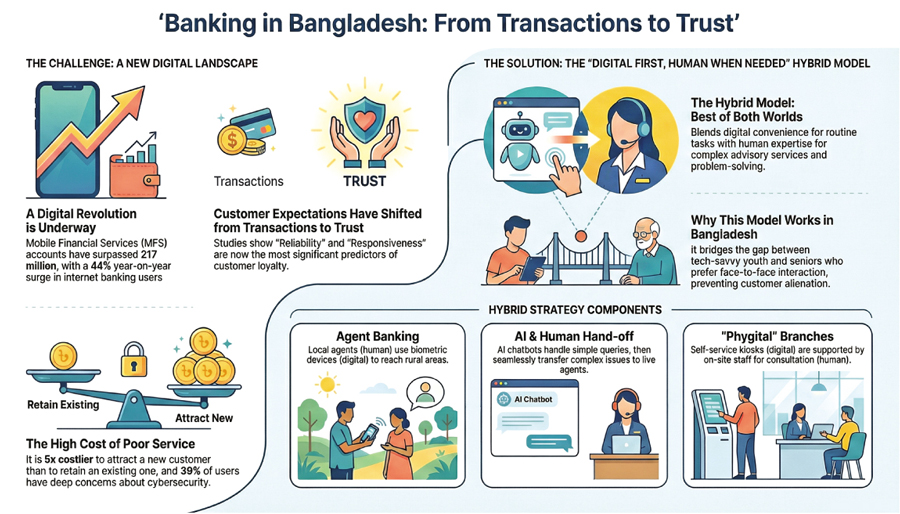
WHY THIS MODEL: According to recent research, the older generation in Bangladesh still associates "safety" with physical bank visits. Conversely, the youth demand 24/7 access. The hybrid model prevents alienating either group. Digital-only banks face trust issues in rural areas. The hybrid approach-specifically through Agent Banking-provides the physical presence needed to build trust while using digital back ends for scale. By moving low-value transactions to digital channels, banks can reduce branch congestion and focus their expensive human capital on sales and specialized services.
 CURRENT CHALLENGES: A significant portion of the population still struggles with mobile interfaces, requiring banks to keep "floor walkers" in branches to guide customers through digital kiosks. Frequent internet disruptions or server downtimes in remote areas force a fallback to traditional manual systems, making the "hybrid" balance difficult to maintain perfectly. As services go digital, the risk of cyber-fraud increases. Bangladeshi banks must balance ease-of-use with stringent (and sometimes cumbersome) security protocols.
FUTURE OUTLOOK: With the Bangladesh Bank (the central bank) recently issuing licenses for Digital Banks, traditional commercial banks are accelerating their hybrid transition. Expect to see "Universal Bankers"-staff trained to handle both digital troubleshooting and financial advisory-becoming the standard in the industry.
Customer service is no longer just a department; it is a philosophy that must permeate from the boardroom to the teller counter. For the banking sector in Bangladesh, excellence in service is the most effective shield against market volatility and the strongest magnet for sustainable growth. In the end, at the heart of every digital transaction is a human being seeking security, respect, and a helping hand.
The writer is a banking professional. mdruhinhossain@gmail.com
© 2026 - All Rights with The Financial Express

