Tarnima Warda Andalib and Dauwood Ibrahim Hassan | May 10, 2025 00:00:00
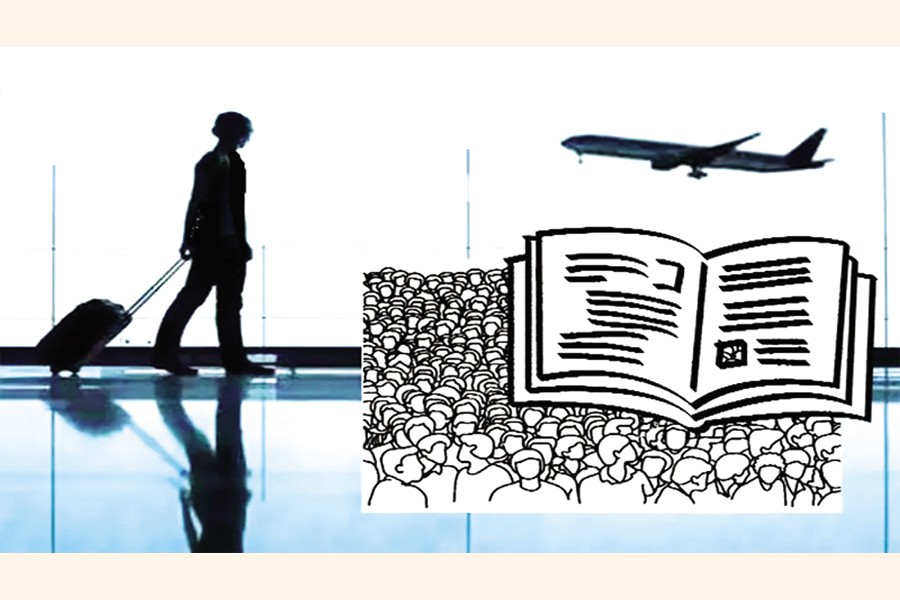
 The emigration of skilled young professionals, commonly referred to as brain drain, poses a significant challenge to national talent retention, particularly in developing countries. A decade ago, in 2012, Docquier and Rapport addressed the issue of several young professionals leaving their home countries in search of better job opportunities, higher wages, and improved living conditions, leading to a loss of young talent and weakening the domestic workforce. Wang Ping, the popular Chinese American writer, wrote in one of her poetry pieces :
"Condemned to wander,
Lost among the roots of our six senses,
Gazing at New York,
Gazing homeward."
At the time in 2009, Bhagwati and Hanson also stated that limited job opportunities and insufficient career growth in their home countries further pushed skilled people towards emigration, contributing to economic stagnation and a decline in innovation. In 2020, Haque said that in Bangladesh, the lack of investment in research, technology, and higher education results in fewer incentives for young professionals to stay, ultimately hampering national development. Additionally, Beine along with a few other colleagues argued in 2008 that brain drain depletes key sectors such as healthcare, engineering, and information technology, which rely heavily on skilled labour. Brain drain of the youth has become a significant problem for Bangladesh, as most educated and experienced young professionals migrate to other countries in pursuit of better opportunities because opportunities are limited in the country.
In 2021, Haque and Rahman also particularly shed light on the political instability, where limited industries are developing, and inability in generating sufficient jobs indeed force most graduates to seek careers elsewhere. Karim emphasized and stated in 2020 that the social elements, including nepotism and corruption in the hiring process, also discourage young talents from staying in the nation, as they are unable to secure employment based on merit. Mahmud along with a few other colleagues discussed back in 2022 that the large-scale migration of skilled employees and specifically created a noise that it is indeed losing the human capital of the country by weakening the capability of Bangladesh to drive innovation, economic growth, and industrial development. Moreover, the lack of an entrepreneurial and research-conducive environment also compels talented young minds to pursue stability and career growth elsewhere. Brain drain will continue to hamper the national development, therefore, policy-makers of the country must prelude innovative policies to increase employment opportunities, allow for more transparency, and provide a better work environment to retain the cream of the crop. In 2020, Rahman and Sarker talked about Bangladesh's economic expansions and advancement in development, where they mentioned that the ongoing exodus of skilled workers creates a vacuum in the local industries' expertise, especially the essential industries, which face massive challenges inside the country. Sometimes, consultants from a different country are hired by these industries to fill-up that gap of expertise, which is expensive. Therefore, the continuous loss of talented individuals from the country known as brain drain affects Bangladesh the most through its young population.
There are plenty of reasons that drive this mobility of young talents from Bangladesh to elsewhere. First and foremost, the reason to leave the country lies in the social insecurity and unemployment problems. The scarcity of work opportunities coupled with inadequate salaries and minimal professional growth forces Bangladeshi young professionals to search for better career opportunities in foreign countries. In 2021, Haque and his colleagues addressed the political instability, along with corruption, as well as one of the biggest reasons to leave the country.
Moreover, the infrastructural issues along with the lack of consistent management policies. A large number of international higher education students avoid returning home because they find better standards of living and career opportunities in developed nations. In 2019, Ahmed stated that the underutilised graduate skills compound the existing gap between educational subjects and industrial requirements throughout Bangladesh.The government together with policymakers should develop strategic approaches to resolve this problem. Enhancing employment prospects together with rising pay scales in important economic sectors would prevent youth from migrating. Rahman and Sarker discussed the higher education institutions in 2020 and emphasised improving the institutions' curriculum aligned with the local and global market as well as focused on the research initiatives to retain talented students as well.
Young professionals will gain confidence when governance systems become transparent, along with the reduction of corruption and investment in modern infrastructure. Haque and a pool of colleagues also discussed the tax benefits, together with startup funding, to establish incentives that encourage local talent to invest in domestic economic development instead of pursuing opportunities in foreign nations in 2021. The reduction of youth brain drain in Bangladesh will become possible through addressing these fundamental issues which create an environment that retains and develops skilled workers. The ongoing brain drain through skilled professional migration is affecting Bangladesh as it is causing a loss of valuable human resources that limits economic growth potential. When skilled young professionals migrate abroad in search of better career prospects, they carry with them all the potential, innovative capabilities, and expert knowledge needed for national development. People with potential and ability seek better opportunities because their employment prospects are low, their income is inadequate, and the social situation is marked by political instability and biases based on family ties. As the education system fails to meet the needs of the industry, trained graduates find limited use of their education in the local workforce. Policymakers need to take immediate action by establishing an environment that encourages both professional advancement and fair social opportunities.
To address this issue, governments must create policies that improve job prospects, increase investments in innovation, and offer incentives for skilled workers to remain and contribute to their home country's development. Bringing together Bangladesh's educational institutions with updated curricula and improved infrastructure will encourage young people to stay within the country. For the purpose of building the nation, Bangladesh should establish tax incentives and improved governance systems with startup capital so that talented individuals are able to join and make meaningful contributions. Funding for youth development programs will successfully transform Bangladesh's brain drain pattern into a brain gain that will accelerate sustainable national development. In conclusion, we would suggest this: "True talent is not meant to leave but to thrive where it is nurtured."
Dr.Tarnima Warda Andalib is working as an Assistant Professor in BRAC University, Dhaka as well as a Global Consultant Director at Oxford Impact group, UK.
Dauwood Ibrahim Hassan is a marketing and CIM fresh graduate with a strong passion for digital marketing, content creation, and data analysis.
© 2026 - All Rights with The Financial Express

