 As the world's climate is intensifying rapidly, Bangladesh also finds itself as the vanguard of this intensifying climate change problem. Dominated by its low lying deltaic geography, high population density and its dearth of physical infrastructure, Bangladesh is one of the climate-vulnerable countries in the world. From 2000 to 2019, Bangladesh was the seventh most affected country in the world by climate impacts. It is buffeted almost every year by cyclones, monsoon flooding, landslides and riverbank erosion, which displace millions and hurt livelihoods. Nevertheless, as this challenge mounts, one institution has quietly and potently resurrected itself as an agent for national resilience: the Bangladesh Army. The Army now understands that national security is about more than traditional defense functions; it is also about taking the long view: from climate adaptation to disaster response and sustainable establishment.
True to its slogan, "In War and Peace, we are everywhere for the Country," the Army has emerged as a central player in organizing and adapting to climate disasters. And with natural disasters so frequent and severe these days, the matter of climate disaster has fallen to the Army to perform nontraditional security duties. In coordination with the Ministry of Disaster Management and Relief (Mo DMR) it delivers a combination of both emergency response and recovery. Most significantly, Bangladesh Army deals with all the biggest infrastructure projects, such as replenishing embankments after cyclones, building flood shelters and creating climate-resilient houses for those who have been displaced due to different climate disasters.
Emergency Response: The Army as Lifesaver
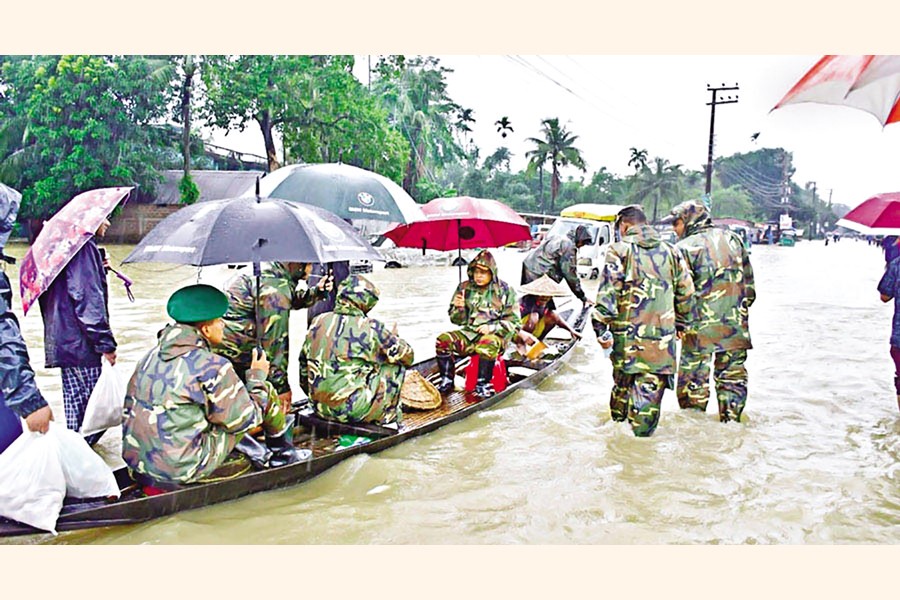
Whenever any threatening disaster hits in our country, the Bangladesh Army is amongst the first to arrive and mitigate the issue. The Army's ability to rapidly mobilize and logistically move it about, makes it the building block of the national disaster response. We have seen the contributions of Bangladesh Army in the time of need for rebuilding the nation during different disasters like, Cyclone Sidr (2007), Cyclone Aila (2009), Cyclone Mahasen (2013), Cyclone Fani (2019), Cyclone Amphan (2020), Cyclone Yaas (2021), Cyclone Sitrang (2022), Cyclone Mocha (2023), where diverse climate sensitive zones of Bangladesh like Cox's Bazar, Sylhet, Noakhali, Patuakhali, Barishal, Khulna, Satkhira, Feni districts were badly affected. Bangladesh Army also undertakes different Asrayan Projects for the disaster affected people. One of the premier projects is the Khurushkul Special Ashrayan Project in Cox's Bazar, the largest climate refugee rehabilitation programme in Bangladesh.
In 2024, among the worst in memory, the Army conducted evacuations and brought relief in Cumilla and Feni, helping more than 350,000 people escape flash floods, and rebuilding embankments, while offering farmers seeds and tools for recovery. Bangladesh Army constructed 300 new houses for the poor families who had lost their home. The project was implemented in Feni, Noakhali, Cumilla, and Chattogram, with funding from the Chief Adviser's Relief Fund of Tk 50 crore. Army completed the entire project by expending only about half of the allocation, Tk 24.98 crore, all with good quality, speed and efficiency, into the bargain. Each of the homes is roughly 500 square feet, and the houses were given to all the affected people. Speaking during a handover ceremony, Chief Adviser Professor Muhammad Yunus thanked the Bangladesh Army for their integrity and efficiency, adding that he hoped the Army continued to provide support in future disasters. This program did not only offer safe shelter to poor families but also demonstrated how effectively the military could work with the government to recuperate after natural disasters.
Green Operations and Clean Energy
The armed force of Bangladesh has also come forward in dealing with sustainability issues. To talk about that, one notable project is the 1,000MW (megawatt) Swarna Dweep Solar Power Project, led by the AWT (Army Welfare Trust) and United States firm Eleris Energy Ltd. It envisions building five solar-hybrid plants of 200 MW each over five years. Electricity produced will be used to the national grid, in line with Bangladesh's target of having 40% of all power stemming from renewables by 2041. This Project will make a significant contribution to Bangladesh's green energy, which will be delivered in a timely manner to help reduce the country's reliance on fossil fuels.
Planting the Seeds of Sustainability
Beyond all sorts of crises response, the Bangladesh Army also leads environmental protection initiatives. It launched a nationwide pro-project to plant 192,173 saplings on military lands in 2023 in a bid to restore ecological balance systems. Designated areas of all the cantonments and training areas are being transformed into mini-forests, helping with biodiversity and preventing soil erosion. In water-deprived places of Bangladesh such as the Chattogram Hill Tracts, there, the military provides drinking water and constructs durable systems such as a rainwater harvesting tanks and pumps. The projects do address immediate needs, but also prepare these communities for the next droughts of the future.
Policy Integration and Government Synergy
Bangladesh's disaster management laws formally acknowledge the military's role in disaster handling. According to the Disaster Management Act and Standing Orders on Disaster, the Armed Forces Division (AFD)-a wing of the Prime Minister's Office-is responsible for coordinating all military support during the crucial times of national disaster. The Army operates in close harmony with the Health, Local Government and Foreign Affairs ministries to deliver a combined effort.
This integration allows for rapid action and the ability to collaborate with civil authorities, NGOs, and international organizations. The people of Bangladesh have also seen during the time of any disasters/foods, the Army worked hand in glove with the Red Crescent, as well as UN agencies such as UNICEF and WFP, and local NGOs to distribute all sorts of relief and build shelters.
International Partnerships and Peace Missions
The Bangladesh Army is also a modest contributor to cross-border causes. Since 2010, Bangladesh Army is conducting the Disaster Response Exercise and Exchange (DREE) programs with the United States Pacific Army and all the representatives of regional countries. It is one of the Asia Pacific's largest emergency preparedness platforms, where representatives of almost all the regional countries, the United States regional armed forces, law enforcement agencies, and civilian emergency response authorities participate.
In the year of 2023, a massive earthquake happened in Turkey, during which Bangladesh Army engineers and medics delivered life-saving assistance and received international acclaim. Moreover, in recent past after a powerful 7.7-magnitude earthquake shook Myanmar on March 28, 2025, the Bangladesh Army quickly mobilized support to aid the affected persons. Bangladesh Army sent a 55-member team comprising doctors, engineers and rescue workers under orders from Chief Adviser Professor Muhammad Yunus. They shipped more than 151.5 tons of emergency supplies, including food, medicine, tents and hygiene supplies, which were flown and shipped using army planes and navy ships over three phases from 30 March to 12 April 2025. The Army medical team treated many affected people in Myanmar's capital, Naypyidaw, even performed all sorts of lifesaving operations. However, this mission conducted by the Army highlighted Bangladesh's rapid response, generosity and strong regional responsibility spirit.
Regional Cooperation for Climate Resilience
In South Asia, where risks to the climate change often reach across borders, the Armed forces of Bangladesh are spearheading joint efforts with its regional countries. Bangladesh Army takes part in joint disaster drills, exchanges information and gets assisted in relief distribution planning under structures such as BIMSTEC and SAARC. The regional cooperation has even led to collective building of cyclone shelters and flood embankments. This operational structures have dual uses, providing safe shelters in the times of disaster and serving as places of community gathering on regular days. The Army is equally engaged in promotion of sustainable agriculture projects in the neighboring countries, including climate-smart agriculture. These projects' alliances advance food security and environmental resilience in common ecosystems.
Future Pathways
However, despite all the successes which Bangladesh Army gained through its wisdom, future difficulties remains. Formal regional treaties with lower focus on climate migration; trans-boundary water resource sharing and defense sector decarburization could impede the learning curve for Bangladesh Army. The military needs to be an advocate for climate security integration into national and regional defense planning. There is also increasing demand for specialized climate units in the armed forces to provide an individual focus on readjustment, mitigation, and environmental safety. The military is also conducting its own capability enhancement programs, training soldiers in sustainable development and disaster resilience. At an international level, supports from global climate funds, the United Nations Framework Convention on Climate Change (UNFCCC) and multilateral development banks can help deliver the long-term financing needed for mega projects like cyclone/flood defenses and non-conventional energy plants.
A Model for the World
Bangladesh Army's development as an innovative leader in climate change resilience is a model of civil-military collaboration on a global scale; and it can be instructive for other similarly situated countries around the globe. It's rapid response to national emergencies, efforts to make itself sustainable and incorporation with government's national disaster policy have made itself a core component of development agencies. However, as climate change continues to recast our world, the leadership of the Bangladesh Army provides a roadmap for other developing countries struggling to meet such crises. It proves that forces, when armed with resolve and a sense of purpose, can be warriors not only of battle but of sustainability.
The author is a Major with the Bangladesh Army
anas.manzur8324@gmail.com
© 2026 - All Rights with The Financial Express

