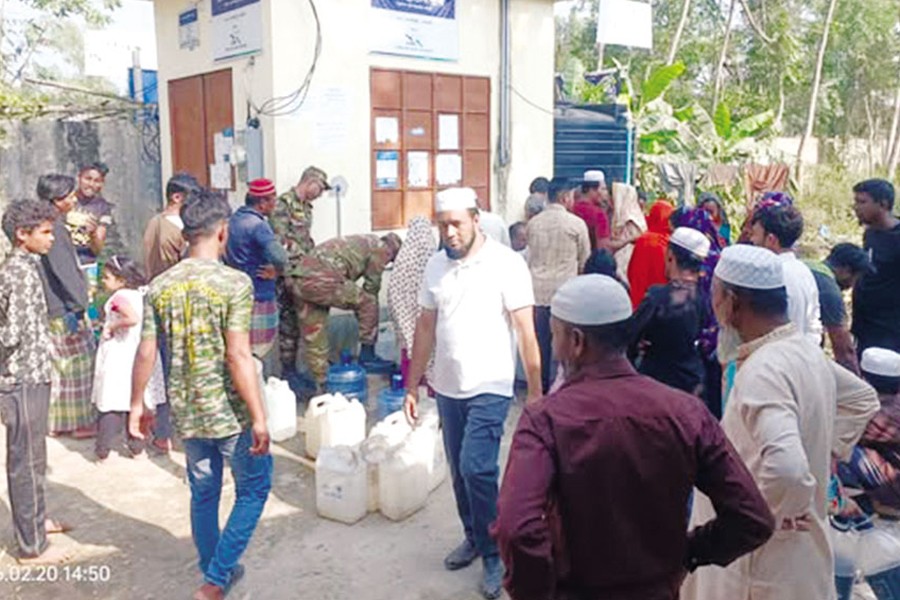
Despite significant economic growth and declining national poverty rates, extreme poverty remains persistently concentrated among specific communities in Bangladesh. Nowhere is this paradox more visible than in Sonaimuri upazila of Noakhali, located in a district officially recorded as having one of the lowest poverty rates in the country, yet home to thousands of households living in intergenerational poverty. This persistence raises a policy-relevant question: can domestically mobilized Islamic social finance instruments improve poverty graduation outcomes at lower fiscal cost than conventional interventions?
A project endline assessment of the Sonaimuri Integrated Zakat-Based Livelihood Project (2014-2025) implemented by Center for Zakat Management (CZM), provides a rare longitudinal dataset to assess this question empirically. Data-driven insight into whether faith-based social finance, specifically zakat, can move beyond short-term relief and function as a credible poverty graduation mechanism is essential for policy and practice. The findings are striking when strategically designed and integrated with livelihood support, health services, skills development, WASH and managerial support for grassroots organizations, zakat can contribute not only to immediate consumption smoothing but also to sustainable income generation and asset building.
The evidence suggests that integrated, graduation-oriented zakat models are more effective than one-time cash or in-kind assistance in improving income stability, strengthening resilience to economic shocks, and promoting social development. This positions zakat not merely as a charitable safety net, but as a structured pathway toward economic inclusion and long-term poverty reduction.
The Sonaimuri Context: Poverty Beneath the Average
Baseline surveys across Sonaimuri upazila identified 10,279 households, of which 98 % were classified as extreme poor by income, asset, and vulnerability criteria. Most were landless, dependent on low-return informal work, and highly vulnerable to health shocks, climate stress, and debt cycles. Female-headed households and persons with disabilities were disproportionately affected. This reality stood in sharp contrast to district-level poverty statistics, exposing a well-known gap in policy design: aggregate success masking localized deprivation.
 The intervention model conceptualizes zakat not only as a consumption subsidy, but as an equity transfer to economically active (productive) underprivileged households, accompanied by health support, education, savings mobilization, skills training, and institutional support. At the same time, individuals who are unproductive (physically inactive) receive regular basic sustenance assistance through a structured grassroots delivery mechanism.
Different Uses of Zakat: Core Economic Outcomes
The Sonaimuri project, implemented by the Center for Zakat Management (CZM) over 11 years in phases, adopted a structured graduation-oriented financing model. Rather than relying on one-off transfers, zakat was deployed as equity capital for income-generating activities, supplemented by health services, safe drinking water, improved sanitation, pre-primary education, emergency assistance, Qard-e-Hasana and management support. This integrated design was critical, as livelihoods were addressed holistically rather than in isolation from other basic needs such as health, education, and WASH.
The Project was based on three pillars:
• Economic empowerment through productive asset transfer and equity financing
• Human development via health, education, WASH, and emergency protection
• Institutional anchoring through grassroots organizations (GROs) and community hubs (Jeebika Unnayan Kendra)
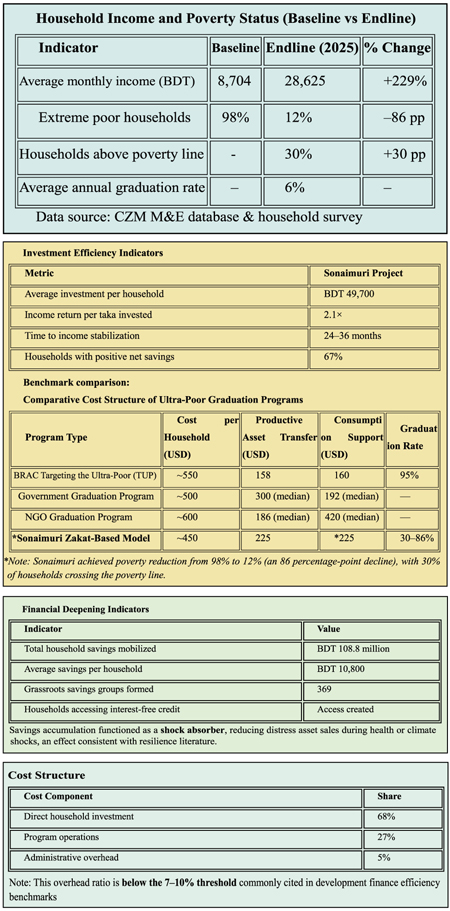
The project has contributed to a notable reduction in income poverty among the extreme poor, even as the extreme poverty rate has increased at the national level.
The observed 6% annual graduation rate is substantially higher than Bangladesh's estimated 1% national poverty reduction rate, indicating that the outcomes are more likely attributable to Zakat-based interventions rather than general macroeconomic trends.
Importantly, income gains occurred despite approximately 60% cumulative inflation over the project period, implying positive real income growth. A household earning BDT 28,625 in 2025 had a purchasing power equivalent to BDT 17,842 in 2019 prices, reflecting the cumulative price increase of 60.4% between 2019 and 2025. To maintain the same standard of living as in 2019, the household would need a nominal income of about BDT 25,664 in 2025 (16,000 × 1.604). Since the actual nominal income is BDT 28,625, the household's real purchasing power exceeds the 2019 baseline, increasing to BDT 17,842 in 2019 prices, which is approximately 11.5% higher than the 2019 rural baseline of BDT 16,000 after adjusting for inflation.
Beyond income growth, the program generated substantial social and institutional outcomes that reinforced economic progress. Access to regular primary healthcare reached 75% of participating households, while pre-primary enrollment and school attendance rates exceeded 90%, indicating strong human capital development. Women's participation in savings groups and enterprise activities increased to more than 70%, strengthening both household decision-making and community-level economic engagement. At the same time, ethical financial practices, including interest-free lending (Qard-e-Hasana) introduced and planned savings, became widely adopted, contributing to greater financial discipline, social trust, and institutional cohesion.
Capital Efficiency and Returns: Value for Money
The Sonaimuri Livelihood Project demonstrates that zakat can serve as a cost-efficient development financing tool for ultra-poor graduation. With an average investment of BDT 49,700 (approximately USD 450) per household, the program generated an estimated income return of 2.1 times per taka invested, achieved income stabilization within 24-36 months, and enabled 68% of households to build positive net savings. Compared with global benchmarks, including BRAC's Targeting the Ultra-Poor programme, NGO graduation program, and other donor-funded graduation initiatives, the zakat-funded Sonaimuri model achieved graduation outcomes comparable to or in some cases higher than those reported in global graduation program, with results ranging from 30% of households crossing the poverty line to an 86-percentage-point reduction in extreme poverty. Notably, these outcomes were achieved at the lower end of the international cost range (around USD 450 per household), demonstrating that domestically mobilized zakat can deliver strong poverty graduation results with high cost-efficiency and potential scalability. The study shows that the Sonaimuri model achieves graduation outcomes comparable to the lower bound of global cost ranges, despite relying largely on domestic capital.
Savings, Assets, and Financial Behaviors
The Sonaimuri project contributed significantly to financial deepening and household resilience among ultra-poor participants. A total of BDT 108.8 million in savings was mobilized, with an average of BDT 10,800 saved per household over five years, supported through the formation of 369 grassroots savings groups. The households also gained access to interest-free credit, enabling productive investment without exposure to debt burdens. These savings mechanisms functioned as critical financial buffers, helping households absorb health and climate-related shocks and reducing the need for distress asset sales, thereby strengthening long-term economic stability and resilience.
Operational Efficiency
The cost structure of the Sonaimuri project reflects high operational efficiency and strong resource prioritization toward beneficiaries. Approximately 68% of total program funds were allocated directly to household investments, while 27% supported program operations and only 5% was used for administrative overhead. This overhead ratio is notably below the commonly accepted development finance efficiency benchmark of 7-10%, indicating that the zakat-based model maximized fund utilization for direct poverty reduction while maintaining lean administrative costs.
Distributional and Institutional Effects
The assessment highlights multidimensional impacts that extend well beyond average income gains. It documents significant social improvements, including increased female labour force participation and decision-making power, near-universal primary school enrolment, expanded use of primary healthcare services, and reduced dependence on high-cost informal debt. Additionally, the establishment of 369 grassroots institutions strengthened decentralized savings management, enhancing allocative efficiency and accountability at the community level.
Constraints Identified by the Assessment
The data also reveal several structural constraints that limit the full realization of program outcomes. These include debt overhang affecting net wealth accumulation, liquidity timing risks linked to delayed zakat mobilization, limited livelihood diversification for vulnerable groups, and temporary income reversals caused by external shocks such as COVID-19 and floods. The findings indicate that zakat capital yields stronger and more resilient results when complemented by other Islamic social finance instruments, particularly Qard-e-Hasana, debt repayment mechanisms, and climate-risk mitigation strategies.
Policy-Relevant Inference
From an economic policy perspective, three inferences emerge:
1) Zakat can function as quasi-equity capital for economically active ultra-poor households when embedded within productive ecosystems.
2) Integrated graduation-oriented models outperform single-instrument transfers in sustaining poverty exit.
3) Mobilized domestic social finance can partially offset fiscal constraints amid declining aid flows and budgetary pressures.
This positions zakat not as an alternative to public expenditure, but as a co-financing instrument within a broader poverty and social protection architecture.
Conclusion
The Sonaimuri project demonstrates that faith-based capital, especially zakat, when professionally managed and empirically evaluated, can generate returns, graduation rates, and cost efficiencies comparable to mainstream development programme. For a country facing fiscal pressure, inflationary stress, and aid uncertainty, such instruments warrant systematic policy consideration grounded in empirical evidence and institutional feasibility.
Quazi Ahmad Faruque, Head of Operations, Center for Zakat Management (CZM),
ahmad.faruque@czm-bd.org
The author has been professionally associated with Center for Zakat Management (CZM). The analysis presented here draws on findings from a project completion report, and all interpretations are the author's own.
© 2026 - All Rights with The Financial Express

