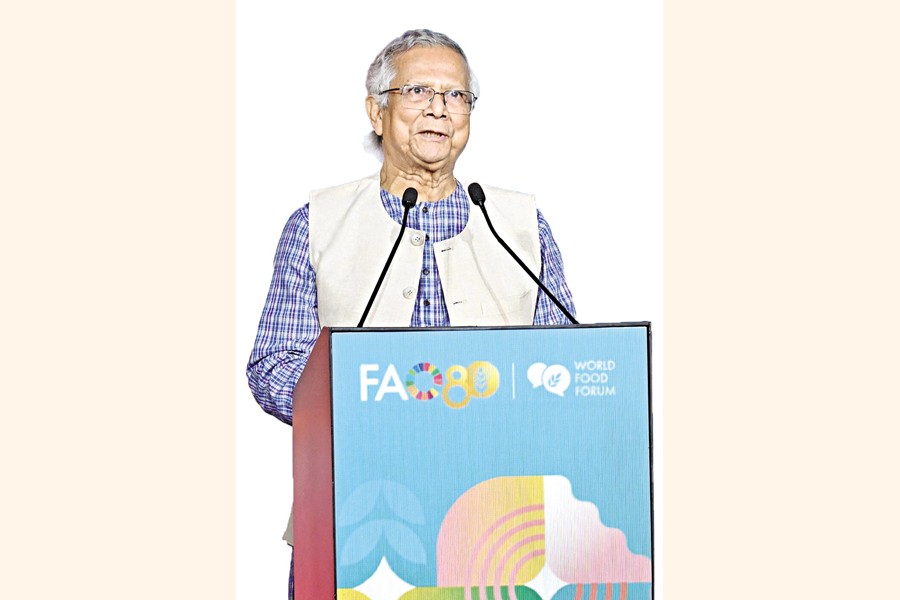
 Chief Adviser Professor Muhammad Yunus speaks at the grand opening of the World Food Forum (WFF) 2025 at the Food and Agriculture Organization (FAO) headquarters in Rome on Monday. — Focus Bangla
 Bangladesh's six-point proposal was mooted at the World Food Forum 2025 in Rome on Monday by Chief Adviser Professor Muhammad Yunus with a call for a fundamental overhaul of the global economic system to eliminate hunger and inequality.
The head of Bangladesh's post-uprising interim government made the international appeal while speaking before world leaders, policymakers and youth delegates at the FAO meet's plenary.
"In 2024, 673 million people went hungry - yet we produced more than enough food," he said. "While we couldn't raise a few billion dollars to end hunger, the world spent 2.7 trillion dollars on weapons. Is this how we define progress?"
The Chief Adviser's address - his first major international speech since Bangladesh's transition - reflects a mix of moral urgency and structural reform, positioning food as both a human right and a global-security issue.
Yunus outlined a six-point plan to tackle the hunger-conflict cycle, calling for the creation of regional food banks, an end to export bans, and greater access to technology for the Global South. The proposals also include fulfilling global SDG- financing commitments, empowering youth entrepreneurs, and ensuring food access in conflict zones through dialogue and peacebuilding.
"We must break the hunger-conflict cycle - stop the wars, start the dialogue," he said. "Trade rules must support food security, not undermine it."
Yunus praised the Food and Agriculture Organisation (FAO) "bold vision" in transforming the World Food Forum into "a platform for action, not just discussion."
Marking FAO's 80th anniversary, he said, the milestone was "a call to prepare for the future," urging nations to move beyond rhetoric and re-imagine food systems as engines of justice and dignity.
Reflecting on recent events at home, Yunus told delegates that Bangladesh's peaceful civic movement last year - led largely by young people - had restored "the people's power to ensure democracy, peace, and human rights."
Youths were now at the centre of rebuilding Bangladesh's institutions and governance, ahead of the national elections scheduled for February 2026.
"Today, those young people are shaping a new Bangladesh - one that puts its people at the centre of governance," he told his audience.
He also highlighted Bangladesh's progress in agricultural self-sufficiency despite limited land resources, noting that the country now feeds over 170 million people and shelters 1.3 million Rohingya refugees. He cited significant gains in rice production, mechanisation, and the development of 133 climate-resilient rice varieties.
"Our farmers have achieved cropping intensity of 214 per cent. We are greening agriculture, protecting soil, water, and biodiversity."
The Nobel Peace laureate urges leaders to move beyond profit-maximisation and adopt what he defines as "social business" - enterprises designed to solve problems without personal profit. This model, he argues, can drive sustainable food production, create jobs, and curb wealth concentration.
"We need a new kind of business - business that solves problems, not creates them," he said. "Social business is the way forward."
Yunus called for the creation of social-business funds to finance young entrepreneurs, farmers, and agri-tech innovators, saying that such initiatives could "turn jobseekers into job-creators".
He envisioned a 'Three-Zero World' - zero wealth concentration, zero unemployment through universal entrepreneurship, and zero net carbon emissions - as the ultimate goal of global cooperation.
The chief adviser reaffirms Bangladesh's commitment to the Global Alliance Against Hunger and Poverty, launched under the G20 with FAO's support, and pledges "real, practical support - technical, financial, and moral."
Concluding his speech, he called on nations to unite around FAO's 2025 theme-'Hand in Hand for Better Food and a Better Future'.
"Today's world has the resources and the technology," he said. "If we can imagine it, we can create it."
mirmostafiz@yahoo.com
© 2026 - All Rights with The Financial Express

