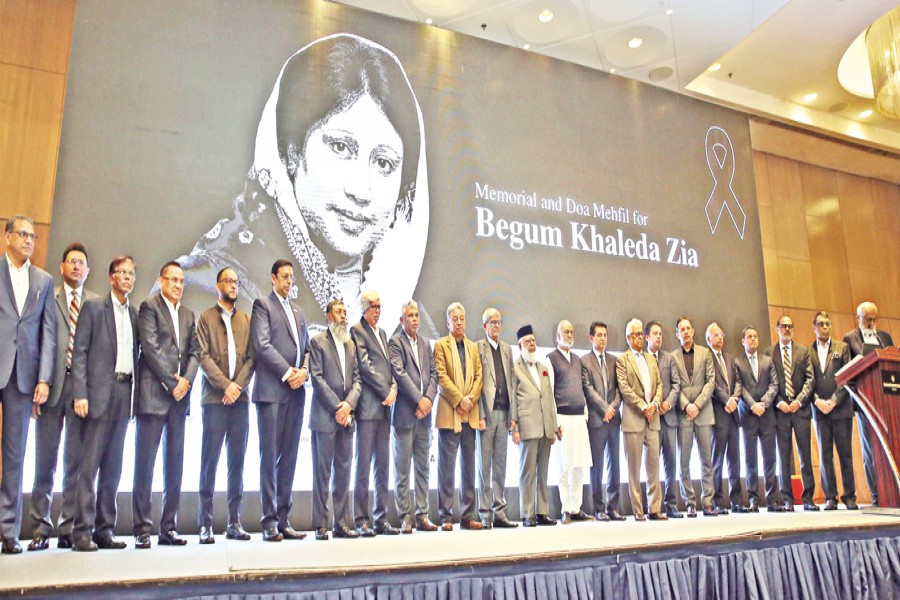
 Leaders of the BNP and the country's business community observe a one-minute silence at a Memorial and Dua Mahfil organised by the International Chamber of Commerce (ICC) Bangladesh to pay respect to former prime minister Begum Khaleda Zia at a city hotel on Monday. — FE photo by K Asad-Uz-Zaman
 Begum Khaleda Zia blended public-and private-sector development in a way uniquely suited to Bangladesh, prioritising business growth while ensuring social responsibility, a commemorative meeting recalls.
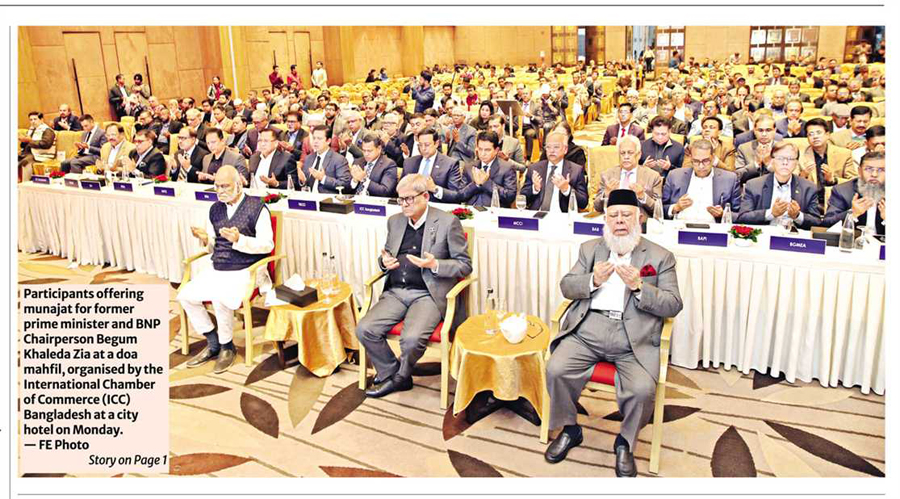
The International Chamber of Commerce (ICC) Bangladesh organised the 'Memorial and Dua Mahfil' at a city hotel in honour of the country's first woman prime minister and BNP chairperson, remembering her political courage, democratic struggles, and contributions to Bangladesh's economic and social development.
BNP Secretary-General Mirza Fakhrul Islam Alamgir told the meet that Begum Khaleda Zia's life symbolised resilience in the face of systematic repression.
He alleged around 6,000 people disappeared, nearly 6.0 million activists faced legal cases, and 47 cases were filed against Begum Zia during the last regime.
He was critical of the judiciary's role at the time, noting that a lower court sentenced her to five years in prison, later increased to 10 years by the High Court. "This reflected the condition of the judiciary during that period."
Mirza Fakhrul described her as an icon whose popularity transcended party lines.
Bangladesh Nationalist Party (BNP) Standing Committee member Prof Dr Abdul Moyeen Khan elaborated on this economic mix as the business community at a function Monday commemorated the former premier and political matriarch.
Prof Khan notes the decision to bring Begum Khaleda Zia in politics in at a critical juncture in the early 1980s proved to be historic for Bangladesh.
He recalls that BNP was passing through a critical phase in 1982, following military rule and political repression.
Senior party leaders encouraged her to step forward, and she gradually emerged as a leader through continuous protest and resistance against the authoritarian regime of general Hussain Muhammad Ershad.
"Shaheed Zia initiated the journey of democracy, and Begum Zia carried it forward," Dr Moyeen Khan told his audience.
According to him, her leadership style was shaped by struggle, patience, and moral clarity, which later defined her approach to governance.
Begum Zia did not blindly follow any single economic ideology. Instead, she introduced a balanced model that combined public-sector responsibility with private-sector dynamism.
"She believed in market forces, but not at the cost of social justice," he says, adding that nearly one-third of government revenue during her tenure was spent on development.
Another Standing Committee member of BNP, Amir Khasru Mahmud Chowdhury, told the audience that the Zia era was defined by private- sector development, economic reforms, and global engagement rather than dependence on a single country.
"If the private sector does not flourish, development is impossible," he asserts, noting that economic growth reached 7.03 per cent in 2006.
He assures that trade regulation will be business-friendly if BNP forms the government through the upcoming polls.
President of ICC Bangladesh Mahbubur Rahman said it was not merely Begum Zia's party identity but her dedication to the country that led people from all walks of life to pray for her.
He describes her as a defining figure in Bangladesh's political history who helped shape democratic institutions during a time of deep uncertainty.
He recalls that she entered politics after the assassination of her husband, Shaheed President Ziaur Rahman, in 1981, and went on to play a crucial role in the movement that restored parliamentary democracy in 1991.
"At a critical moment, she stepped forward with courage and determination."
Following the 1991 election, Begum Khaleda Zia became Bangladesh's first female prime minister and one of the earliest elected women heads of government in the Muslim world.
She later served two terms between 1991-1996 and 2001-2006, breaking longstanding barriers for women in leadership and inspiring generations.
The business leader notes that her leadership helped re-establish parliamentary governance and strengthen democratic institutions. "Her role remains an important chapter in our national history," he observes.
Mahbubur Rahman notes that Bangladesh experienced steady economic advances during the 1990s and early 2000s, supported by rising investment and expanding social programmes.
He refers to the landmark US$500 million worth of multinational investment in the KAFCO fertiliser project during her second term, involving partners from Japan, Denmark, and the Netherlands.
"Her government pursued policies that encouraged private-sector growth and foreign investment," he told the meet.
Education and human development were also central to her agenda.
Her government introduced free and compulsory primary education and launched the Food for Education Programme to support children from disadvantaged families.
Free education for girls up to Grade 10, he recalls, was a transformative step that significantly improved female enrolment and women's empowerment.
Md Abdur Rahim Khan, Administrator of the Federation of Bangladesh Chambers of Commerce and Industry (FBCCI), said the Zia family contributed not only to democracy but also to economic development.
Kamran T Rahman, President of the Metropolitan Chamber of Commerce and Industry (MCCI), said it was a great loss for the nation and recalled her role in parliamentary democracy, economic development, RMG growth, remittances and export expansion during the 1990s.
Dhaka Chamber of Commerce and Industry (DCCI) President Taskeen Ahmed looks up the former prime minister and national leader, Begum Khaleda Zia, as not only a symbol of democracy and sovereignty but also a key architect of Bangladesh's modern, market-oriented economy.
"She revitalised a stagnant economy after assuming office in 1991 through private sector-led growth and open-market policies."
Landmark reforms, including in VAT and financial-sector laws, helped strengthen revenue, banking-and capital markets while export-oriented industries, especially RMG, expanded.
Referring to BNP's 31-point reform agenda, he hopes for a stable, inclusive and production-driven Bangladesh ahead.
A representative of the Foreign Investors' Chamber of Commerce & Industry (FICCI) said major foreign investment began during her tenure following VAT reforms in 1991.
Anwar-ul Alam Chowdhury (Parvez), President of the Bangladesh Chamber of Industries (BCI), notes with deep grief that her life was dedicated to democracy, infrastructure development and investment promotion.
Abdul Hai Sarker, Chairman of the Bangladesh Association of Banks (BAB), recalls that she was a woman of few words but strong action, "never speaking ill of her rivals despite enduring years of suffering".
Mohammad Hatem, President of the Bangladesh Knitwear Manufacturers and Exporters Association (BKMEA), recalls attending the funerals of both Shaheed Zia and Begum Zia and says the garment sector flourished mainly during the 1990s.
Senior Vice-President of BGMEA Inamul Haq Khan highlighted her firmness in democracy and industry-friendly policies, including VAT reforms, agricultural reforms and women's education as the foundation of the economy.
Syed Ishtiaq Ahmed, Vice-President of the Bangladesh Association of Publicly Listed Companies (BAPLC), remembers that she stood firm during uncertainty and strengthened parliament and national institutions.
Abdul Muktadir, President of the Bangladesh Association of Pharmaceutical Industries (BAPI), notes that the sector was liberalised in 1994 -- a model later followed by other countries.
M A Jabbar, President of the Bangladesh Semiconductor Industry Association (BSIA), mentions that people from all political affiliations gathered with heavy hearts to express grief over the leader's passing.
Mohammed Amirul Haque, President of the Bangladesh Cement Manufacturers Association (BCMA), reminds that the World Trade Centre in Chattogram was established during her tenure, noting that Chattogram was named commercial capital under her leadership.
Vice-President, ICC Bangladesh, Naser Ezaz Bijoy said the innumerable people who attended the janaza, despite Begum Zia being out of power for over two decades, demonstrated national acceptance beyond political divides.
"This shared respect underscored the importance of national unity at a difficult time," he remarks.
ICC vice-president A K Azad delivered the concluding remarks.
tonmoy.wardad@gmail.com, bdsmile@gmail.com
© 2026 - All Rights with The Financial Express

