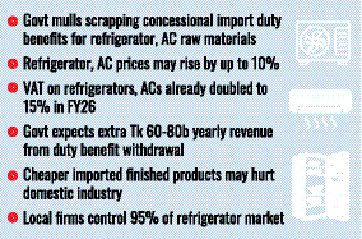
The government is considering withdrawing concessional import facilities for raw materials used in manufacturing refrigerators and air-conditioners in the upcoming FY27 budget.
This could significantly increase the prices of the two household appliances and put pressure on local industries, according to finance ministry sources.
They say the interim government has already doubled the VAT on refrigerators and air-conditioners in the FY26 budget to 15 per cent from the previous 7.5 per cent.
Now, within a year, the government is planning to scrap the concessional duty benefits on raw material imports for these products, a move expected to raise production costs and ultimately increase consumer prices, they add.
Currently, manufacturers can import raw materials at concessional customs duty rates ranging from 5 per cent to 15 per cent, depending on the product category.
Without these facilities, duty rates on many inputs could more than double.
The imported raw materials include polypropylene, refined copper tubes and pipes, zinc alloy, colour masterbatch, aluminium foil, dryers, lock rings, PCB inverters, evaporators, temperature sensors, power cords, switches, electric magnets, printed circuit boards, body cabinets, brush fittings, expansion valves, oil separators, and aluminium foil used in air-conditioner fins.
Industry insiders say the prices of refrigerators and air-conditioners could rise by up to 10 per cent if the benefits are withdrawn.
They warn that local manufacturers would face tougher competition from finished products imported directly.
While importers may benefit, domestic producers could suffer, they say.
However, policymakers hold a different view.
They argue that the country's electronics industry has matured after enjoying tax benefits for years and it is now time to gradually phase out incentives to increase government revenue.
A senior National Board of Revenue (NBR) official, requesting anonymity, says both domestic and external pressures are pushing the government to raise revenue collection.
"These sectors have enjoyed concessional import facilities for a long time. Now the industry has become self-sufficient, and it is time for them to contribute more revenue to the government," he says.
According to NBR sources, the government could collect an additional Tk 60-80 billion in revenue annually by withdrawing the facilities.
Bangladesh's refrigerator market currently records annual sales of around 3.3 million to 3.5 million units.
Industry sources say local manufacturers now control nearly 95 per cent of the domestic market, driven by rapid growth in local production over the past decade.
The market size of the refrigerator industry stands at around Tk 73.5 billion in FY26.
According to industry estimates, around 60 per cent of households have refrigerators across the country.
Walton dominates the market, while Vision, Singer, Jamuna, Minister, MyOne, LG, Samsung, and Hisense are also competing in the local market.
The air-conditioner market has also expanded rapidly due to rising temperatures, urbanisation, and the growing middle-class purchasing power.
Increased local production has reduced import dependence, while domestic firms have also started exporting refrigerators, air-conditioners and other electronic products.
According to the Export Promotion Bureau (EPB) data, Bangladesh exported electrical and electronic products worth around $167 million in FY25.
newsmanjasi@gmail.com
© 2026 - All Rights with The Financial Express

