Bangladesh's economy is staring at a challenging and fragile path in the current fiscal year amid decelerating growth momentum and stubborn inflationary pressures, cautions the ADB and cites major headwinds.
The country's gross domestic product (GDP) growth projection for FY2026-27 has been revised downward while inflation forecasts have been raised significantly in the latest Asian Development Outlook (ADO).
The July 2026 report released by the Asian Development Bank (ADB) Thursday has lowered the country's growth forecast for this fiscal to 4.5 per cent, cutting down by 0.2-percentage points from its previous projection of 4.7 per cent in April.
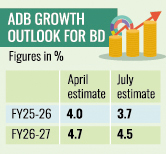
This downgrade highlights persistent structural bottlenecks and constraints within the domestic economy.
"The revised outlook reflects weaker export performance, subdued private investment, high energy prices, persistent inflationary pressures, and a more adverse external environment," the ADO says.
The Manila-based multilateral lender also points out several critical factors weighing down economic activity, including energy-infrastructure bottlenecks, banking-sector fragility, and sluggish base from last FY2026.
For the just-concluded FY2026, the ADB in the latest ADO has estimated that Bangladesh's GDP might grow at a subdued 3.7-percent rate, down from the April estimate of 4.0 per cent, owing to weak exports and constrained private investment.
Meanwhile, Bangladesh Bureau of Statistics (BBS) a month ago had unveiled its provisional estimation where it showed that Bangladesh's GDP expanded 4.14 per cent in FY2026.
In the latest Asian Development Outlook, the ADB has projected the country's inflation at a higher 8.8-percent rate in the current FY2027 amid lingering cost pressures compounding the growth slowdown and consumers facing prolonged price instability.
The revised consumer inflation projection marks a 0.2-percentage-point increase from the April forecast.
The elevated inflation is primarily attributed to energy pass-through as the lingering second-round effects from domestic fuel-and electricity-cost hikes are continuing to pass through to general commodities.
Prolonged geopolitical conflicts in the Middle East and supply-chain disruptions keep input, logistics, and freight costs high across South Asia, the ADB report further mentions.
About the inflationary pressure the Bank says although the inflation is projected unchanged from the April forecast at 9.0 per cent in FY2026, the recent adjustments to domestic petroleum, gas, and electricity prices are expected to continue passing through to transport, utilities, and other consumer prices.
The ADB says the nation's primary fiscal balance remains under pressure, exacerbated by the domestic costs of fossil-fuel subsidies, which historically absorb around 3.0 per cent of the country's GDP.
"Furthermore, external trade risks are mounting. Bangladesh has been named in ongoing United States Trade Representative (USTR) Section 301 investigations regarding manufacturing excess capacity and forced-labour import bans, putting the country at risk of facing a proposed 10-percent US import tariff surcharge," the report reads.
This could further complicate the recovery of Bangladesh's export sector on the global market.
While resilient domestic demand provides a minor buffer, the combination of high pricing pressures, energy deficits, and financial-sector weaknesses means that Bangladesh's macroeconomic policy must tread a careful line between containing inflation and avoiding a deeper economic slowdown, the development financier suggests.
The ADO July 2026 update notes that growth in FY2026 is supported by strong remittance inflows, steady services activity, and targeted credit-easing measures for priority sectors within a generally tight macro-financial environment.
"However, high inflation continues to erode real purchasing power and constrain private consumption. Weak export performance and moderate import growth point to soft external demand and subdued private investment."
On the supply side, export-oriented manufacturing is likely to remain under pressure from high energy prices, subdued external demand, and structural bottlenecks, while agriculture faces risks from fertiliser shortages, the report notes.
Services are expected to provide some support to growth, helped by remittance-backed household income.
In FY2027, moderate inflation, simplified business regulations, improved governance, tax administration reforms, and continued remittance incentives are expected to help strengthen consumption and investment, the ADB outlook predicts.
However, banking-sector vulnerabilities, energy constraints, and weak competitiveness are likely to keep the pace of expansion gradual rather than strong.
kabirhumayan10@gmail.com
© 2026 - All Rights with The Financial Express

