Almost all of Bangladesh's development partners have put their aid commitments on hold ahead of the national polls in February next year, adopting a wait-and-see approach until a politically stable government is in place, analysts said on Saturday.
The pause -- covering stalled project approvals and delayed loan tranches -- comes as global institutions seek clarity on the country's political outlook following a year of intense transition under the interim government.
Economists warn that if the government fails to secure the groundwork for the next administration to tap pledged assistance in the coming months, fiscal pressure could build toward the end of the current fiscal year.
Except for the Asian Development Bank (ADB), neither multilateral lenders nor bilateral development partners have come forward with medium- to long-term (MLT) concessional loans and grants during the first four months of the current fiscal year (FY2025-26), they said.
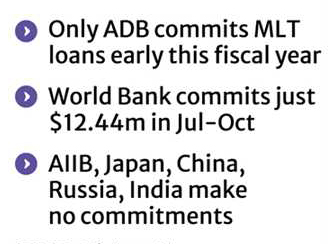
The largest multilateral lender, the World Bank (WB), committed only US$12.44 million during the July-October period, while major donors -- including the Asian Infrastructure Investment Bank (AIIB), Japan, China, Russia and India -- made no commitments, according to Economic Relations Division (ERD) data.
Five key donors -- the AIIB, Japan, China, Russia and India -- have not confirmed a single penny over the past four months.Major multilateral organisations, including the World Bank, ADB and the International Monetary Fund (IMF), have signalled a preference for negotiating long-term commitments with an elected and stable administration, officials said.
While humanitarian assistance and ongoing critical projects continue, fresh budgetary support and major infrastructure funding have slowed.
According to the ERD, the World Bank confirmed only US$12.44 million in assistance during July-October, while the AIIB, Japan, Russia and India made no commitments over the same period.
Meanwhile, the Manila-based ADB committed US$581.71 million during July-October of this fiscal year but disbursed US$248.81 million -- less than half of the commitment.
However, development partners have continued disbursements for ongoing projects in Bangladesh.
A senior ERD official said several high-value agreements originally slated for late 2025 have been pushed back to the second quarter of 2026.
"Donors are naturally risk-averse in the lead-up to a transition of this scale," he said. "They are looking for a clear mandate and a predictable policy environment before releasing the next wave of multi-billion-dollar assistance," he added, requesting anonymity.
Analysts said election-related uncertainty is compounded by broader shifts in international aid dynamics.
The so-called "Trump effect"-- following a US executive order in early 2025 -- led to a review and temporary freeze of many USAID-funded projects, creating a ripple effect across the NGO sector.
The IMF postponed a key loan tranche in April 2025, citing the need for deeper reforms in revenue mobilisation -- reforms the interim government has found difficult to fully implement during the transition.
Humanitarian aid for the 1.2 million Rohingya refugees in Bangladesh has also fallen to nearly 50 per cent of the required budget, further straining domestic resources.
The upcoming election will be the first in more than 15 years not led by the Awami League, which was ousted in August 2024.
With the Bangladesh Nationalist Party (BNP) widely seen as the frontrunner, development partners are closely watching the return of exiled leaders and the risk of civil unrest during the campaign period, which officially begins on January 22.
Masrur Reaz, executive chairman of Policy Exchange Bangladesh, said development partners paused commitments after the election roadmap was announced.
"Given multiple factors -- including the next government's development priorities and strategy, as well as donors' own priorities -- foreign partners have adopted a wait-and-see policy," he told The Financial Express.
He added that the interim government's cautious stance on launching new projects amid fiscal and macroeconomic stress has also reduced aid demand.
Former economics professor at Chittagong University Dr Muinul Islam said development partners had taken a wait-and-see approach ahead of the February 12 national election.
Towfiqul Islam Khan, a researcher at the Centre for Policy Dialogue (CPD), said donor confirmations may have fallen due to lower budget-support commitments, the government's cautious approach to large projects and the impending election.
He added that some donors' aid commitment ceilings for Bangladesh have also been exhausted, affecting overall confirmations in recent months.
Mr Khan urged the government to secure the aid pipeline for the next administration so development work is not disrupted.
He also advised the interim government to ensure utilisation of around US$45 billion currently stuck in the pipeline, largely due to weaknesses in project execution.
© 2026 - All Rights with The Financial Express

